
Table of Contents
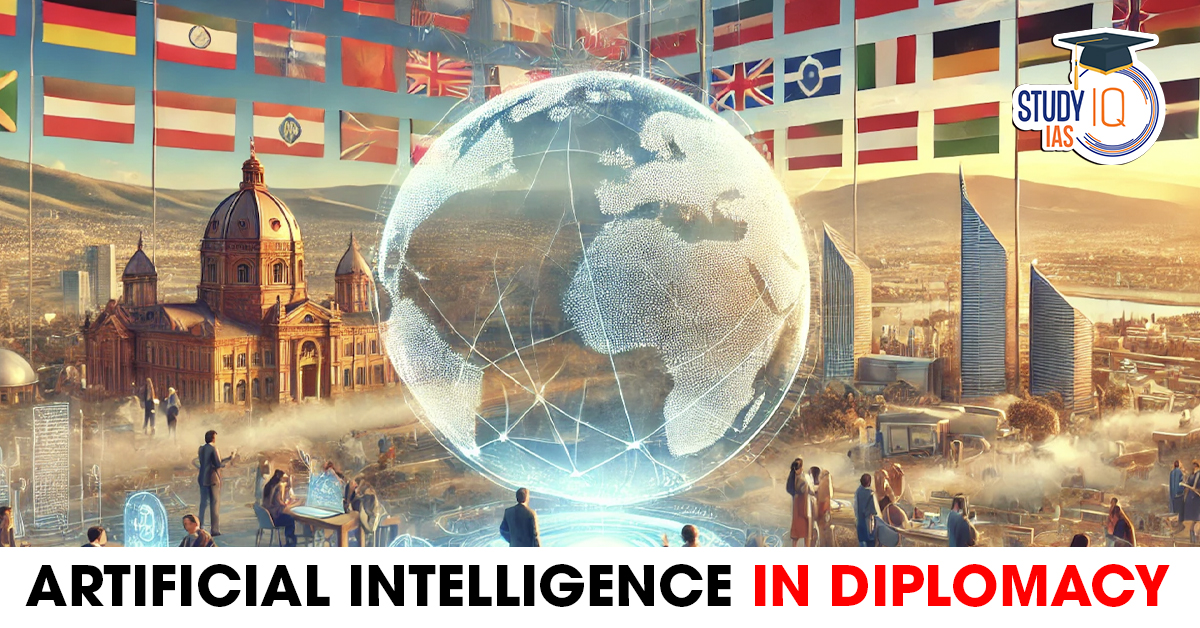
Context: Countries are starting to use AI in foreign policy work, showing how diplomacy is becoming faster and more technology-driven.
Application of Artificial Intelligence in Diplomacy
- Quick Information Access: AI helps diplomats find old agreements and past decisions instantly.
- Eg. Singapore’s AI tool stores and recalls past talks like a digital memory.
- Faster Drafting: AI can write notes, reports and official statements quickly.
- Eg. Ministries can prepare speeches or agreements in minutes instead of hours.
- Scenario Simulation: AI models negotiate outcomes and suggest strategies based on historical data.
- Eg. During trade or climate negotiations, AI can simulate how different concessions may impact outcomes.
- Levelling the Playing Field: AI reduces dependence on large bureaucracies, allowing smaller states to compete diplomatically
- E.g. a small delegation equipped with AI tools can match the analytical capacity of major powers with large teams.
- Real-Time Support: AI integrates diverse inputs (documents, voice notes, images) to provide instant insights.
- Eg. AI assistants used by diplomats can process incoming communications and generate actionable summaries in real time.
- Focus on Core Diplomatic Skills: By automating repetitive tasks, AI allows diplomats to focus on negotiation, persuasion and relationship-building
- Eg. Reducing time spent on paperwork increases engagement in strategic dialogue.
Risks Associated with AI in Diplomacy
- Erosion of Human Judgment: Diplomacy depends on empathy, cultural understanding and political intuition, which AI lacks (Eg. AI may fail to interpret subtle diplomatic signals or cultural sensitivities in negotiations
- Over-Reliance on Automated Decisions: Policymakers may begin to depend excessively on AI-generated recommendations (e.g., using AI simulations to decide negotiation positions without sufficient human deliberation could lead to strategic miscalculations).
- Misinterpretation of Context: AI can produce flawed analysis due to incorrect pattern recognition (e.g., misreading past treaty obligations or geopolitical contexts, leading to wrong policy advice).
- Data Security & Confidentiality Risks: Diplomatic data is highly sensitive and vulnerable to cyber threats (e.g., hacking of AI systems handling negotiation data could expose national strategies).
- Algorithmic Bias: AI systems trained on biased data may generate skewed recommendations (e.g. favouring certain geopolitical perspectives embedded in training datasets).
- Technological Inequality: Advanced AI capabilities may concentrate power among technologically advanced nations (e.g., developed countries gaining disproportionate diplomatic advantage over developing nations).
- Reduced Accountability: AI-driven decisions create ambiguity in responsibility (e.g., unclear whether policymakers or AI systems are accountable for flawed outcomes).
Way Forward
- Human-Centric Approach: Maintain human control over final decisions (e.g., AI as an advisory tool, not a decision-maker in negotiations).
- Capacity Building: Train diplomats in AI tools and digital skills (e.g., incorporating AI literacy in foreign service training programmes).
- Robust Cybersecurity Measures: Protect sensitive diplomatic data (e.g., secure AI systems against cyberattacks and data breaches).
- Balanced Integration: Combine AI efficiency with human judgment (e.g., using AI for analysis while relying on diplomats for negotiation and trust-building).
- International Cooperation: Promote multilateral frameworks to regulate AI in global governance (e.g., collaboration through the UN and other forums).
AI is transforming diplomacy by enhancing efficiency, analysis and strategic capability, but its effective use depends on preserving the human core of diplomacy—empathy, judgment and trust—while leveraging technological advantages responsibly.

 Skyroot Vikram-1 Mission Aagaman: India'...
 Oor Pare Prehistoric Site: Location, Roc...
 Assam Election 2026: Exit Poll, Result D...









 WhatsApp





