Table of Contents
Context
Environmental justice has become a vital aspect of constitutional governance, especially in emerging nations such as India, where environmental degradation disproportionately impacts marginalised people. The recent address by Justice B. V. Nagarathna at the 4th Justice S.B. Sinha Memorial lecture emphasises the importance of including equity in environmental adjudication. Her observations indicate an increasing awareness that poor and marginalised communities disproportionately experience environmental harms.
The theme of her address, “Environmental Justice & Climate Change: How Courts Can Lead the Way Forward,” positions the judiciary as a pivotal entity in confronting the nexus of environmental degradation and social inequality.
Context of the Lecture and Institutional Setting
Justice Nagarathna presented her speech at the National University of Study and Research in Law, attended by Chief Justice M. S. Sonak, Justice S. N. Prasad, and Vice-Chancellor Prof. Ashok R. Patil. The lecture was held in commemoration of Justice S. B. Sinha, whose judicial legacy persists in shaping modern constitutional discourse.
Justice Nagarathna honoured Justice Sinha, characterising him as a distinguished jurist recognised for his intellectual rigour and bold dissents. She specifically remembered his dissenting opinion in Zed Telefilms v Union of India, in which he contended that the Board of Control for Cricket in India (BCCI) should be classified as “State” under Article 12 of the Constitution. His contributions to cases like Kesoram Industries v State of West Bengal and his works on constitutional governance were emphasised as indicative of his scholarly approach to law.
Conceptualising Environmental Justice
Environmental justice is based on the principle that environmental benefits and burdens should be allocated fairly throughout society. Justice Nagarathna underscored that environmental harm is seldom equitably dispersed, with marginalised people frequently suffering the most from pollution, displacement, and ecological degradation. She notably mentioned the State of Jharkhand, where industrial operations and resource exploitation have historically affected tribal and economically disadvantaged communities.
Incorporating environmental justice into the larger justice framework guarantees that environmental conservation does not compromise equity. This approach acknowledges that environmental degradation is not solely an ecological concern but also a social and economic one, necessitating a multifaceted response.
Constitutional Underpinnings of Environmental Law
Development under the 42nd Amendment
Justice Nagarathna observed that the term “environment“ was not first incorporated into the Constitution of India. The 42nd Constitutional Amendment introduced the following provisions:
- Article 48A mandates the State to safeguard and enhance the environment.
- Article 51A(g) establishes a fundamental duty for citizens to safeguard the environment.
These laws established the foundation for the evolution of environmental jurisprudence in India.
Expansion via Article 21
The judiciary has significantly expanded the interpretation of Article 21 of the Constitution, encompassing the right to a clean and healthy environment within the right to life. This judicial innovation has permitted courts to tackle environmental challenges despite the lack of express statutory provisions.
Evolution of Principles in Environmental Law
Indian courts have progressively established a comprehensive framework of principles to direct environmental adjudication. Justice Nagarathna cited numerous theories that have become fundamental to environmental jurisprudence.
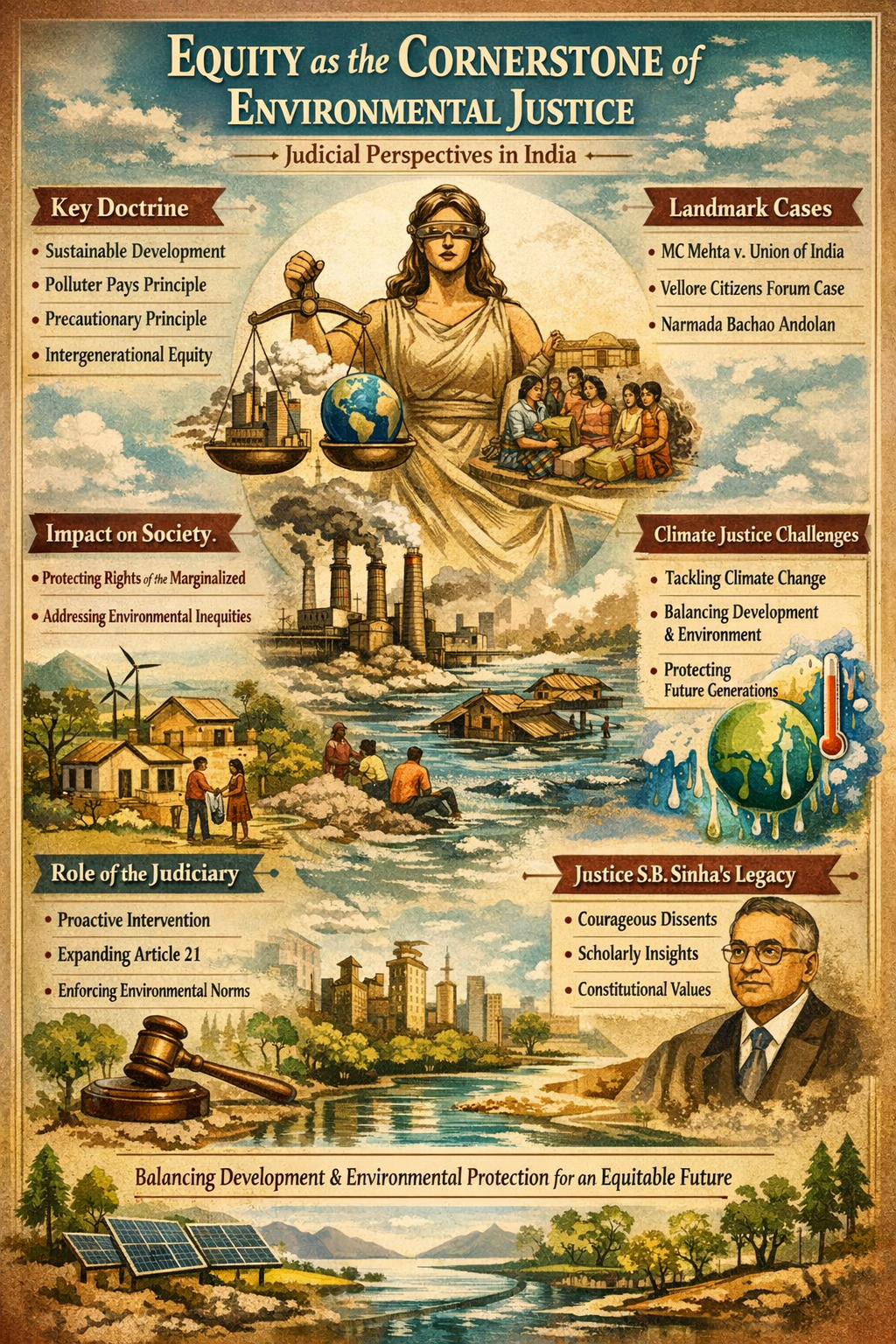
Sustainable Development
This principle seeks to balance economic growth with environmental protection, ensuring that development does not compromise the ability of future generations to meet their needs.
Principle of Polluter Pays
This principle stipulates that individuals accountable for environmental harm must incur the expenses of restoration and compensation.
Precautionary Principle
The precautionary principle mandates preemptive measures in situations of environmental uncertainty, assigning the burden of proof to those advocating for possibly detrimental activity.
Intergenerational Equity
This notion underscores the obligation of the present generation to conserve environmental resources for future generations.
Environmental Law as a Prominent Legal Field
Referencing the scholarship of Elizabeth Fisher, Justice Nagarathna characterised environmental law as “hot law,” marked by conflicting interests and evolving issues. In contrast to conventional legal issues, environmental lawsuits frequently entail intricate compromises among development, sustainability, and social justice.
Every case necessitates a meticulous balance of interests, rendering environmental adjudication intrinsically uncertain and context-dependent. This intricacy requires a sophisticated approach, wherein legal ideas are implemented flexibly instead of rigorously.

The Dichotomy Between Development and Environment
A prominent issue in Justice Nagarathna’s address was the apparent tension between development and environmental conservation. She noted that courts frequently face criticism irrespective of their position.
- When courts prioritise environmental protection, they are characterised as anti-development.
- When they endorse development, they are perceived as undermining environmental integrity.
This duality poses a considerable difficulty for judges, who must reconcile conflicting interests while maintaining constitutional principles.
Justice Nagarathna asserted that development and environmental conservation are not intrinsically antagonistic but can be synergistic when treated with consideration. The essential factor is attaining a balance that honours both economic requirements and ecological sustainability.
Anthropocentric versus Ecocentric Approaches
The lecture emphasised a significant transition in environmental law from an anthropocentric to an ecocentric perspective. The former emphasises human interests, whereas the latter acknowledges the inherent worth of nature and ecosystems.
The Supreme Court has progressively adopted an ecocentric viewpoint, recognising that environmental protection is vital for both human welfare and the conservation of biodiversity and ecological equilibrium.
Anthropogenic Environmental Catastrophes
Justice Nagarathna highlighted the persistent problem of flooding resulting from the invasion of water bodies, referencing the Rajakaluve situation in Bangalore. She noted that such catastrophes are frequently categorised as “natural disasters,” while being predominantly attributable to human activities.
This finding highlights the significance of accountability in environmental governance. It underscores the necessity for preventive strategies and sustainable urban design to alleviate the effects of environmental degradation.
Judicial Accountability and Engaged Involvement
In her final remarks, Justice Nagarathna underscored that courts are not just spectators but engaged contributors in environmental governance. She discerned three fundamental principles for judicial decision-making:
- The necessity for contextual comprehension in each instance
- The dynamic evolution of environmental principles
- The acknowledgement that some ecological thresholds must remain unbreached
These observations demonstrate a forward-thinking perspective of the judiciary as an engaged entity dedicated to preserving environmental and constitutional principles.
Judicial Authority in Environmental Conservation
The Indian judiciary, especially the Supreme Court of India, has been instrumental in developing environmental governance through broad constitutional interpretation and the advancement of novel legal theories.
This judicial activism has been important in converting environmental protection into a legally enforceable right. Judicial bodies have expanded beyond conventional adjudication to actively oversee compliance, issue ongoing mandamus, and formulate remedies specifically designed to address the distinct issues of environmental degradation. Justice B. V. Nagarathna’s assertion of courts as “active participants“ corresponds with this overarching judicial ideology.
The judiciary’s involvement is especially crucial in situations where government failings jeopardise constitutional protections. This encapsulates the attitude expressed by Justice S. B. Sinha, who contended that judicial intervention is necessary to maintain the rule of law when institutional processes are inadequate.
Significant Judicial Precedents Influencing Environmental Law
The development of environmental jurisprudence in India is characterised by numerous significant decisions that have set foundational concepts for the judiciary and policymakers.
In M. C. Mehta v Union of India, the Supreme Court established the idea of absolute liability, determining that entities involved in hazardous activities are strictly accountable for any resulting harm, regardless of guilt. This idea greatly enhanced accountability and represented a shift from conventional negligence-based liability.
In Subhash Kumar v State of Bihar, the Court specifically acknowledged the right to a pollution-free environment as an integral component of the right to life under Article 21. The decision established the basis for environmental rights as fundamental rights.
The decision in Vellore Citizens Welfare Forum v Union of India significantly progressed environmental jurisprudence by officially integrating the principles of sustainable development, the precautionary principle, and the polluter pays principle into Indian law. These theories have since become fundamental to environmental adjudication.
In Narmada Bachao Andolan v Union of India, the Court examined the conflict between development and environmental conservation, underscoring the necessity for a balanced strategy. The Court emphasised the necessity of environmental safeguards and rehabilitation measures while permitting the dam’s construction.
These cases collectively illustrate the judiciary’s function in establishing a comprehensive legal framework that harmonises environmental preservation with constitutional principles.

Societal Implications of Environmental Law
The evolution of environmental jurisprudence has significantly impacted Indian society. By acknowledging environmental rights as fundamental, the judiciary has enabled citizens to pursue legal recourse for environmental damage. Public Interest Litigation has developed into a formidable instrument, allowing individuals and civil society organisations to petition courts on behalf of impacted populations.
Justice Nagarathna’s focus on equity highlights the fact that environmental deterioration disproportionately affects marginalised communities. Industrial pollution, deforestation, and urban encroachment frequently impact individuals with constrained resources and political clout. By incorporating environmental justice into legal reasoning, courts can rectify these imbalances and foster inclusive growth.
The societal impact is manifest in enhanced environmental governance, heightened awareness, and the fortification of regulatory procedures. Judicial interventions have resulted in the cessation of polluting industries, the safeguarding of forests, and the preservation of natural resources. Nonetheless, obstacles persist in guaranteeing the proper execution and adherence to judicial mandates.
Climate Change and the Broadening Parameters of Environmental Justice
Environmental justice has acquired increasing importance in light of climate change, which presents unparalleled challenges to ecosystems and human society. Climate change intensifies existing disparities, disproportionately impacting disadvantaged groups via extreme weather events, resource constraints, and displacement.
Justice Nagarathna’s presentation emphasised the necessity for courts to have a proactive stance in tackling climate-related challenges. This entails not just the enforcement of the present ones but also the adaptation of legal principles to emerging challenges. The notion of intergenerational equity is especially pertinent here, given that the ramifications of climate change reach far into the future.
The judiciary’s involvement with climate change signifies a wider movement towards acknowledging environmental concerns as essential to human rights. Judicial bodies are increasingly tasked with reconciling conflicting interests, such as economic advancement and environmental preservation, within a swiftly evolving global context.
The Necessity for Judicial Training and Institutional Competence
Justice Nagarathna underscored the significance of ongoing judicial training in environmental law. Due to the intricate and evolving characteristics of environmental challenges, judges must possess specialised knowledge and expertise. Judicial academies are essential in this context by implementing training programs that educate judges on environmental issues and developing challenges.
The designation of environmental law as “hot law” emphasises the necessity for flexibility and contextual comprehension. Judges must traverse scientific data, policy implications, and conflicting interests, rendering environmental adjudication especially challenging. Enhancing institutional capacity is thus crucial for successful judicial involvement.
Conclusion
Justice B.V. Nagarathna’s address presents a persuasive perspective on environmental justice grounded in equality, fairness, and constitutional principles. By emphasising the unequal effects of environmental degradation on marginalised populations, she stresses the necessity for a more inclusive framework in environmental governance.
The Indian court has significantly contributed to environmental preservation through its progressive interpretation of constitutional provisions and the creation of legal concepts. Significant rulings and developing principles have established a strong framework for tackling environmental issues.
As environmental challenges get more intricate due to climate change, the function of courts will gradually broaden. Justice Nagarathna’s advocacy for the incorporation of equity into environmental justice establishes a vital basis for pursuing environmental conservation in conjunction with social and economic justice.
The quest for environmental justice necessitates a unified dedication to reconciling conflicting interests, preserving ecological integrity, and protecting the rights of both present and future generations.

 Supreme Court on Plaint Amendment After ...
 Supreme Court on Children's Right to Int...
 Supreme Court Dowry Enforcement Order 20...








 WhatsApp