Table of Contents
Context
The issue of whether a purported merger by legislators constitutes a valid defence under the anti-defection law has re-emerged in current constitutional discussions, especially following assertions by Raghav Chadha regarding a merger of Aam Aadmi Party (AAP) members with another political party. Such changes have political implications and simultaneously evoke intricate constitutional questions concerning the interpretation of the Tenth Schedule of the Constitution of India.
The core of the issue is a fundamental conflict between legislative independence and party discipline. The anti-defection law, outlined in the Tenth Schedule, aims to maintain the integrity of the political mandate by prohibiting opportunistic party-switching. Nonetheless, it acknowledges specific exceptions, such as mergers, designed to facilitate genuine political realignments. Assessing whether a given conduct constitutes a legitimate merger under the Constitution requires a meticulous examination of both the law’s language and intent.
Historical Context: The Development of Anti-Defection Law
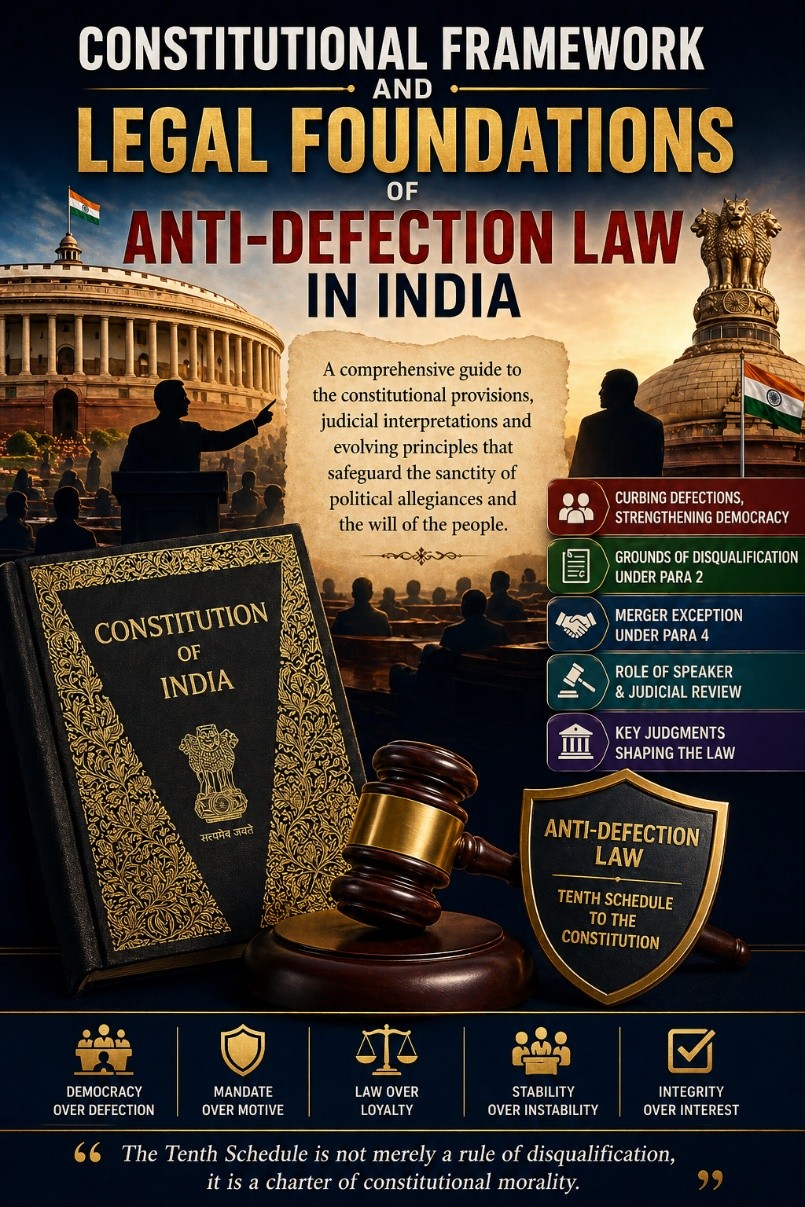
The anti-defection law was enacted via the 52nd Constitutional Amendment Act of 1985 in response to widespread political defections that undermined governments in the years following independence. The occurrence, referred to as “Aya Ram, Gaya Ram,” exemplified a trend of legislators regularly altering party affiliations for personal or political advantage, thereby jeopardising democratic stability.
The Tenth Schedule was incorporated into the Constitution to facilitate the disqualification of legislators based on defection. The 91st Constitutional Amendment Act, 2003, subsequently fortified the provision by eliminating the prior exception for splits and instituting more stringent standards for mergers.
The fundamental aim of these provisions is to guarantee that elected members remain loyal to the political parties that facilitated their election, thus preserving the integrity of the electoral mandate.
Framework of the Tenth Schedule: Bases for Disqualification
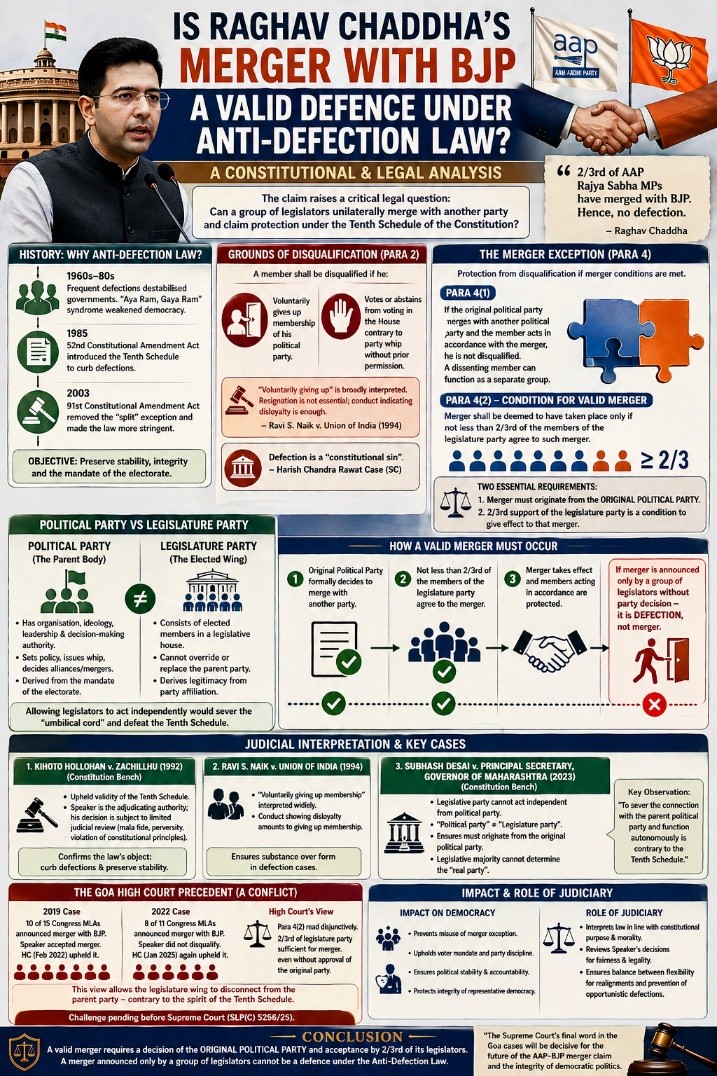
The Tenth Schedule delineates the conditions under which a member of a legislative body may be disqualified. Paragraph 2 constitutes the principal stipulation in this context. A member shall be disqualified if they voluntarily resign from their political party or vote (or refrain from voting) against the party whip without prior authorisation.
The Supreme Court has extensively interpreted the phrase “voluntarily giving up membership.” In Ravi S. Naik v. Union of India, the Court determined that resignation is not the sole method of relinquishing membership; behaviour demonstrating disloyalty to the party may also be adequate. This broad approach guarantees that politicians cannot circumvent disqualification via technicalities.
Additionally, in Kihoto Hollohan v. Zachillhu, the Supreme Court affirmed the constitutional legality of the Tenth Schedule, acknowledging the Speaker’s function as the adjudicating authority in defection cases, with limited scope for judicial review.
The Court has characterised defection as a significant constitutional violation. In instances like the Harish Chandra Rawat defection case, defection has been labelled a “constitutional sin,” highlighting the seriousness of the transgression.
The Merger Exception: Part 4 of the Tenth Schedule
The Tenth Schedule enforces stringent limitations on defections, and it offers a restricted exception for mergers under Paragraph 4. This exception is essential for comprehending the current dispute.
Paragraph 4(1) stipulates that a member shall not be disqualified if their original political party amalgamates with another political party, provided they comply with the terms of the merger. Members who reject the merger are safeguarded, as they retain the right to operate as an independent group.
Paragraph 4(2) establishes the criteria for a valid merger. The merger shall be considered effective only if at least two-thirds of the members of the legislature party consent to it.
An attentive examination of these regulations uncovers two fundamental prerequisites. The merger must first come from the “original political party.” Secondly, the consent of a minimum of two-thirds of the legislature party is required to implement the merger.
The differentiation between the political party and the legislative party is fundamental to the constitutional framework. The political party denotes the organisational and ideological entity, whereas the legislative party comprises elected legislators within a legislative body. The Constitution prohibits the latter from superseding the former.
Conceptual Distinction: Political Party versus Legislature Party
The difference between a political party and its legislative party is not only linguistic; it is essential to the operation of parliamentary democracy. Political parties serve as the mechanisms by which electoral mandates are expressed and executed. Legislators, despite being elected separately, obtain their legitimacy through their affiliation with these parties.
Permitting the legislature party to operate autonomously from the political party would jeopardise this relationship and compromise the integrity of party-based governance. It would allow a faction of legislators to essentially “usurp” the party by announcing a merger without the approval of the party leadership.
This issue is especially pertinent with assertions that a coalition of legislators, by obtaining a two-thirds majority, might autonomously amalgamate with another party. This interpretation would reverse the constitutional system, elevating the legislative party above the political party.
Application to Current Context: Legal Issues Emerging
The primary legal issue in the case of merger requests by certain legislators is the fulfilment of the standards outlined in Paragraph 4. The inquiry pertains to whether the merger was instigated by the original political party or just by a faction of its legislators.
If the merger lacks endorsement from the political party’s organisational structure, it will not satisfy the initial criterion of Paragraph 4. In this scenario, aligning with another political party would constitute defection under Paragraph 2, resulting in disqualification.
The necessity of two-thirds endorsement within the legislature party cannot, in itself, legitimise a merger. A prerequisite for acknowledging a merger that has already occurred at the party level is established. To consider it the exclusive standard would be to overlook the clear wording and purpose of the Constitution.
Objective and Constitutional Ethics
The anti-defection law should be construed in accordance with its fundamental objective, which is to foster stability, integrity, and accountability within the political process. The merger exemption is not designed to create a loophole for evading disqualification; instead, it aims to facilitate authentic fundamental alterations in political alliances.
A careful reading of the Tenth Schedule necessitates that courts remain vigilant against the exploitation of the merger provision for strategic or opportunistic ends. Constitutional morality necessitates the application of legislation in a manner that upholds the essence of democratic governance.
Supreme Court’s Focus on Party Primacy
Judicial statements, especially from the Supreme Court, have greatly influenced the understanding of the merger exception under the Tenth Schedule. A significant step in this context is the Constitution Bench decision in Subhash Desai v. Principal Secretary, Governor of Maharashtra. The case, while primarily focused on internal party conflicts and the right to designate a party whip, offers significant insights into the relationship between a political party and its legislative branch.
The Supreme Court unequivocally determined that the legislative party cannot operate autonomously from the political party. The anti-defection statute is based on preserving the connection between elected officials and the political party under which they ran for office. The Court noted that allowing parliamentarians to separate from their political party and operate independently would undermine the fundamental objective of the Tenth Schedule.
The Court emphasised that the phrases “political party” and “legislature party” are not synonymous. The Constitution intentionally preserves a contrast between the two, especially with Paragraph 4. The stipulation that two-thirds of the legislature party must consent to a merger does not replace the decision of the original political party; instead, it serves as a prerequisite that legitimises a merger that has already commenced. This perspective underscores the pre-eminence of the political party in merger-related issues.
Contradictory High Court Interpretation: The Goa Precedent
Notwithstanding the clarity provided by the Supreme Court, conflicting interpretations have arisen at the High Court level, particularly in the decisions of the Bombay High Court (Goa Bench). In instances of Congress MLAs merging with another political party, the High Court affirmed the Speaker’s order, deeming the merger legal only because the two-thirds criterion of the legislature party was satisfied.
The High Court interpreted Paragraphs 4(1) and 4(2) disjunctively, determining that the consent of two-thirds of the legislature party alone suffices to establish a lawful merger, regardless of any official resolution by the original political party. This view asserts that the legislative branch has the unilateral right to execute a merger.
This method represents a notable divergence from the purposive interpretation employed by the Supreme Court. Enhancing the function of the legislative party jeopardises the structural integrity of political parties and permits factional groups to supersede party leadership.
The case has been escalated to the Supreme Court via a Special Leave Petition, and its forthcoming resolution is anticipated to offer definitive clarification on the problem.
Doctrinal Dispute: Textual Interpretation against Constitutional Intent
The disparity between the Supreme Court’s rationale and the Bombay High Court’s methodology illustrates a wider doctrinal disagreement between textualism and purposive interpretation. A literal interpretation of Paragraph 4(2) may imply that the two-thirds numerical criterion is the determining element. Nonetheless, an interpretation detached from Paragraph 4(1) may result in conclusions that contradict the aims of the Tenth Schedule.
The Supreme Court has always endorsed a purposive approach to constitutional interpretation. In Kihoto Hollohan v. Zachillhu, the Court affirmed the constitutional legitimacy of the Tenth Schedule, highlighting its function in mitigating political defections and maintaining democratic stability. In Ravi S. Naik v. Union of India, the Court expanded the definition of disqualification by reading “voluntarily giving up membership” in a substantive manner rather than a formal one.
These decisions suggest that constitutional provisions concerning democratic governance should be understood to further their fundamental aim rather than just following a strict interpretation.
Consequences for Modern Assertions of Merger
The application of the aforementioned criteria to the situation concerning Raghav Chadha and other MPs reveals that the validity of a purported merger depends on its initiation by the original political party. If the merger is solely a proclamation by a contingent of legislators, even if they represent two-thirds of the legislative party, it may not fulfil the stipulations of Paragraph 4.
In this context, aligning with another political party would constitute defection under Paragraph 2, rendering the legislators susceptible to disqualification. Relying solely on the two-thirds criterion would be inadequate to activate the protection of the merger exemption.
Nonetheless, the presence of the Bombay High Court precedent confuses the legal framework. Until the Supreme Court definitively resolves the matter, a level of ambiguity persists about the interpretation of Paragraph 4.
Effects on Democratic Governance and Political Stability
The interpretation of the merger provision has substantial ramifications for democratic governance. The anti-defection law was designed to mitigate the instability arising from frequent party-switching, which frequently led to governmental failure and eroded public trust in the political system.
If the merger exception is broadly interpreted to permit legislators to unilaterally execute mergers, it may jeopardise the stability that the law aims to maintain. It would promote factionalism within political parties and allow politicians to evade disqualification through tactical realignments.
Furthermore, such methods may undermine the electorate’s mandate. Electors select members according to party allegiance and ideological principles. Permitting legislators to change their political affiliation without party approval may be regarded as a violation of that requirement.
Function of the Judiciary: Protector of Constitutional Integrity
The judiciary is essential in preserving the equilibrium between adaptability and order within the anti-defection framework. The Constitution permits specific exceptions to address political realities, but these exclusions should be construed restrictively to avert misuse.
The judicial review of the Speaker’s decisions, as established in Kihoto Hollohan, guarantees the equitable and uniform application of the anti-defection law. Courts are responsible for examining compliance with the Tenth Schedule’s stipulations and assessing adherence to the norms of constitutional morality.
In challenged merger cases, the judiciary must meticulously assess the factual and legal circumstances to ascertain if the merger is authentic or simply a stratagem to circumvent disqualification.
Conclusion
The subject matter of whether a merger by lawmakers serves as a legitimate defence under the anti-defection law poses essential enquiries regarding the essence of representative democracy and party-centric government in India. The Tenth Schedule offers a restricted exception for mergers, necessitating precise delineation to avert exploitation.
The dominant judicial perspective, especially as demonstrated in Subhash Desai, asserts that a valid merger must stem from the original political party rather than solely from the legislative party. Conflicting High Court judgments have generated ambiguity, highlighting the necessity for definitive clarity.
The efficacy of the anti-defection system relies on a judicious equilibrium between legal adaptability and constitutional rigour. The judiciary, as the protector of the Constitution, must uphold this equilibrium, thereby safeguarding the tenets of democratic accountability and political stability.

 Supreme Court Dowry Enforcement Order 20...
 Supreme Court Modifies 3-Year Practice R...
 Doctrine of Per Incuriam Explained: Supr...





 WhatsApp