
Table of Contents
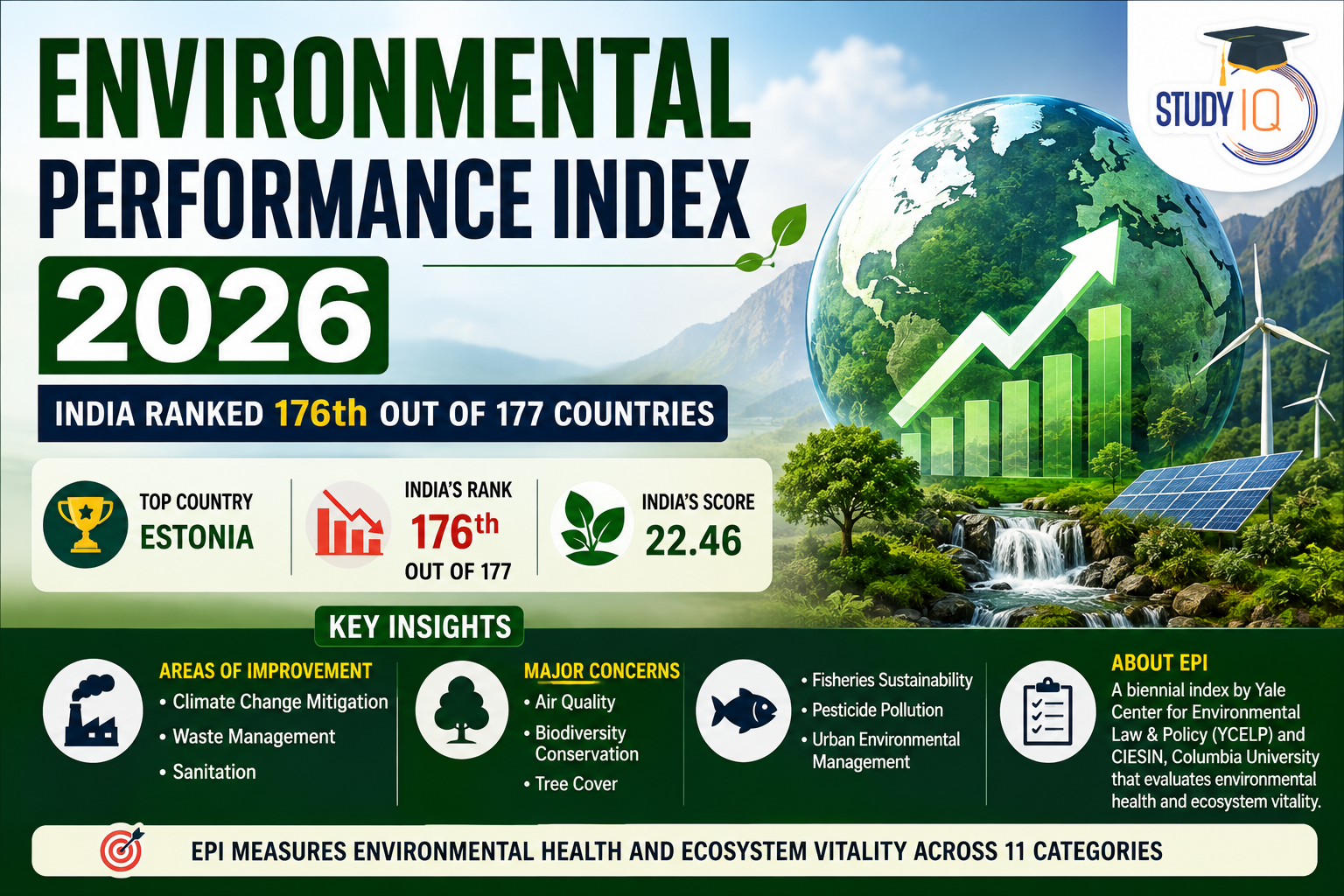
The Environmental Performance Index (EPI) 2026, released by the Yale Center for Environmental Law & Policy (YCELP) in collaboration with the Center for International Earth Science Information Network (CIESIN), Columbia University, has ranked India 176th out of 177 countries with a score of 22.46. While India has shown progress in areas such as climate change mitigation, waste management, and sanitation, the report highlights significant challenges in air quality, biodiversity conservation, urban environmental management, and ecosystem protection.
The EPI is one of the world’s most widely referenced environmental indices, providing a comprehensive assessment of countries’ environmental health, ecosystem vitality, and policy effectiveness. The findings are particularly relevant for UPSC Civil Services Examination, especially under Environment & Ecology, Climate Change, and Sustainable Development.
Environmental Performance Index 2026: Highlights
- India ranked: 176th out of 177 countries
- India’s Score: 22.46
- Top-ranked country: Estonia
- Last-ranked country: Laos
- Published by: Yale Center for Environmental Law & Policy (YCELP) in collaboration with CIESIN, Columbia University
- Frequency: Biennial (every two years)
What is the Environmental Performance Index (EPI)?
The Environmental Performance Index (EPI) is a biennial global ranking that evaluates countries based on their environmental performance and sustainability efforts.
It was developed to provide policymakers with a data-driven framework to measure how effectively nations are protecting the environment while ensuring sustainable development.
The index assesses environmental outcomes rather than policy intentions, enabling cross-country comparisons using standardized indicators.
Who Publishes the Environmental Performance Index?
The EPI is jointly developed by:
- Yale Center for Environmental Law & Policy (YCELP), Yale University
- Center for International Earth Science Information Network (CIESIN), Columbia University
The report uses internationally recognized datasets to evaluate environmental performance across multiple sectors.
Objectives of the Environmental Performance Index
The primary objectives of EPI are to:
- Measure environmental health and ecosystem vitality.
- Evaluate the effectiveness of environmental policies.
- Compare countries using globally standardized indicators.
- Encourage governments to improve environmental governance.
- Promote evidence-based policymaking for sustainable development.
Indicators Used in EPI 2026
The Environmental Performance Index evaluates countries across several environmental dimensions, including:
- Air Quality
- Climate Change
- Biodiversity and Habitat Protection
- Water Resources
- Agriculture
- Fisheries
- Waste Management
- Sanitation
- Ecosystem Vitality
- Environmental Health
These indicators collectively assess how well countries protect natural resources and public health while promoting sustainable economic growth.
EPI 2026: Key Findings
| Indicator | Details |
|---|---|
| Report | Environmental Performance Index 2026 |
| Ranking Countries | 177 |
| India’s Rank | 176 |
| India’s Score | 22.46 |
| Highest Ranked Country | Estonia |
| Lowest Ranked Country | Laos |
| Frequency | Biennial |
India’s Performance in EPI 2026
India’s ranking reflects a mixed environmental performance, with improvements in certain sectors but persistent weaknesses in others.
Areas Where India Improved
The report acknowledges progress in:
Climate Change Mitigation
India has expanded renewable energy capacity, improved energy efficiency, and strengthened climate-related policies.
Waste Management
Growing focus on solid waste management, waste processing, and recycling has contributed to better performance.
Sanitation
National sanitation initiatives and improved access to sanitation facilities have positively influenced environmental health indicators.
Major Challenges Highlighted in the Report
Despite improvements, India continues to perform poorly in several environmental indicators.
1. Air Pollution
Air quality remains India’s biggest environmental challenge due to industrial emissions, vehicular pollution, construction dust, crop residue burning, and fossil fuel use.
2. Biodiversity Conservation
Rapid infrastructure development, habitat fragmentation, and deforestation continue to threaten wildlife and ecosystems.
3. Declining Tree Cover
Land-use changes and developmental pressures have affected forest ecosystems in several regions.
4. Fisheries Sustainability
Overexploitation and degradation of aquatic ecosystems remain significant concerns.
5. Pesticide Pollution
High chemical inputs in agriculture contribute to soil degradation and water pollution.
6. Urban Environmental Management
Rapid urbanisation has increased challenges related to waste disposal, sewage treatment, pollution control, and green infrastructure.
Why Did India Rank So Low?
Several structural and developmental factors influence India’s performance.
Rapid Urbanisation
Expanding cities generate enormous pressure on land, water resources, waste management, and air quality.
Industrialisation
Economic growth has increased energy demand, industrial emissions, and resource consumption.
Population Pressure
India’s large population places significant stress on natural resources and public infrastructure.
Environmental Governance Challenges
Implementation gaps, limited enforcement capacity, and uneven environmental compliance continue to affect environmental outcomes.
Criticism of the Environmental Performance Index
Although the EPI is widely cited, it has also attracted criticism from several countries and researchers.
Some common concerns include:
- Heavy reliance on model-based datasets.
- Methodological changes across editions make year-to-year comparisons difficult.
- Limited consideration of developmental contexts and historical emissions.
- Equal weighting of indicators may not reflect national priorities.
- Developing countries argue that some indicators disproportionately penalize emerging economies with large populations and lower per capita emissions.
Therefore, EPI rankings should be interpreted alongside national environmental indicators and other international assessments.
India’s Environmental Initiatives
India has launched several major initiatives aimed at improving environmental sustainability, including:
- National Clean Air Programme (NCAP)
- National Action Plan on Climate Change (NAPCC)
- Green India Mission
- National Afforestation Programme
- Swachh Bharat Mission
- Jal Jeevan Mission
- National Biodiversity Action Plan
- Renewable Energy Expansion Mission
- LiFE (Lifestyle for Environment) Initiative
These programmes seek to balance economic development with environmental conservation.
Read Also: UPSC Daily Current Affairs 2026
 World Pharmacists Day 2026: Date, Theme,...
 UPSC EPFO Exam Strategy 2026: Complete 3...
 Census Town in India: Criteria, Meaning ...














 WhatsApp





