Table of Contents
Context
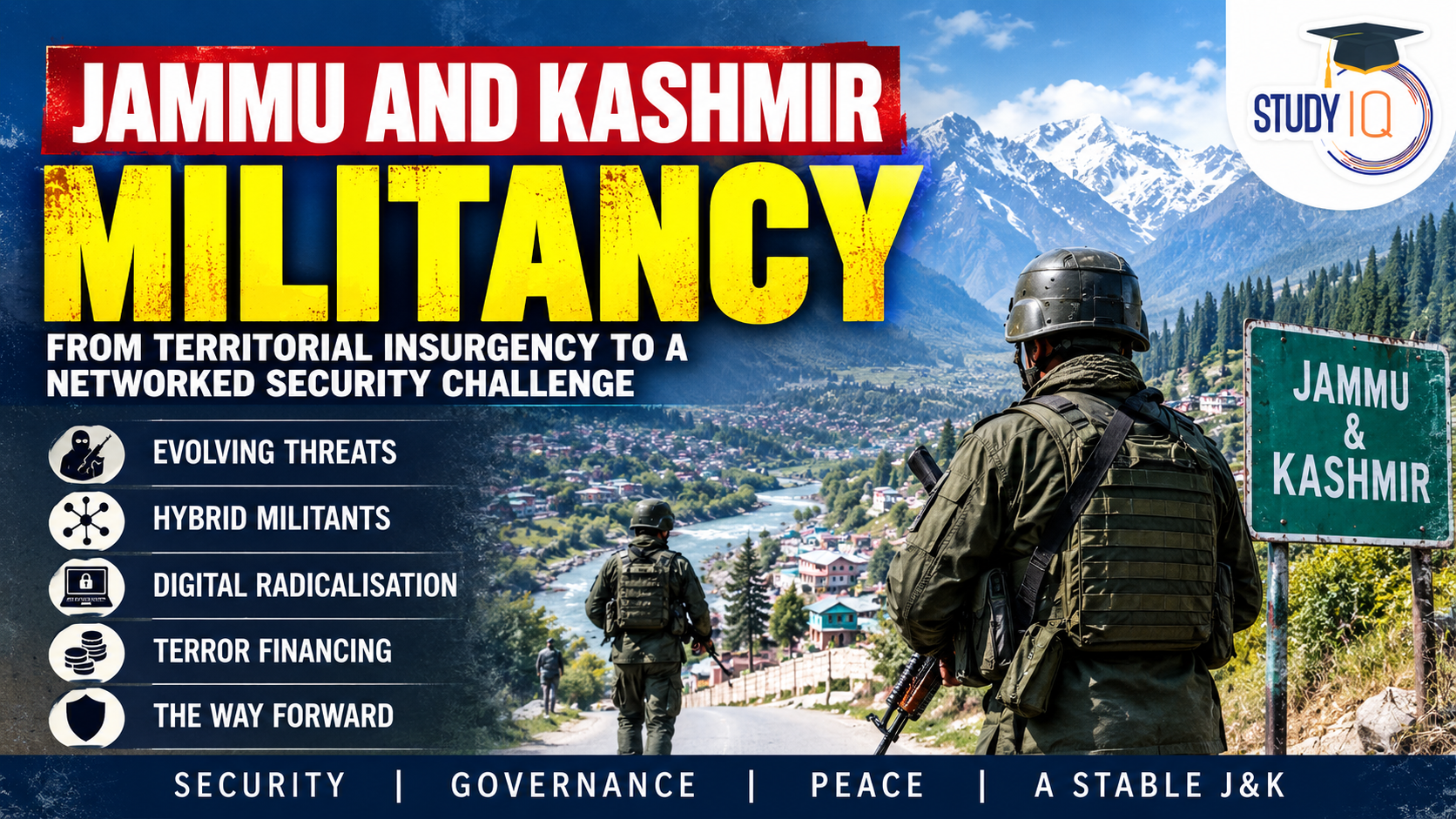
Recent targeted attacks on migrant workers from Chhattisgarh in Jammu and Kashmir’s Kulgam district have renewed concerns over the evolving security situation in the region.
How has Jammu & Kashmir militancy evolved from a territorial insurgency into a networked security challenge?
- Recruitment De-territorialisation: Militancy’s recruitment base shifted from mass mobilisation rooted in Valley-specific grievances to individualised, technology-driven radicalisation operating beyond J&K’s geography. Consequently, the insurgent ecosystem was no longer confined to territorial control zones.
- g., NIA investigations have traced radicalised recruits from Kerala and Karnataka joining Kashmir-linked terror modules.
- Hybrid Militant Mechanism: As recruitment became geographically dispersed, sustaining conventional militant camps became difficult. Consequently, militant groups adopted hybrid militants—part-time, unlisted armed civilians who strike and then blend back into civilian life.
- g., J&K Police have documented social media-recruited hybrid militants involved in targeted killings before returning to civilian identity.
- Encrypted Command Diffusion: Command-and-control shifted to encrypted, cross-border digital communication, allowing handlers to direct operatives while remaining operationally concealed.
- g., NIA charge sheets describe Pakistan-based handlers issuing operational instructions through encrypted messaging platforms.
- Proxy Front Multiplication: Increasingly relied on multiple proxy fronts that preserved strategic direction while maintaining plausible deniability and reducing exposure to international sanctions.
- g., The Resistance Front (TRF) and People’s Anti-Fascist Front (PAFF) are widely assessed by Indian security agencies and several international assessments as fronts linked to LeT/JeM, although they publicly project themselves as indigenous groups.
- Narco-Terror Financing Network: Financing increasingly shifted from traceable hawala transfers towards narcotics trafficking, generating covert revenue for dispersed militant cells.
- g., Joint NCB–NIA investigations have linked heroin trafficking through the Punjab border to financing Pakistan-backed terror modules operating in Jammu & Kashmir.
What consequences can arise from highly successful counter-insurgency campaigns in Jammu and Kashmir?
- Tactical Displacement: Successful counter-insurgency dismantles organised militant formations but does not necessarily eliminate extremist intent. Violence consequently shifts from coordinated insurgency to dispersed, low-visibility hybrid attacks that increasingly evade conventional security metrics.
- g., Declining infiltration and encounter figures have coincided with targeted civilian killings by hybrid militants.
- Political Legitimacy Deficit: The persistence of hybrid violence despite declining militant numbers limits the ability of tactical success alone to establish political normalcy. Security-led stability may therefore be viewed as administrative order rather than durable political reconciliation, leaving a gap between state control and political trust.
- g., Despite improved security conditions after 2019, debates over political representation and constitutional status have continued in parts of the Valley.
- Governance Overcentralisation: An incomplete transition from security-led stability to political legitimacy encourages continued dependence on security institutions for preserving order. Administrative authority therefore remains concentrated in central and security-led structures instead of progressively shifting to routine civilian governance.
- g., The continuation of AFSPA in notified areas alongside prolonged phases of centrally administered governance reflects the priority accorded to preserving security gains.
- Narrative Radicalisation Migration: The predominance of security-led governance narrows opportunities for physical mobilisation without fully neutralising extremist narratives. Radicalisation consequently migrates towards digital ecosystems where mobilisation is less dependent on territorial presence or militant infrastructure.
- g., NIA investigations have identified individuals radicalised primarily through encrypted online content without exposure to conventional militant infrastructure.
- External Sponsor Recalibration: Digital-first radicalisation reduces dependence on large militant formations, encouraging external sponsors to support decentralised and deniable modes of conflict. Proxy fronts, externally supported hybrid militant activation, drone-enabled logistics, and narco-terror financing consequently become more prominent than conventional infiltration.
- g., Pakistan-backed networks have increasingly relied on proxy organisations such as TRF, drone-enabled arms drops, and narcotics-linked financing to sustain militancy
Way Forward to Address Militancy in Jammu & Kashmir
- Strengthen the Jammu & Kashmir Police: Position the J&K Police at the core of counter-terrorism efforts by enhancing its operational capacity, as its local knowledge of language, culture, and terrain enables more effective and intelligence-driven operations.
- Deepen Democratic Governance: Reinforce democratic institutions from panchayats to the legislature to ensure public grievances are addressed through participatory governance, reducing alienation and extremist influence.
- Ensure Responsive and Transparent Administration: Promote accountable, corruption-free governance and improve citizen–administration engagement to rebuild public trust and weaken separatist narratives.
- Promote Employment and Livelihood Opportunities: Expand private investment, industrial development, and skill-building programmes such as Himayat to address youth unemployment and reduce susceptibility to militant recruitment.
- Disrupt Terror Financing: Intensify financial intelligence and investigations through agencies like the National Investigation Agency (NIA) to dismantle hawala networks, front organisations, and Over-Ground Worker (OGW) funding channels.
- Maintain Diplomatic Pressure on Pakistan: Sustain diplomatic engagement at forums such as FATF and the UN, while employing calibrated strategic measures to increase accountability and constrain cross-border terror infrastructure.
Read Also: UPSC Daily Current Affairs 2026
 World Pharmacists Day 2026: Date, Theme,...
 UPSC EPFO Exam Strategy 2026: Complete 3...
 Census Town in India: Criteria, Meaning ...













 WhatsApp