Table of Contents
Context
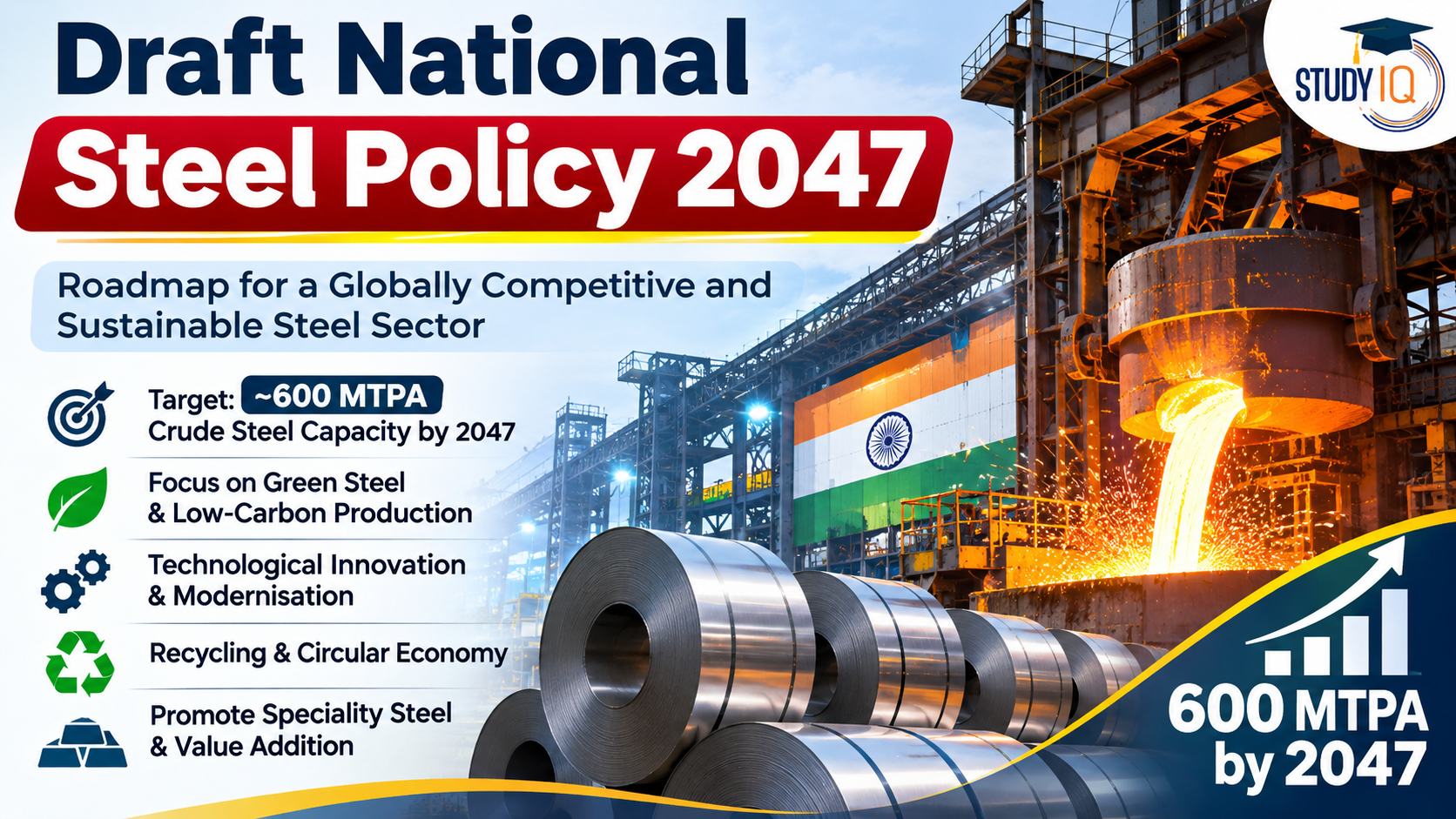
The Ministry of Steel has released the Draft National Steel Policy: Vision 2047, aiming to transform India into a globally competitive and sustainable steel manufacturing hub. It envisages expanding crude steel capacity to approximately 600 MTPA by 2047, alongside promoting technological innovation and green steel production.
What is the present status of India’s steel sector?
- Global Position: India has remained the world’s second-largest crude steel producer since 2018, after China.
- Production Capacity: In FY 2025–26, India recorded crude steel production of 170.15 MT against an installed capacity of 220.41 MT.
- Domestic Consumption: Finished steel consumption stood at 164.36 MT, reflecting strong domestic demand.
- Industrial Contribution: The sector contributes around 2% to India’s GDP and supports infrastructure and manufacturing activities.
What is the significance of India’s steel sector?
- Economic Growth: Steel contributes to industrial output and supports India’s ambition of becoming a developed economy by 2047.
- Infrastructure Development: It is a critical input for roads, bridges, railways, airports, ports and urban infrastructure.
- Employment Generation: The sector provides direct and indirect employment to over 2.5 million people across mining, manufacturing, transport and allied industries.
- Strategic Autonomy: Strong domestic production reduces dependence on foreign suppliers for critical industrial and defence requirements.
- Regional Development: Steel plants promote industrial clusters and economic activity in mineral-rich states such as Odisha, Jharkhand and Chhattisgarh.
What are the major strengths of India’s steel sector?
- Raw Material Availability: Extensive iron ore deposits, particularly in Odisha, Jharkhand, Chhattisgarh and Karnataka, provide a strong domestic resource base.
- Large Domestic Market: Urbanisation, infrastructure expansion and manufacturing growth ensure sustained demand for steel.
- Cost Advantage: Relatively lower labour and conversion costs support the competitiveness of domestic steel producers.
- Established Industrial Base: Public-sector enterprises such as SAIL and RINL have contributed to developing domestic manufacturing capabilities.
- Private-Sector Participation: Companies such as Tata Steel, JSW Steel and AM/NS India have expanded production capacity and technological capabilities.
- Skilled Workforce: Availability of engineers, metallurgists and technicians supports industrial expansion.
- Geographical Advantage: Coastal steel plants and proximity to major shipping routes create opportunities for international trade.
Why is the steel industry concentrated in specific geographical regions of India?
- Historical Industrial Development: Early industrialisation around the Bengal–Jharkhand belt created an established steel manufacturing ecosystem, attracting subsequent investments.
- Proximity to Coking Coal: Regions such as Jharkhand and West Bengal offer relatively better access to coalfields, reducing dependence on long-distance transportation of critical inputs.
- Availability of Water: Steel production requires large quantities of water for cooling and processing, encouraging plants to locate near perennial rivers and reservoirs.
- Port-Based Advantages: Coastal locations such as Visakhapatnam and coastal Odisha facilitate the import of coking coal and export of finished steel.
- Availability of Land: Large integrated steel plants require extensive land for production units, storage, waste disposal and future expansion, favouring regions with suitable land availability.
- Power Availability: Steelmaking requires a reliable and continuous electricity supply, encouraging concentration in regions with established power-generation and transmission infrastructure.
What are the major challenges facing India’s steel sector?
- Coking Coal Dependence: Inadequate domestic availability of high-quality coking coal makes the industry heavily dependent on imports, particularly from Australia, Russia, the USA and Canada.
- High Logistics Costs: Poor railway connectivity, port congestion and geographical distance between mines, steel plants and consumption centres increase transportation costs.
- Technological Gaps: Many small and medium-scale producers continue to use outdated technologies, resulting in lower productivity, higher costs and inconsistent product quality.
- Environmental Pollution: Conventional steelmaking generates significant greenhouse gas emissions, particulate matter, industrial waste and wastewater.
- Import Dependence on Speciality Steel: Limited domestic capabilities in high-grade steel manufacturing create dependence on imports for defence, aerospace, automobiles and power generation.
- Fragmented Industry Structure: Smaller producers often lack economies of scale, institutional finance and access to advanced technologies.
- Global Competition: Cheap imports, international overcapacity and aggressive pricing by major producers such as China, Japan and South Korea affect domestic competitiveness.
- Carbon Border Measures: The European Union’s Carbon Border Adjustment Mechanism (CBAM) may increase compliance costs for India’s carbon-intensive steel exports.
What are the major government initiatives to strengthen India’s steel sector?
- Draft National Steel Policy 2047: Provides a long-term roadmap for expanding capacity to around 600 MTPA, increasing domestic consumption, promoting exports and accelerating green steel production.
- PLI Scheme for Speciality Steel: Launched in 2021 to encourage domestic manufacturing of high-value steel through financial incentives linked to incremental sales.
- DMI&SP Policy: Promotes domestically manufactured iron and steel products through preference in government procurement and minimum domestic content requirements.
- Green Steel Initiative: Promotes low-carbon steel production through green steel taxonomy, certification and hydrogen-based steelmaking pilots.
- Steel Scrap Recycling Policy, 2019: Encourages organised scrap collection and recycling to improve resource efficiency and reduce dependence on imported raw materials.
Way Forward
- Ensure Raw Material Security: Diversify coking coal imports, expand domestic exploration and improve mineral beneficiation to reduce external dependence.
- Modernise Steel Production: Promote automation, artificial intelligence, robotics and advanced manufacturing technologies to improve productivity and efficiency.
- Accelerate Green Steel: Scale up hydrogen-based DRI technology, renewable energy and carbon capture, utilisation and storage (CCUS).
- Improve Logistics Infrastructure: Strengthen railway connectivity, ports and dedicated freight corridors; promote slurry pipelines and multimodal transportation.
- Promote Speciality Steel: Encourage technology transfer, indigenous R&D and industry-academia collaboration to reduce dependence on high-grade steel imports.
- Strengthen Recycling: Develop organised scrap collection, segregation and recycling systems to promote resource efficiency and a circular economy.
- Support Secondary Steel Producers: Improve access to institutional finance, modern technology and affordable energy while encouraging economies of scale.
- Ensure Policy Implementation: Convert the National Steel Policy 2047 targets into measurable milestones through coordination between the Centre, states and industry.

 VISTAR Scheme 2026–31: Objectives, Fea...
 World Tsunami Awareness Day 2026: 5 Nove...
 Chidambaram Nataraja Temple: History, Ar...













 WhatsApp