Table of Contents
Context: Women’s representation in India continues to be limited, with participation in Parliament and State Assemblies reflecting persistent gender disparities. The trends also underscore India’s low global standing and highlight the pressing need for structural reforms, including measures like reservations or quotas.
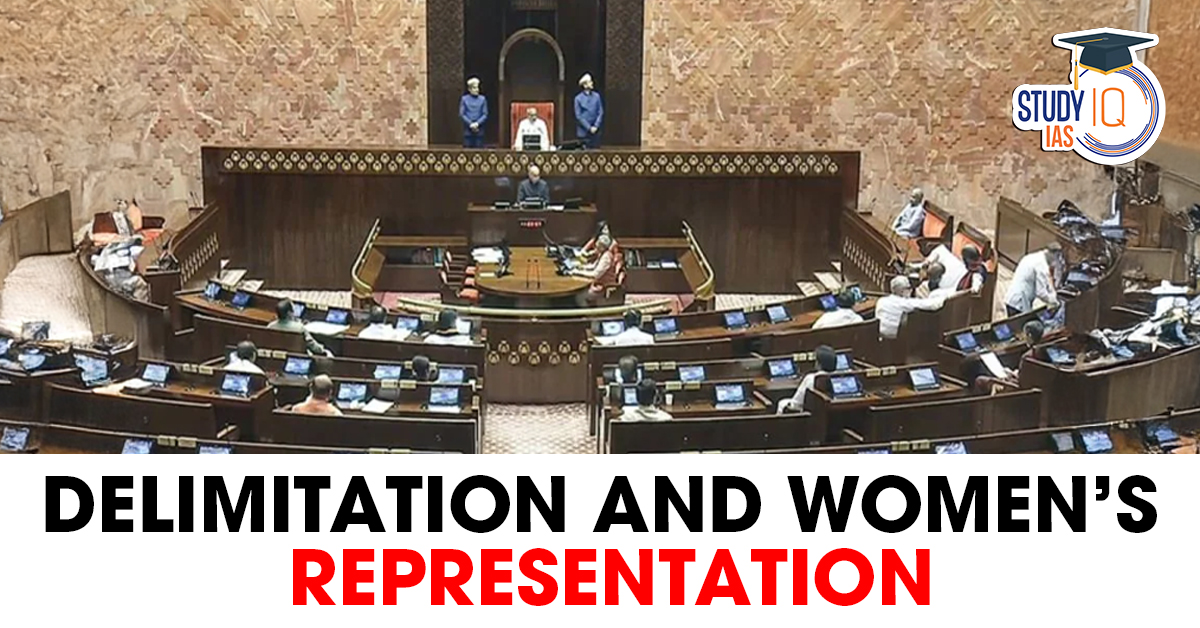
Delimitation and Women’s Representation
Delimitation and women’s representation are closely linked in shaping a more inclusive and balanced democratic system in India. Delimitation refers to the process of redrawing electoral boundaries to ensure equal representation based on population changes, while women’s representation focuses on increasing the participation of women in legislative bodies.
With the introduction of the Nari Shakti Vandan Adhiniyam, which provides 33% reservation for women in the Lok Sabha and State Assemblies, the role of delimitation has gained renewed importance, as its implementation is tied to future census and boundary reorganisation. Together, these processes have the potential to significantly transform India’s political landscape by promoting gender equality, fair representation, and stronger democratic governance.
Check here: Recent trends on Women’s Representation in India
Three Major Bills Introduced
- Constitution (131st Amendment) Bill, 2026: Proposes expansion of the Lok Sabha and seeks amendments to Articles 81 and 82
- Delimitation Bill, 2026: Establishes a revised framework for the Delimitation Commission
- Third Bill: Facilitates reservation for women in State Assemblies and Union Territory legislatures
Key Provisions of the Bills
Expansion of Lok Sabha
- Increase in strength from 543 seats to nearly 850
-
- Up to 815 seats for States
- Around 35 seats for Union Territories
- Reflects a ~50% rise in representation
- Aligns with the capacity of the new Parliament building
- Likely to result in smaller constituencies geographically
Women’s Reservation (Target: 2029 Elections)
- Although 33% reservation was approved earlier through the Constitution (106th Amendment) Act, 2023, its implementation depended on delimitation after the Census.
- Due to delays in the 2021 Census, the government proposes using 2011 Census data.
- Aims to implement reservations from the 2029 general elections.
Redefinition of “Population” (Article 81)
- Shifts from using the “last Census” to any Census chosen by Parliament through law.
- Provides flexibility to Parliament in deciding the basis for delimitation.
Women’s Reservation vs. Delimitation
- Evolution of Women’s Reservation Policy: The current framework differs significantly from earlier efforts and marks a move from direct empowerment to conditional empowerment, altering the original intent of the policy.
- The 2010 Women’s Reservation Bill, passed by the Rajya Sabha, proposed immediate implementation without preconditions
- The Nari Shakti Vandan Adhiniyam, 2023, introduced conditional implementation linked to Census and delimitation
- Delay in Representation: Women’s representation in Parliament dropped from 78 to 74 MPs after the 2024 elections
- In State Assembly elections (2024–25), women constituted less than 10% of elected representatives
- Triple Linkage Problem: The proposed framework creates three interconnected conditions:
- Delimitation based on Census data
- Expansion of seats in Parliament
- Reservation for women only after these steps
- Concerns over Use of Outdated Census Data: The Delimitation Bill mandates the use of the 2011 Census, despite significant demographic changes since then.
- Representation may not reflect current population realities and reduces urgency for conducting a fresh Census
- Impact on SC/ST Representation: Delimitation also determines the number of seats reserved for Scheduled Castes (SCs) and Scheduled Tribes (STs), based on their population share. This has a cascading effect, as one-third of these reserved seats are meant for SC/ST women, thereby compounding the injustice.
- Political Sensitivity of Delimitation: Linking women’s reservation to such a politically sensitive and disputed process risks further delays and controversies.
- Eg: Recent State-level exercises in Assam and Jammu & Kashmir faced criticism over alleged bias in redrawing boundaries
- Women’s Reservation as a Stand-Alone Reform: Historically, women’s reservation has been viewed as an independent measure to strengthen democracy which does not require boundary redrawing and has already undergone extensive parliamentary scrutiny.
Solutions for Balanced Delimitation
- Capping Lok Sabha Seats: Keeping the number of MPs fixed, as done in the U.S., would maintain the status quo in state-wise representation and uphold the federal principle.
- Eg: It can help build national consensus
- Increasing State Assembly Seats: To address democratic representation needs, the number of MLAs in State Legislative Assemblies can be increased based on population growth.
- Weighted Representation Model: A formula ensuring fair weightage for states with lower population growth can be considered to maintain regional balance.
- Incentivizing Population Control: States that have effectively managed their population growth should not be disadvantaged in seat allocation; a mechanism to reward them should be explored.
- Consensus-Based Decision: Engaging political leaders across regions to reach a balanced and widely acceptable solution can help prevent regional tensions.
- Parliamentary Debate & Review: A thorough discussion in Parliament, considering both numerical representation and federal equity, is essential before finalizing the new seat distribution.
- Adopting a Hybrid Formula: A balanced approach could incorporate factors such as population, economic contribution, demographic performance, and geographic size to ensure fairness.
- Reforming the Rajya Sabha: Strengthening the Upper House by ensuring more balanced state representation could help offset population-based disparities in the Lok Sabha.
- Separating Reservation from Delimitation: Women’s reservation could be implemented independently of delimitation to avoid linking it to a contentious redistribution process.

 Chief Election Commissioner Removal 2026...
 Fundamental Duties of Indian Constitutio...
 Anti-Defection Law: Origin, Provisions o...





 WhatsApp