
Table of Contents
Context
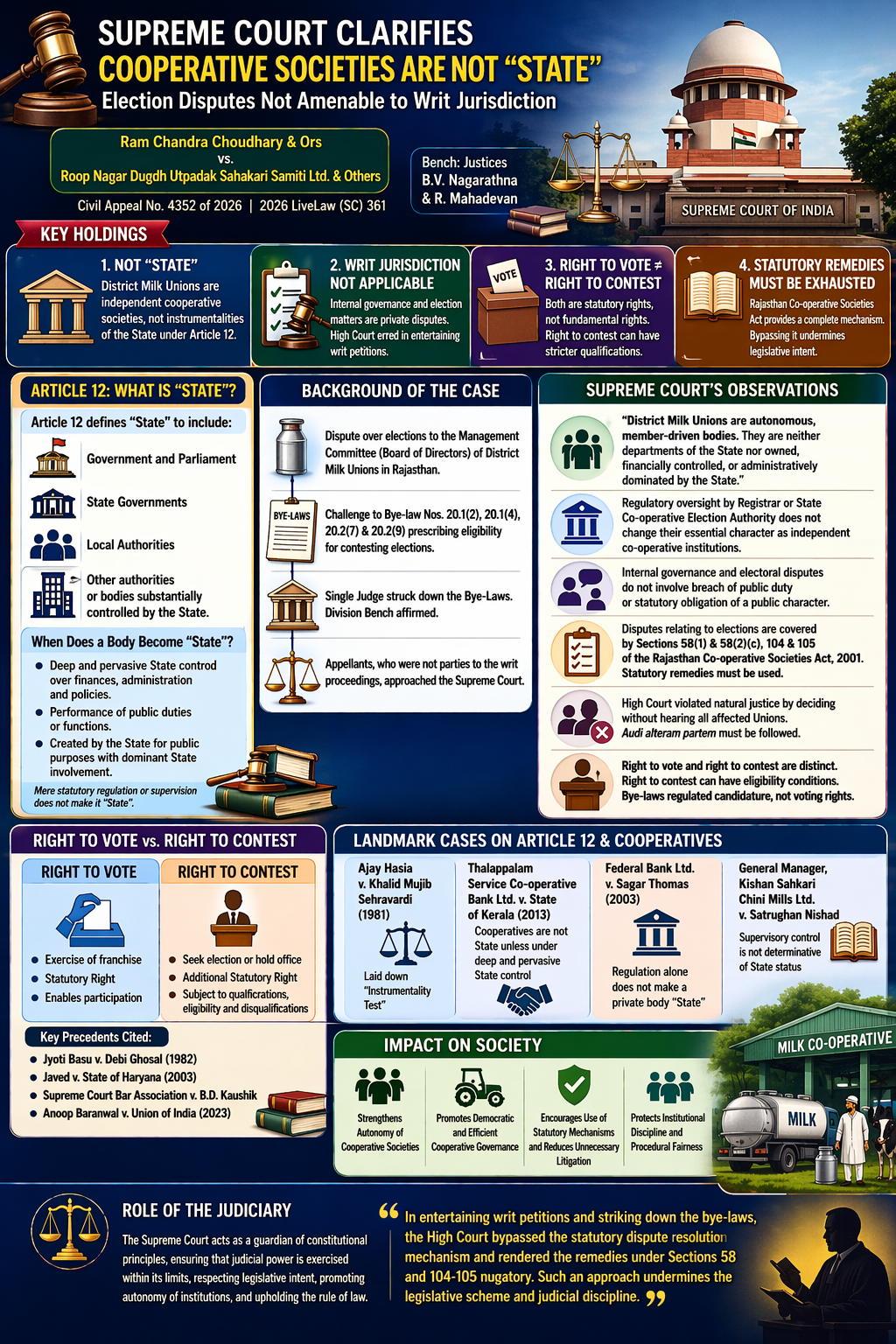
The constitutional definition of “State” in Article 12 of the Indian Constitution is crucial for delineating the scope of fundamental rights and the breadth of judicial review. In a recent decision in Ram Chandra Choudhary v Roop Nagar Dugdh Utpadak Sahakari Samiti Ltd, the Supreme Court of India reaffirmed that independent cooperative societies, including District Milk Unions in Rajasthan, do not constitute “State” under Article 12.
The opinion clarifies the parameters of writ jurisdiction under Article 226 and emphasises the conceptual distinction between public law and private conflicts. The Court emphasised a significant electoral principle- that the right to vote and the right to contest elections are statutory rights rather than fundamental rights.
Context of the Controversy
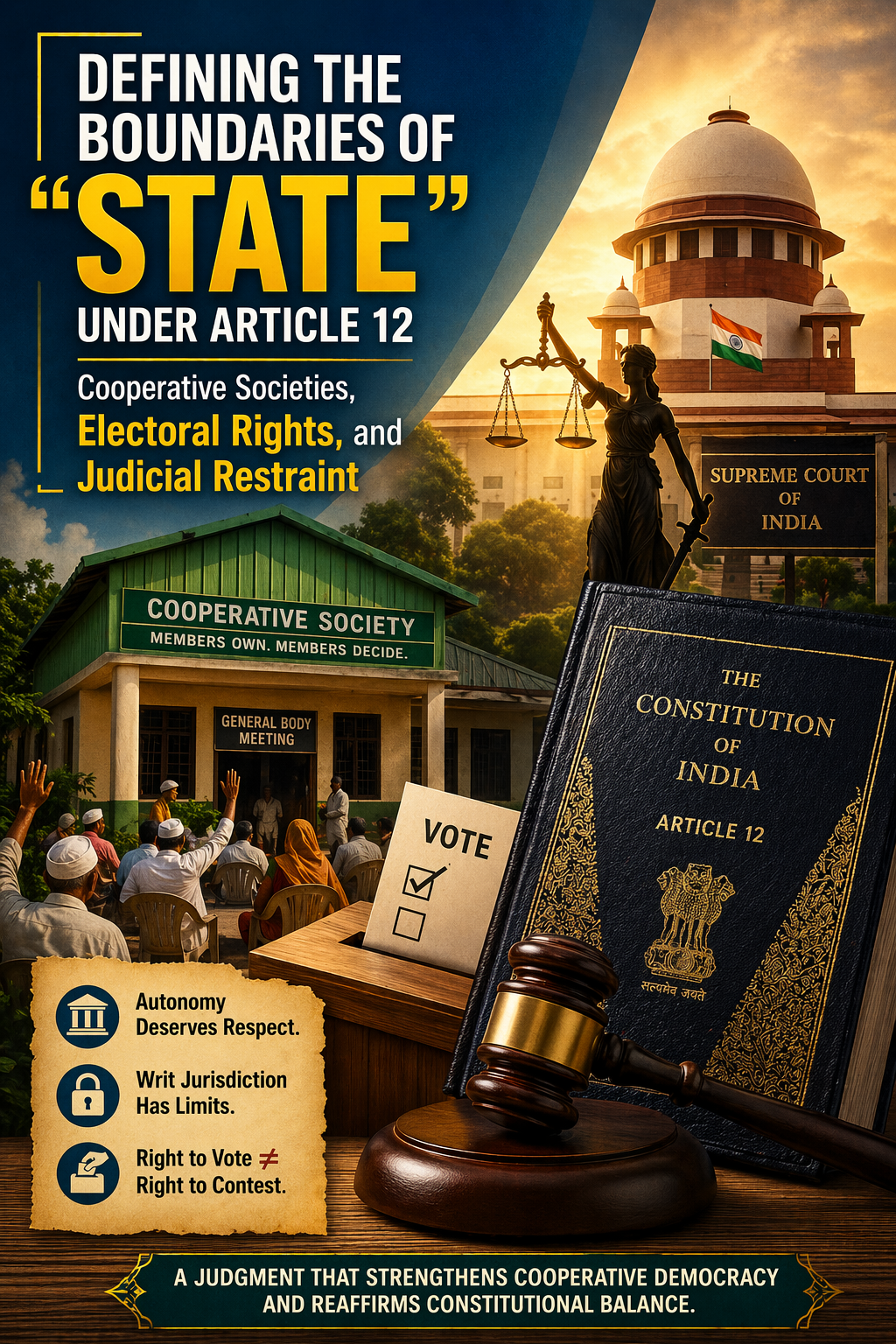
The matter arose from a conflict over elections to the Management Committees (Boards of Directors) of several District Milk Unions in Rajasthan. The unions, functioning as cooperative societies, established special bye-laws- namely Bye-law Nos. 20.1(2), 20.1(4), 20.2(7), and 20.2(9)- that delineated the eligibility criteria for participating in elections.
Members of primary cooperative societies contested these bye-laws before the Rajasthan High Court via writ petitions under Article 226. A Single Judge deemed the bye-laws ultra vires, and a Division Bench later upheld its decision.
Discontented with these decisions, appellants who were not involved in the initial proceedings petitioned the Supreme Court, contesting the High Court’s use of writ jurisdiction.
Fundamental Constitutional Question: Who constitutes the “State”?
The central issue of the case was whether District Milk Unions qualified as “instrumentalities of the State” pursuant to Article 12. This finding is essential since only entities that meet the criteria of “State” are directly accountable for fundamental rights responsibilities and writ jurisdiction.
The Court determined that the District Milk Unions are independent, member-oriented entities regulated by legal statutes and their own bylaws. They are neither governmental departments nor entities subjected to extensive State supervision.
The Court underscored that mere statutory regulation or supervision does not convert a private or cooperative entity into a State instrumentality. This idea has been constantly maintained in Indian constitutional law.
Development of Article 12 Jurisprudence
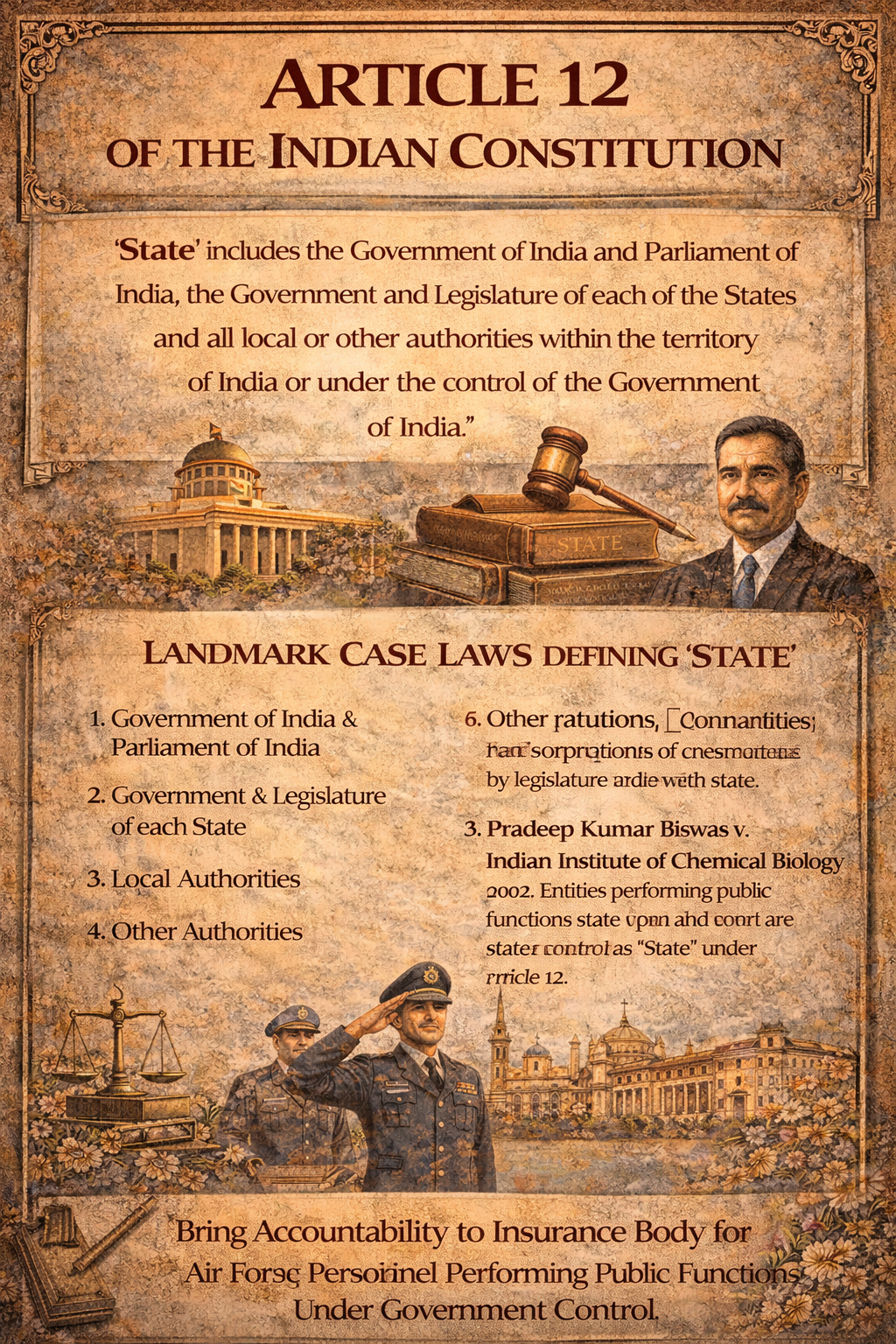
The interpretation of Article 12 has undergone substantial evolution throughout time. In Ajay Hasia v Khalid Mujib Sehravardi, the Supreme Court established the “instrumentality or agency“ test to ascertain if an entity qualifies as the State. The assessment evaluates elements like fiscal oversight, administrative governance, and operational attributes.
In Thalappalam Service Cooperative Bank Ltd v State of Kerala, the Court determined that cooperative societies are typically not considered State entities unless there is substantial and extensive governmental supervision.
In Federal Bank Ltd v Sagar Thomas, the Court clarified that even heavily regulated private bodies do not become the State merely due to regulatory oversight
The present decision relies on these precedents and reasserts that autonomy and member-driven governance are essential criteria for distinguishing against categorisation as a State.
Writ Jurisdiction and Its Constraints
The decision also examines the extent of writ jurisdiction under Article 226 of the Constitution of India. Writs may be issued against non-State entities under specific conditions; such jurisdiction is confined to instances where the entity executes public responsibilities or fulfils public duties.
The Court emphasised that conflicts concerning internal governance, management, or electoral procedures of cooperative societies typically do not encompass elements of public law. Consequently, these conflicts are beyond the scope of writ jurisdiction.
The difference between public and private law is essential for upholding judicial discipline and averting overreach.
Statutory Remedies and Judicial Restraint
A notable element of the decision is the stress on the necessity of exploring statutory remedies. The Court observed that the Rajasthan Cooperative Societies Act, 2001, establishes a thorough framework for the resolution of disputes, encompassing electoral matters.
Sections 58(1) and 58(2)(c) of the Act explicitly address conflicts related to the election of executives within cooperative organisations. Moreover, Sections 104 and 105 establish a multi-tiered appeal structure.
The Court determined that by considering writ petitions, the High Court circumvented the statutory system, rendering it ineffectual. The Court noted that this approach undermines the legislative aim and disturbs the equilibrium between judicial and administrative processes.
Internal Governance versus Public Law
The Court delineated a fundamental separation between internal governance concerns and public law challenges. It asserted that problems concerning bye-laws, electoral eligibility, and administration structures are fundamentally internal issues.
The existence of regulatory control by entities like the Registrar or State Cooperative Election Authority does not change the intrinsic nature of these societies as autonomous institutions.
This rationale is consistent with prior decisions, such as General Manager Kishan Sahkari Chini Mills Ltd v Satrughan Nishad, in which the Court determined that regulatory supervision does not define State status.
Natural Justice and Procedural Equity
The Supreme Court condemned the High Court for contravening the concept of audi alteram partem, a cornerstone of natural justice. The High Court’s decision has extensive ramifications for several District Milk Unions, although these organisations were not afforded the chance to present their case.
The Court noted that a decision functioning in rem must be preceded by sufficient notice and involvement of all impacted parties. The inability to comply resulted in the High Court’s judgement being procedurally defective.
Electoral Rights: Legislative, Not Inherent
An essential observation in the decision concerns the essence of electoral rights. The Court reaffirmed that the right to vote and the right to contest elections are not fundamental rights.
Drawing on cases like Jyoti Basu v Debi Ghosal and Javed v State of Haryana, the Court determined that these rights are exclusively statutory and exist solely to the extent stipulated by law.
The Court also differentiated between the two rights. The right to vote facilitates engagement in the political process, but the right to contest elections is an ancillary right that may be governed by more stringent qualifications and disqualifications.
Misinterpretation by the High Court
The Supreme Court determined that the High Court had merged the right to vote with the right to contest elections. The contested bye-laws, the Court observed, solely governed eligibility for candidature and did not impact the right to vote.
The High Court erroneously used a flawed legal norm by regarding eligibility constraints as limitations on voting rights. This misconception resulted in the annulment of bye-laws that were otherwise aligned with the statutory framework.
Doctrinal Distinction: Public Law Versus Private Law Spheres
The decision of the Supreme Court in Ram Chandra Choudhary & Ors v. Roop Nagar Dugdh Utpadak Sahakari Samiti Limited (2026) significantly reaffirms the theoretical distinction between public law and private law. The Court unequivocally determined that conflicts concerning the internal administration, governance, and electoral procedures of cooperative organisations reside within the realm of private law and are hence not often subject to writ jurisdiction under Article 226.
This difference is essential in constitutional law. Public law remedies, especially writ jurisdiction, aim to rectify infringements of fundamental rights or violations of public duties. In contrast, private disputes, particularly those stemming from contractual, organisational, or internal governance matters, must be addressed within the designated statutory or institutional frameworks established for these reasons.
The Court underscored that the existence of a formal framework governing cooperative societies does not transform their internal disputes into issues of public law. This rationale is consistent with prior cases like Federal Bank Ltd. v. Sagar Thomas, in which the Court determined that private entities do not fall under writ jurisdiction solely due to their regulation by statutory restrictions
Legal Remedies and Judicial Accountability
The judgement significantly underscores the idea of exhaustion of other remedies. The Supreme Court vehemently condemned the Rajasthan High Court for circumventing the statutory dispute settlement process established by the Rajasthan Co-operative Societies Act, 2001.
Sections 58(1) and 58(2)(c) of the Act establish a thorough framework for the resolution of disputes, encompassing issues about the elections of office bearers. Furthermore, Sections 104–105 delineate a multi-tiered appeal structure. The Court noted that this comprehensive statutory framework demonstrates the legislative intention to resolve such issues within the internal adjudicatory system of the cooperative sector.
By adjudicating writ petitions in these cases, the High Court essentially deemed these legislative remedies “nugatory,” so compromising the integrity of judicial review. This principle has long been acknowledged in Indian jurisprudence, where courts have consistently maintained that writ jurisdiction should not be exercised when sufficient alternative remedies are available, except in extraordinary situations involving the infringement of fundamental rights, principles of natural justice, or absence of jurisdiction.
Principles of Natural Justice and Procedural Fairness
The Supreme Court recognised a significant procedural error in the High Court’s methodology. The High Court invalidated specific bye-laws with extensive ramifications without guaranteeing that all impacted District Milk Unions were included as parties in the proceedings.
The Court determined that this contravened the essential principle of audi alteram partem- the right to a hearing. The High Court’s decision, which operated in rem and impacted several cooperative organisations, was procedurally faulty due to the lack of notice and a chance for a hearing for all stakeholders.
This facet of the verdict underscores the judiciary’s dedication to procedural fairness as a fundamental element of constitutional governance. It also emphasises that even benevolent judicial interventions must comply with fundamental principles of natural justice.
Eligibility versus Disqualification: An Essential Distinction
A significant aspect of the decision is the Court’s meticulous differentiation between “eligibility” and “disqualification.” The High Court annulled the contested bye-laws based on the presumption that they imposed supplementary disqualifications beyond those stipulated by the statute.
The Supreme Court dismissed this rationale, elucidating that the bye-laws solely established qualifying standards for election candidature or officeholding. The criteria were founded on functional and performance-related standards and did not modify or extend the statutory disqualifications outlined in Section 28 of the Act.
This distinction holds doctrinal significance. Disqualifications are often comprehensively listed in statutes and cannot be broadened by subordinate legislation; nonetheless, eligibility criteria may be established to guarantee effective governance and representation. The High Court employed an erroneous standard of scrutiny by combining these two ideas.
Re-examining Electoral Rights: Voting vs Contestation
The decision also offers a significant reaffirmation of the nature of electoral rights in India. Referencing cases like Jyoti Basu v. Debi Ghosal and Javed v. State of Haryana, the Court reaffirmed that the right to vote and the right to contest elections are not fundamental rights.
These rights are solely statutory and exist only as delineated by law. The Court underscored that the right to vote and the right to contest are separate entities. The former facilitates participation in the electoral process, whilst the latter pertains to the pursuit of public office and is consequently governed by more stringent regulations, encompassing qualifications, eligibility criteria, and institutional prerequisites.
The Court additionally observed that the contested bye-laws did not impact the right to vote but were limited to governing candidature and tenure in office. The High Court erred by conflating limitations on candidature with limitations on voting rights.
This explanation is especially pertinent given the changing law, including the Constitution Bench ruling in Anoop Baranwal v. Union of India, which revealed divergent judicial perspectives on the essence of voting rights.
Effects on Cooperative Independence and Administration
The Supreme Court’s ruling has profound ramifications for the independence and administration of cooperative groups. The Court has strengthened the notion of cooperative federalism and decentralisation by asserting that these entities are autonomous, member-driven institutions.
Cooperative societies are essential to India’s rural and agricultural economy, especially in the dairy, lending, and housing sectors. Permitting excessive judicial intervention in their internal matters could jeopardise their democratic processes and operational efficacy.
The judgement does not exempt cooperative societies from judicial examination. The Court emphasised that writ jurisdiction might still be invoked where such entities execute public activities or contravene statutory or constitutional requirements of a public nature. This equitable strategy guarantees responsibility while preserving independence.
Conclusion
The Supreme Court’s decision in Ram Chandra Choudhary & Ors v. Roop Nagar Dugdh Utpadak Sahakari Samiti Limited (2026) is a notable reaffirmation of fundamental constitutional law principles. The Court has affirmed that independent cooperative societies are not encompassed by Article 12 and that their internal conflicts typically do not fall under writ jurisdiction, thus reinforcing the doctrinal limits of judicial review.
The judgement simultaneously offers significant clarifications about electoral rights, the differentiation between eligibility and disqualification, and the imperative of complying with statutory remedies and principles of natural justice. It maintains a judicious equilibrium between autonomy and accountability, guaranteeing that cooperative institutions operate efficiently while adhering to suitable legal supervision.
The decision exemplifies a judicious and measured approach to constitutional interpretation, honouring legislative purpose, maintaining institutional integrity, and upholding the rule of law.

 Nari Shakti Vandan Adhiniyam: Women’s ...
 Evolution of Article 226 and Concept of ...
 Constitutional Equality and Evolution of...



 WhatsApp





