
Table of Contents
The Chhattisgarh Judicial Service Exam 2026 has undergone a major structural overhaul. The Law and Legislative Affairs Department of Chhattisgarh has amended the Chhattisgarh Lower Judicial Service (Recruitment and Conditions of Service) Rules, 2006, through an extraordinary Gazette notification dated September 11, 2026.
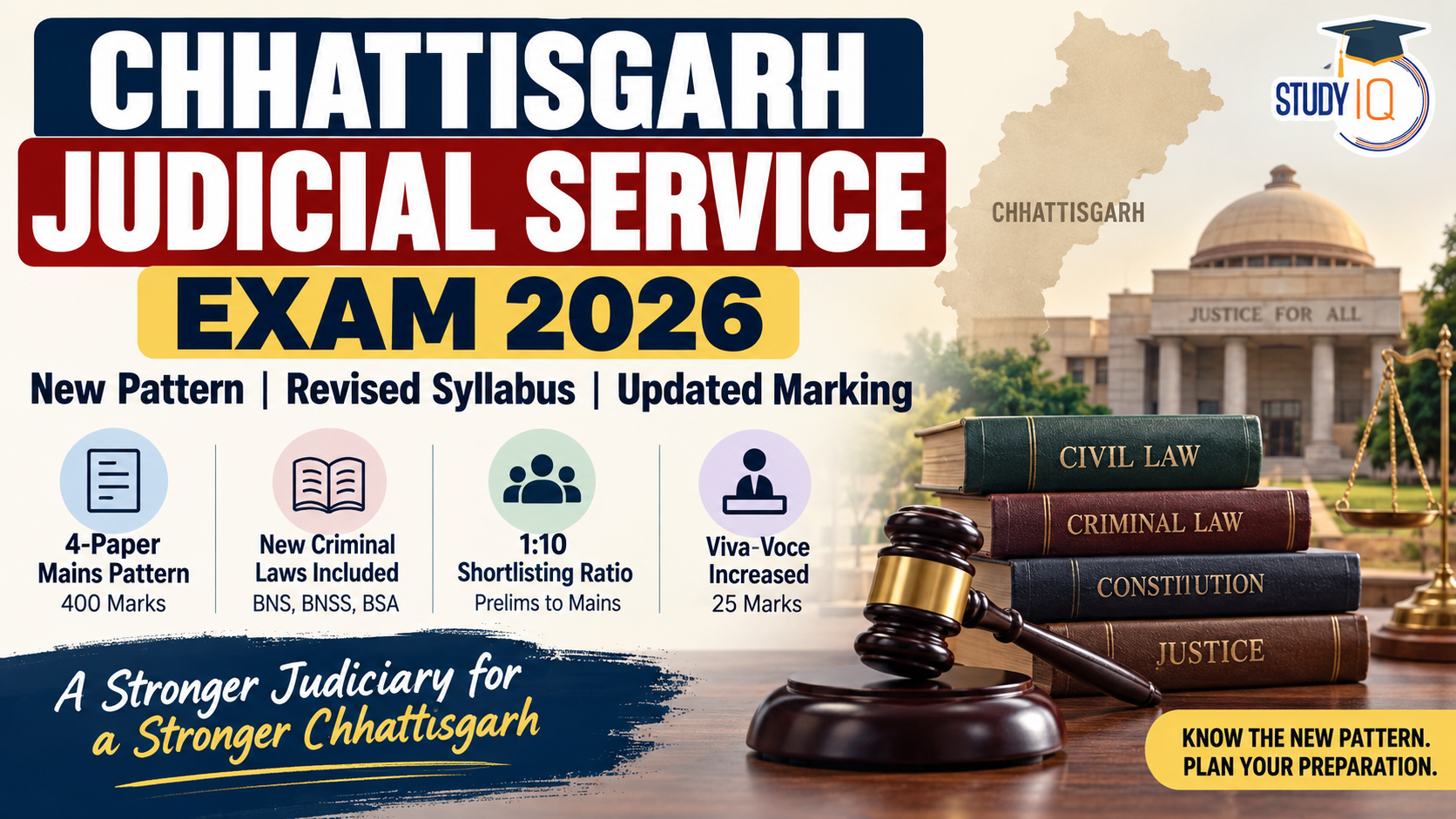
The amendment introduces a completely redesigned Main Written Examination, expanding it from the earlier judgment-writing-centric format to a comprehensive four-paper descriptive examination carrying 400 marks. The changes also formally incorporate the new criminal laws—Bharatiya Nyaya Sanhita (BNS), Bharatiya Nagrik Suraksha Sanhita (BNSS), and Bharatiya Sakshya Adhiniyam (BSA).
Chhattisgarh Judicial Service Exam 2026: Major Changes
The most important changes in the revised judicial service examination pattern are:
- Four descriptive papers in the Main Examination.
- Each paper carries 100 marks and has a 3-hour duration.
- Total Mains written examination: 400 marks.
- Prelims-to-Mains shortlisting ratio revised to 1:10.
- BNS, BNSS and BSA replace the older criminal law framework in the syllabus.
- Viva-voce marks increased from 15 to 25.
- Dedicated weightage for legal updates and contemporary judicial developments.
- Greater emphasis on conveyancing, pleadings and practical drafting.
- Judgment writing continues to be important but now forms part of a broader 100-mark practical paper.
New Chhattisgarh Judicial Service Mains Exam Pattern
| Paper | Subject | Duration | Marks |
|---|---|---|---|
| Paper 1 | Civil Law | 3 Hours | 100 |
| Paper 2 | Criminal Law | 3 Hours | 100 |
| Paper 3 | Language, Social, Legal Perspective & Translation | 3 Hours | 100 |
| Paper 4 | Judgment Writing & Pleadings | 3 Hours | 100 |
| Total | Main Written Examination | 12 Hours | 400 |
| Viva-Voce | Personal Interview | — | 25 |
| Final Total | 425 |
Paper 1: Civil Law – 100 Marks
Paper 1 focuses on the candidate’s understanding of core civil laws, constitutional principles and important state-specific legislation.
The syllabus includes:
- Code of Civil Procedure, 1908 (CPC)
- Indian Contract Act, 1872
- Specific Relief Act, 1963
- Limitation Act, 1963
- Transfer of Property Act, 1882
- Constitution of India
- Hindu Succession Act, 1956
- Chhattisgarh Land Revenue Code, 1959
What Aspirants Should Focus On
Candidates should move beyond merely memorising provisions. Preparation should focus on:
- Important statutory provisions
- Procedural applications
- Legal principles and doctrines
- Landmark judgments
- Problem-based questions
- Application of law to factual situations
The inclusion of constitutional law and the Chhattisgarh Land Revenue Code also makes state-specific preparation particularly important.
Paper 2: Criminal Law – 100 Marks
One of the biggest changes is the complete transition to India’s new criminal-law framework.
The paper covers:
- Bharatiya Nyaya Sanhita, 2023 (BNS)
- Bharatiya Nagrik Suraksha Sanhita, 2023 (BNSS)
- Bharatiya Sakshya Adhiniyam, 2023 (BSA)
- Negotiable Instruments Act, 1881 – relevant provisions, particularly Chapters XIII and XVII
- Chhattisgarh Excise Act, 1915
- Juvenile Justice (Care and Protection of Children) Act, 2015
- Arms Act, 1959
- Information Technology Act, 2000
BNS, BNSS and BSA: A New Preparation Priority
The revised syllabus makes knowledge of the three new criminal statutes indispensable.
Aspirants should prepare:
- Exact statutory provisions
- Definitions and ingredients of offences
- Procedural changes under BNSS
- Rules of evidence under BSA
- Important differences from IPC, CrPC and the Indian Evidence Act
- Transitional provisions
- Recent Supreme Court and High Court interpretation of the new laws
Simply relying on old IPC, CrPC and Evidence Act notes will no longer be sufficient for comprehensive preparation.
Paper 3: Language, Social, Legal Perspective & Translation – 100 Marks
Paper 3 introduces a significant combination of language skills, analytical writing, legal awareness and translation.
| Section | Components | Marks |
|---|---|---|
| English Language | Sentence and word correction, antonyms, synonyms, one-word substitution, summarisation | 10 |
| Hindi Language | वाक्य एवं शब्द शुद्धि, विलोम, पर्यायवाची, वाक्यांश के लिए सार्थक शब्द, संक्षेपण | 10 |
| Social Topic | Structured article | 20 |
| Legal Topic | Structured article | 20 |
| Legal Knowledge | Updated law and current judicial trends | 20 |
| English → Hindi | Sentence-wise translation | 10 |
| Hindi → English | Sentence-wise translation | 10 |
| Total | 100 |
Structured Essay Writing
The social and legal articles carry 20 marks each and are evaluated under four broad components:
- Introduction – 5 marks
- Impact – 5 marks
- Suggestion – 5 marks
- Conclusion – 5 marks
This makes answer structure an important scoring factor.
Candidates should therefore avoid writing generic essays. A good judicial-service article should demonstrate legal reasoning, constitutional values, balanced analysis and practical solutions.
Legal Knowledge and Current Judicial Trends
The 20-mark legal knowledge component requires aspirants to stay updated with:
- Recent Supreme Court judgments
- Important High Court judgments
- Constitutional developments
- Legislative amendments
- New criminal laws
- Emerging areas of jurisprudence
- Important legal and social issues
Regular current-affairs revision should therefore become part of judicial-service preparation.
Paper 4: Judgment Writing & Pleadings – 100 Marks
Judgment writing remains a core component of the examination, but its scope has been significantly expanded.
Part 1: Conveyancing & Pleadings – 20 Marks
Candidates may be required to demonstrate practical drafting skills involving:
- Plaint
- Written statement
- Bail application
- Petitions
- Notices
- Civil and criminal pleadings
- Other legal documents
Part 2: Civil Judgment Writing – 40 Marks
Candidates need to demonstrate the ability to:
- Frame and settle issues
- Marshal and appreciate evidence
- Apply relevant statutory provisions
- Analyse pleadings and evidence
- Apply appropriate legal principles
- Reach reasoned findings
- Draft the final decree
Part 3: Criminal Judgment Writing – 40 Marks
This section focuses on practical criminal adjudication, including:
- Framing of charges
- Appreciation of prosecution evidence
- Appreciation of defence evidence
- Statutory presumptions
- Determination of guilt or innocence
- Conviction or acquittal
- Sentencing orders
Chhattisgarh Judicial Service: Old Pattern vs New Pattern
The revised architecture represents a fundamental change in preparation strategy.
Preliminary Examination
↓
Shortlisting at 1:10 Ratio
↓
Main Written Examination – 400 Marks
- Paper 1: Civil Law – 100
- Paper 2: Criminal Law – 100
- Paper 3: Language, Legal/Social Essays & Legal Updates – 100
- Paper 4: Pleadings, Conveyancing & Judgment Writing – 100
↓
Viva-Voce – 25 Marks
↓
Final Merit – 425 Marks
Why the 2026 Amendment Matters for Aspirants
1. Preparation Can No Longer Be Limited to Judgment Writing
The earlier format allowed candidates to focus heavily on judgment writing and associated practical skills. The new system requires comprehensive knowledge across civil law, criminal law, constitutional law, language, legal developments and drafting.
2. New Criminal Laws Become Essential
Candidates must now build their preparation around BNS, BNSS and BSA rather than depending primarily on IPC, CrPC and Indian Evidence Act-based material.
3. Analytical Writing Gains Importance
With 40 marks dedicated to social and legal articles, candidates need to develop structured analytical writing rather than simply memorising legal content.
4. Drafting Skills Matter More
Conveyancing and pleadings have received dedicated weightage. Aspirants should therefore regularly practise plaints, written statements, bail applications, petitions and notices.
5. Current Legal Awareness Can Affect Scores
The dedicated legal knowledge component makes it important to follow recent judgments and developments in Indian jurisprudence.
6. Viva-Voce Has Greater Weight
The increase in interview marks from 15 to 25 means that judicial temperament, communication skills, legal reasoning and personality can have a greater role in final ranking.
How to Prepare for Chhattisgarh Judicial Service Exam 2026
Aspirants should redesign their preparation around five parallel tracks:
1. Civil Law:
Build strong conceptual and provision-wise command over CPC, Contract, TPA, Specific Relief, Limitation, Constitution, Hindu Succession and CGLRC.
2. Criminal Law:
Give priority to BNS, BNSS and BSA and prepare comparative notes wherever the new laws differ from the previous framework.
3. Language & Translation:
Practise Hindi and English grammar, summarisation and two-way translation regularly.
4. Answer Writing & Drafting:
Practise social and legal articles using the Introduction–Impact–Suggestion–Conclusion framework. Simultaneously practise pleadings and judgments.
5. Legal Current Affairs:
Maintain a running compilation of important Supreme Court and High Court decisions, legislative developments and emerging legal issues.
Read Also: Judiciary Current Affairs
 IOCL Law Officer Recruitment 2026: Eligi...
 AAI Junior Executive (Law) Recruitment 2...
 BPSC Prosecution Officer Answer Key 2026...




 WhatsApp





