
Table of Contents
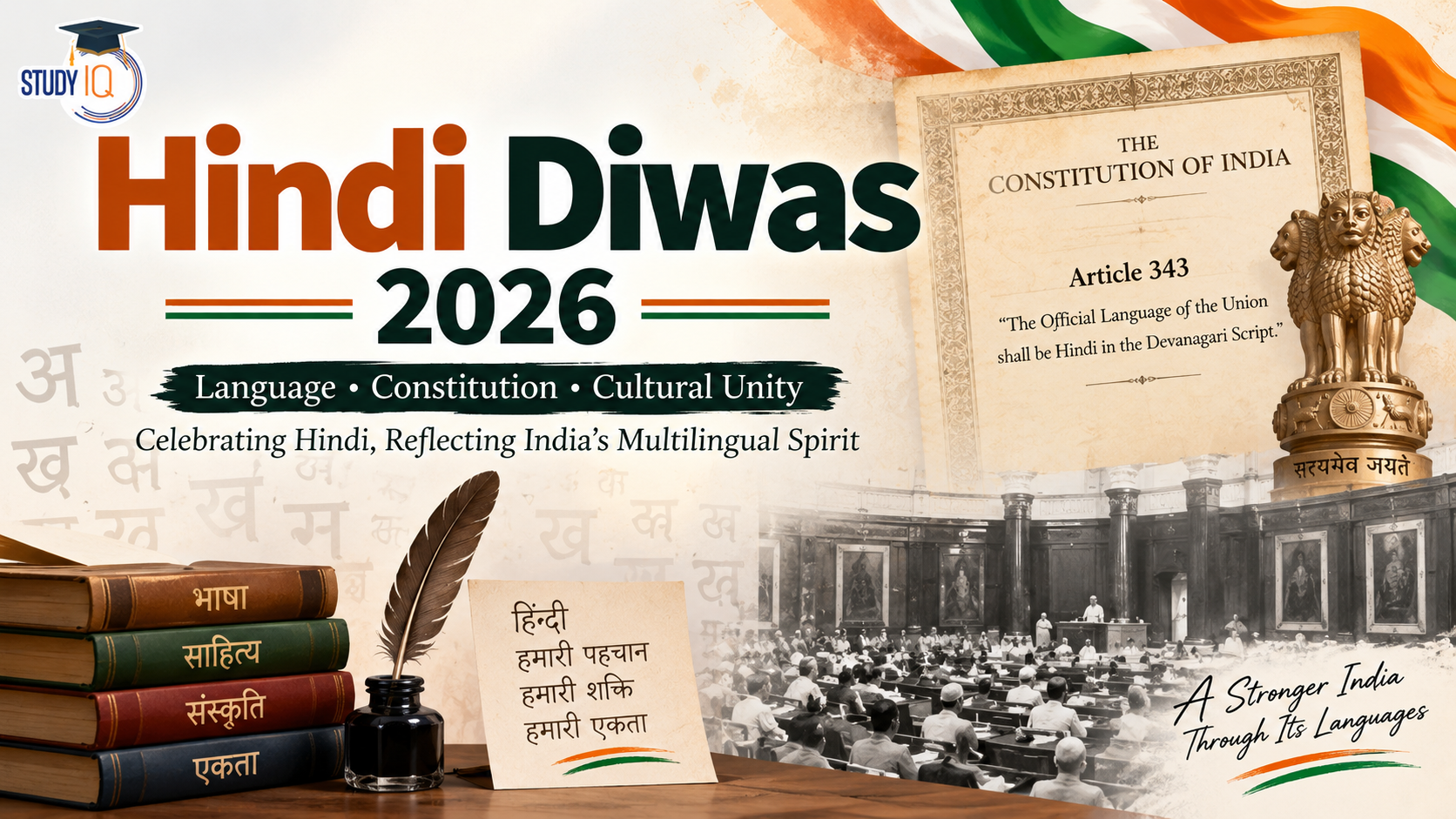
Hindi Diwas 2026 will be observed on September 14, marking a significant moment in India’s constitutional and linguistic history. On September 14, 1949, the Constituent Assembly adopted Hindi in the Devanagari script as the Official Language of the Union.
However, the story behind Hindi Diwas is more complex than the simple statement that “Hindi was made India’s language.” The language question was one of the most contentious issues debated during constitution-making. It involved questions of national identity, administrative continuity, regional diversity and the future role of English.
The eventual settlement was based on constitutional compromise rather than linguistic uniformity.
Read Also: UPSC Daily Current Affairs 2026
Why Is Hindi Diwas Celebrated on September 14?
Hindi Diwas is observed on September 14 because the Constituent Assembly took the crucial decision regarding the Official Language of the Union on September 14, 1949.
When the Constitution came into force on January 26, 1950, this arrangement was incorporated into the constitutional framework through Articles 343 to 351.
The day therefore commemorates not merely the Hindi language but a major constitutional decision through which independent India attempted to create a common administrative framework while accommodating its multilingual character.
What Happened on September 14, 1949?
The Constituent Assembly had been debating the language question for years.
The central issue was:
What should be the language of administration of the newly independent Indian Union?
Different positions emerged during the debate.
One section strongly supported Hindi in Devanagari script, while representatives from several non-Hindi-speaking regions expressed concerns about making Hindi dominant.
There was also a major question over whether English should continue after independence.
The debate therefore went far beyond language. It touched upon:
- National identity
- Federalism
- Regional aspirations
- Administrative continuity
- Cultural diversity
- Political representation
The final arrangement attempted to balance these competing interests.
The Munshi-Ayyangar Formula
The eventual compromise is associated with the Munshi-Ayyangar Formula, named after K. M. Munshi and N. Gopalaswami Ayyangar.
The broad framework provided for:
- Hindi in Devanagari script as the Official Language of the Union.
- Continued use of English for official purposes during the transition.
- Use of the international form of Indian numerals for Union purposes.
- A constitutional mechanism for the progressive development and promotion of Hindi.
This compromise helped bridge the divide between those seeking greater use of Hindi and those concerned about the immediate replacement of English.
Article 343: The Official Language of the Union
Article 343 is central to understanding Hindi Diwas.
It provides that:
The Official Language of the Union shall be Hindi in Devanagari script.
It also provided for the continued use of English for official purposes for a period of 15 years from the commencement of the Constitution, subject to the constitutional framework.
This is an important distinction for competitive examinations:
Hindi = Official Language of the Union
Hindi ≠ National Language of India
Is Hindi India’s National Language?
The Constitution of India does not declare any language as the National Language of India.
Hindi is the Official Language of the Union, while English continues to be used for official purposes under the statutory framework.
This distinction is frequently tested in UPSC and other competitive examinations.
Official Language vs National Language
| Term | Meaning |
|---|---|
| National Language | India has no constitutionally declared National Language |
| Official Language of Union | Hindi in Devanagari script |
| English | Continues to be used for official purposes |
| Article 343 | Deals with the Official Language of the Union |
| Article 351 | Deals with promotion and development of Hindi |
Why Did English Continue After 1965?
The Constitution initially envisaged a 15-year transition period, after which Hindi was expected to assume a greater role in Union administration.
However, English did not disappear in 1965.
The reasons included:
- Administrative dependence on English
- India’s linguistic diversity
- Concerns among non-Hindi-speaking states
- Political opposition to the compulsory replacement of English
- The practical need for a common link language in Union administration
The Official Languages Act, 1963, provided the statutory framework for the continued use of English alongside Hindi for official purposes.
Thus, India’s language policy evolved through accommodation rather than complete linguistic replacement.
Article 351 and the Development of Hindi
Article 351 is another important constitutional provision.
It directs the Union to promote the spread of Hindi and develop it so that it can serve as a medium of expression for India’s composite culture.
It also envisages drawing upon other Indian languages while enriching Hindi.
Therefore, Article 351 should not be viewed in isolation from India’s multilingual constitutional framework.
Hindi Diwas vs World Hindi Day
Hindi Diwas and World Hindi Day are two different observances.
| Basis | Hindi Diwas | World Hindi Day |
|---|---|---|
| Date | September 14 | January 10 |
| Focus | Hindi in India’s official and cultural sphere | International promotion of Hindi |
| Historical association | Constituent Assembly decision, 1949 | First World Hindi Conference, Nagpur, 1975 |
| First observed | 1953 | 2006 |
| Constitutional connection | Article 343 | No specific constitutional provision |
Significance of Hindi Diwas 2026
Hindi Diwas has both constitutional and cultural significance.
1. Constitutional significance
It recalls the Constituent Assembly’s decision concerning the Official Language of the Union.
2. Linguistic significance
It highlights the development and use of Hindi while recognising India’s wider linguistic diversity.
3. Cultural significance
Hindi has played a major role in Indian literature, cinema, journalism, education and public communication.
4. Administrative significance
The observance encourages greater use of Hindi in official work and promotes the objectives associated with the Rajbhasha framework.
5. Federal significance
The history of the language debate demonstrates the importance of accommodating regional linguistic aspirations in India’s federal system.
How Is Hindi Diwas Celebrated?
Government departments, educational institutions and other organisations conduct various activities, including:
- Hindi essay competitions
- Debates
- Poetry recitations
- Hindi quizzes
- Seminars and conferences
- Literary programmes
- Official-language awareness campaigns
- Rajbhasha awards
These activities seek to encourage the use and development of Hindi in public and institutional life.
Hindi Diwas 2026: UPSC Key Facts
For UPSC Prelims and Mains, remember these facts:
- September 14, 1949: Constituent Assembly adopted Hindi in Devanagari as the Official Language of the Union.
- January 26, 1950: Constitution came into force.
- Article 343: Official Language of the Union.
- Article 351: Promotion and development of Hindi.
- Official Languages Act, 1963: Important statutory framework for continued use of English for official purposes.
- 1953: Hindi Diwas was first observed.
- January 10: World Hindi Day.
- India has no National Language.
- The language settlement emerged through constitutional compromise and accommodation.

 Superalignment: Meaning, AI Safety, Weak...
 DILRMP 3.0 (2026–2031): Bhu-Aadhaar, G...
 Bakhira Lake: 25,000-Year Indian Monsoon...











 WhatsApp





