Table of Contents
Context
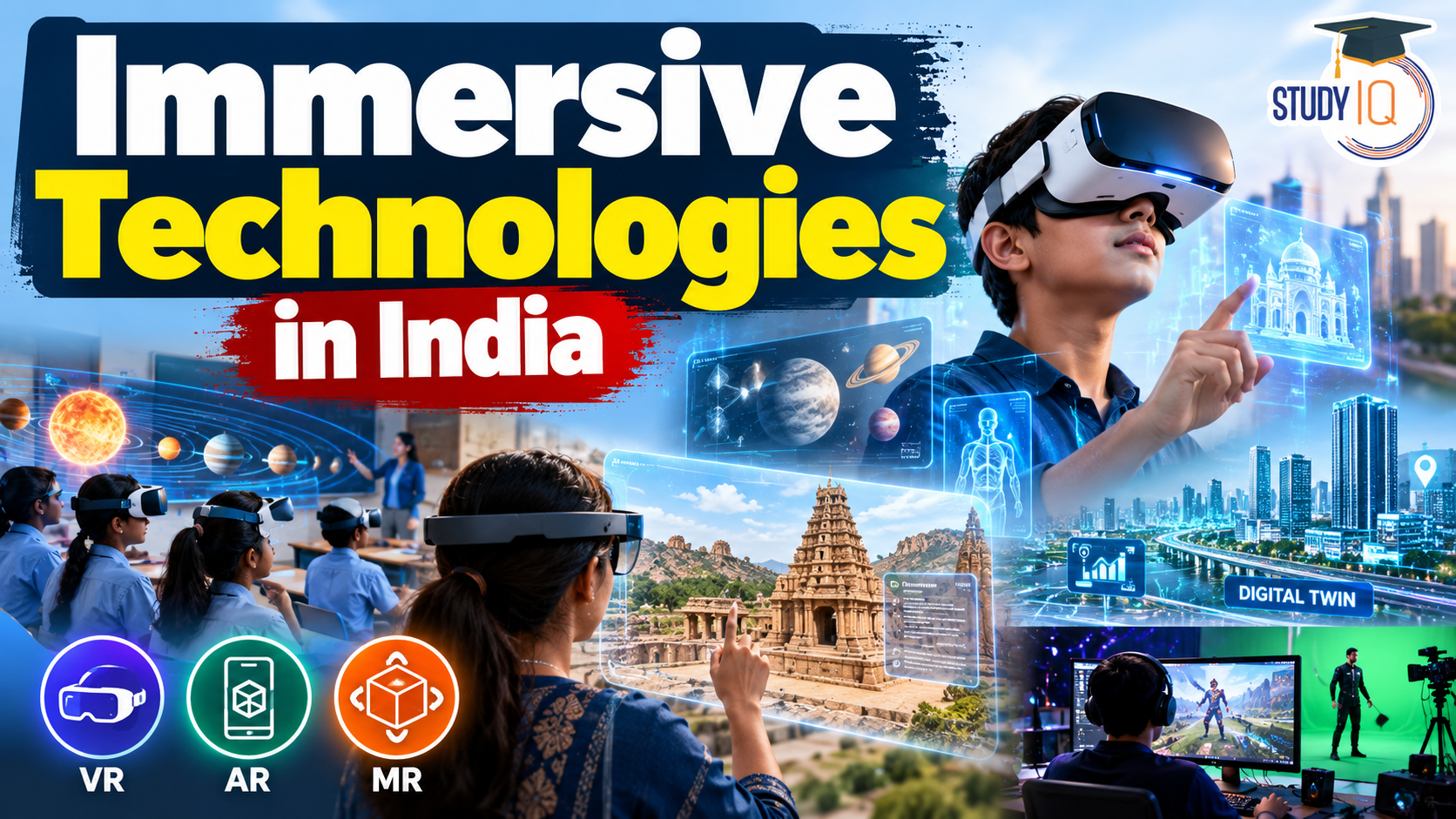
The Ministry of Information and Broadcasting is expanding India’s AVGC-XR ecosystem with ₹250 crore for Content Creator Labs in 15,500 institutions and the new IICT Mumbai. Immersive technologies (VR, AR and MR) blend the physical and virtual worlds, and India’s market is projected to grow from $1.26 billion (2023) to $7.82 billion (2030).
Read Also: UPSC Daily Current Affairs 2026
How can immersive technologies support India’s social and economic development?
Social Development
- Interactive Learning: 3D simulations turn abstract concepts into visual experience, which helps schools with few resources.
- Example: IIT Madras AR/VR modules for history, anatomy and planetary systems in rural schools.
- Cultural Preservation: Digitising monuments and artefacts in high-resolution virtual spaces protects heritage and gives people remote access to it.
- Example: Ministry of Culture’s JATAN software for national museum collections.
- Better Public Infrastructure and Services: Digital twins combine live 5G, IoT and mobility data to test city growth and public infrastructure before construction, which improves planning for traffic, transit and pilgrim movement.
- Example: DoT’s Sangam: Digital Twin initiative; Varanasi 3D spatial planning project; National Digital Twin of major cities by 2035.
Economic Development
- Creative Economy and Jobs: Virtual production, motion capture and indigenous gaming create jobs and Indian intellectual property.
- Example: UP’s AVGC-XR Park near Jewar airport; gaming industry projected to grow from $3.8 billion (2024) to $9.2 billion by FY29.
- Startup and Market Growth: Fast growth in demand creates room for deep-tech startups, especially outside metros.
- Example: Market growing at 29.8% CAGR, the fastest in Asia-Pacific; GENESIS supports 84 AR/VR startups.
- Tourism Boost: Immersive site visits widen the reach of heritage sites and attract more visitors.
- Example: AR virtual tours of Hampi and Nalanda.
What policy and institutional support exists for India’s AVGC-XR ecosystem?
- Grassroots Talent Pipeline: Content Creator Labs bring creative technology into schools and colleges, building early skills.
- Example: ₹250 crore in Union Budget 2026–27 for labs in 15,000 schools and 500 colleges.
- National Centre of Excellence: IICT Mumbai offers industry-linked training and coordinates the labs.
- Example: Set up in 2025 with global tech partners; 18 AVGC-XR professional courses.
- Deep-Tech Incubation: MeitY’s scheme targets innovation beyond metros.
- Example: GENESIS backs 84 AR/VR startups and 106 incubators in Tier-II and Tier-III cities.
- Startup Acceleration: A dedicated accelerator helps early-stage firms commercialise spatial computing and virtual production tools.
- Example: WaveX Media-Tech Incubator under the Ministry of Information and Broadcasting.
- State-Level Policies: States are building local infrastructure and funding.
- Example: Karnataka’s Policy 3.0 (KITVEN Fund); Maharashtra’s ₹3,268 crore roadmap to 2050; Tamil Nadu’s ELCOT Viyan hub-and-spoke model.
What challenges constrain the wider adoption of immersive technologies in India?
- High Cost and Import Reliance: Headsets, GPU servers and motion-capture rigs are costly and depend on foreign supply chains, which limits large-scale deployment.
- Example: High import duties on enterprise XR headsets hinder their use in government schools.
- Connectivity and Latency: High-quality VR and real-time digital twins need ultra-low-latency 5G, which is uneven across rural areas. This widens the digital divide the tools aim to reduce.
- Example: Rural classroom simulations facing lag and buffering on edge networks.
- Shortage of Spatial Talent: Few trained faculty and professionals exist in real-time 3D engines, spatial audio and computer vision, which slows quality content.
- Example: Studios struggle to hire for virtual production, shader programming and haptic design.
- Health and Safety Risks: Long headset use can cause cybersickness, eye strain and disorientation, so young users need strict guidelines.
- Example: Children facing motion sickness or eye strain in long classroom sessions.
- Data Privacy Risks: XR devices capture sensitive biometric, eye-tracking and spatial data, which needs clear rules on collection and use.
- Example: Eye-tracking and spatial mapping data under the Digital Personal Data Protection (DPDP) Act.
Way Forward
- Incentivise Domestic XR Hardware: Introduce a targeted PLI scheme for near-eye displays, spatial tracking sensors and affordable optical lenses to lower device costs.
- Integrate XR into Skilling: Add 3D engine programming, spatial design and digital asset modelling to NSQF vocational courses and engineering syllabi.
- Build an Open Digital Asset Repository: Create a royalty-free national repository of Indian artefacts, architecture and cultural environments to speed up domestic content production.
- Set Responsible XR Standards: Frame standards under the DPDP Act for biometric, eye-tracking and spatial data, and add health guidelines for young users.
- Move from Consumer to Exporter: Link school-level initiatives with manufacturing and startup incentives so that India exports XR hardware, creative IP and simulations, in line with Viksit Bharat 2047.

 IUCN Coral Reef Assessment 2026: Key Fin...
 K9 Vajra Howitzer: Features, Range, Indi...
 Food Colouring: Types, Banned Dyes, FSSA...











 WhatsApp