
Table of Contents
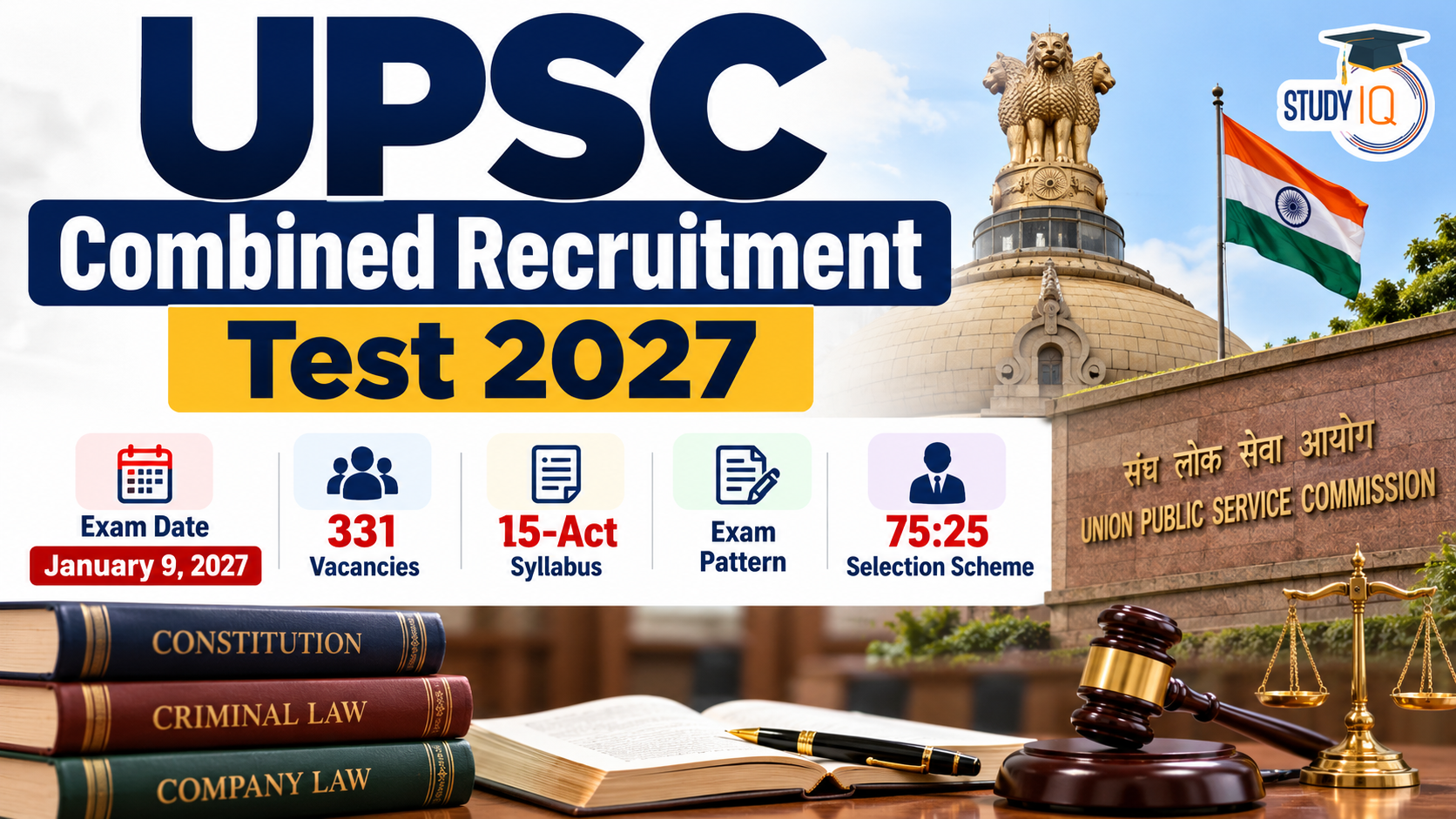
The Union Public Service Commission (UPSC) has announced January 9, 2027, as the date for the UPSC Combined Recruitment Test (CRT) for 16 categories of legal, prosecution and intellectual property posts covered under various recruitment advertisements issued in 2025 and 2026. The examination will be conducted in offline pen-and-paper mode from 2:00 PM to 4:00 PM.
According to the supplied recruitment notice, the combined examination covers 331 vacancies, including 140 Assistant Public Prosecutor (APP) posts in the Government of NCT of Delhi and 100 Examiner of Trade Marks and Geographical Indications posts under the Ministry of Commerce and Industry.
The recruitment test is particularly important for law graduates and eligible legal professionals preparing for government legal services, prosecution positions and intellectual property-related posts.
UPSC Combined Recruitment Test 2027: Overview
The following table provides the key details of the UPSC Combined Recruitment Test 2027.
| Particulars | Details |
|---|---|
| Exam Conducting Body | Union Public Service Commission (UPSC) |
| Examination Name | Combined Recruitment Test (CRT) |
| Exam Date | January 9, 2027 |
| Exam Day | Saturday |
| Exam Timing | 2:00 PM to 4:00 PM |
| Total Vacancies | 331 |
| Post Categories Covered | 16 |
| Examination Mode | Offline, pen-and-paper |
| Question Type | Objective-type MCQs |
| Exam Medium | English |
| Negative Marking | One-third of the marks assigned to a question for each wrong answer |
| Final Selection Weightage | 75% CRT and 25% Interview |
| Admit Card | Expected around December 19, 2026, based on the three-week release schedule stated in the supplied notice |
Candidates should check the official UPSC notice and subsequent updates for any changes to the examination schedule or recruitment conditions.
UPSC CRT Exam Date 2027
The UPSC Combined Recruitment Test is scheduled for January 9, 2027 (Saturday). The examination will take place from 2:00 PM to 4:00 PM and will use an offline objective-type question paper.
The combined examination brings together multiple legal recruitment processes under a common written screening stage. Candidates who applied for the covered posts should review the relevant recruitment advertisement and the official addendum to understand the requirements applicable to their position.
UPSC CRT Admit Card 2027
As stated in the supplied notice, e-admit cards are scheduled to be released approximately three weeks before the examination. Based on the January 9, 2027, exam date, candidates can expect their release around December 19, 2026.
Candidates should visit the official UPSC website to check the admit card announcement, download their e-admit card and verify their examination centre and other instructions.
UPSC Combined Recruitment Test 2027: Vacancy Details
The combined recruitment covers 331 vacancies across 16 post categories in central government departments and the Government of NCT of Delhi.
The major vacancies include:
| Post Name | Vacancies |
|---|---|
| Assistant Public Prosecutor (Delhi) | 140 |
| Examiner of Trade Marks and Geographical Indications | 100 |
| Company Prosecutor | 18 |
| Assistant Legal Adviser | 16 |
| Deputy Legal Adviser | 12 |
| Assistant Legal Adviser, Directorate of Enforcement | 12 |
| Legal Officer, DGCA | 12 |
| Additional Government Advocate | 5 |
| Assistant Public Prosecutor, CBI | 5 |
| Assistant Public Prosecutor, Puducherry | 5 |
Other posts include Additional Legal Adviser, Deputy Government Advocate, Assistant Government Advocate, Prosecutor in the Serious Fraud Investigation Office (SFIO), Superintendent (Legal) and Law Officer (Delhi).
The vacancy figures above are drawn from the supplied recruitment material. Candidates should consult the official notification for the complete category-wise distribution and post-specific eligibility conditions.
UPSC CRT 2027: Complete List of 16 Post Categories
The examination covers legal positions across several ministries, departments and government organisations.
| S. No. | Post Category | Department/Organisation |
|---|---|---|
| 1 | Additional Legal Adviser | Department of Legal Affairs |
| 2 | Assistant Legal Adviser | Department of Legal Affairs |
| 3 | Deputy Legal Adviser | Department of Legal Affairs |
| 4 | Additional Government Advocate | Department of Legal Affairs |
| 5 | Assistant Government Advocate | Department of Legal Affairs |
| 6 | Deputy Government Advocate | Department of Legal Affairs |
| 7 | Examiner of Trade Marks and Geographical Indications | Ministry of Commerce and Industry |
| 8 | Prosecutor in SFIO | Ministry of Corporate Affairs |
| 9 | Assistant Legal Adviser (ED) | Directorate of Enforcement |
| 10 | Company Prosecutor | Ministry of Corporate Affairs |
| 11 | Legal Officer (DGCA) | Directorate General of Civil Aviation |
| 12 | Assistant Public Prosecutor (Puducherry) | Government of Puducherry |
| 13 | Superintendent (Legal) | Legislative Department |
| 14 | Assistant Public Prosecutor (CBI) | Central Bureau of Investigation |
| 15 | Assistant Public Prosecutor (Delhi) | Government of NCT of Delhi |
| 16 | Law Officer (Delhi) | Land and Building Department, Delhi |
UPSC Combined Recruitment Test 2027: Exam Pattern
The written examination is an important component of the final selection process. Candidates should understand the test format, negative marking and interview requirements before beginning their preparation.
Key Features of the Exam Pattern
-
Duration: Two hours, from 2:00 PM to 4:00 PM.
-
Question format: Objective-type multiple-choice questions.
-
Mode: Offline pen-and-paper examination.
-
Language: English only.
-
Negative marking: One-third of the marks assigned to a question for every incorrect answer.
-
Unattempted questions: No penalty, according to the supplied material.
Negative marking makes accuracy an important part of preparation. Candidates should practise timed mock tests and avoid making guesses when they lack sufficient confidence in an answer.
UPSC CRT Selection Process: 75:25 Weightage
According to the supplied notice, the Combined Recruitment Test and Interview carry the following weightage in the final merit assessment:
| Selection Component | Weightage |
|---|---|
| Combined Recruitment Test | 75% |
| Interview | 25% |
The written test therefore has a substantial role in determining the final outcome. However, qualifying the written examination alone does not guarantee selection.
The supplied material also specifies minimum interview suitability marks as follows:
-
General/EWS: 50 marks or above
-
OBC: 45 marks or above
-
SC/ST/PwBD: 40 marks or above
Candidates should verify the applicable interview standards in the official UPSC addendum.
UPSC CRT Syllabus 2027: All 15 Acts and Legislations
The supplied recruitment material identifies 15 statutes and legal frameworks for the combined test. These can be organised into four broad subject areas for systematic preparation.
1. Constitution and Criminal Laws
This group covers the Constitution of India and the three new criminal laws introduced in 2023.
-
Constitution of India
-
Bharatiya Nyaya Sanhita (BNS), 2023
-
Bharatiya Sakshya Adhiniyam (BSA), 2023
-
Bharatiya Nagarik Suraksha Sanhita (BNSS), 2023
Candidates should revise constitutional provisions, criminal offences, procedural requirements, evidence rules and relevant statutory sections. Particular attention should be given to electronic evidence, investigation procedures and important provisions of the new criminal codes.
2. Anti-Corruption, Money Laundering and Investigative Agencies
This section focuses on laws governing corruption, financial crimes and investigative authorities.
-
Prevention of Corruption Act, 1988
-
Central Vigilance Commission Act, 2003
-
Prevention of Money Laundering Act (PMLA), 2002
-
Delhi Special Police Establishment Act, 1946
Preparation should cover statutory powers, investigation procedures, prosecution sanctions, attachment of property, arrest provisions and the relationship between the CVC and the CBI.
3. Corporate, Commercial and Cyber Laws
The third cluster includes important legislation relating to companies, competition, contracts and information technology.
-
Companies Act, 2013
-
Competition Act, 2002
-
Indian Contract Act, 1872
-
Information Technology Act, 2000
Important areas include corporate investigations, company offences, anti-competitive agreements, abuse of dominant position, contract principles, cyber offences and intermediary liability.
4. Intellectual Property and Environmental Laws
The final cluster covers intellectual property rights and environmental regulation.
-
Trade Marks Act, 1999
-
Geographical Indications of Goods (Registration and Protection) Act, 1999
-
Environment (Protection) Act, 1986
Candidates should revise trademark registration and infringement, geographical indication protection, authorised users, environmental regulatory powers and statutory penalties.
How to Prepare for UPSC CRT 2027
With the examination scheduled for January 9, 2027, candidates can use a structured preparation strategy to cover the prescribed legislation and improve their performance in objective questions.
Step 1: Prioritise the New Criminal Laws
Begin with the Constitution of India, BNS, BNSS and BSA. Focus on important sections, definitions, procedural timelines, admissibility of evidence and distinctions between related provisions.
Step 2: Revise All 15 Statutes
Do not restrict preparation to criminal law alone. The combined syllabus also covers corporate law, intellectual property, competition law, anti-corruption legislation and environmental regulation.
Create concise revision notes containing important sections, statutory authorities, penalties, exceptions and procedural requirements.
Step 3: Practise Objective Questions
Solve MCQs based on statutory provisions and legal concepts. After every practice session, analyse incorrect answers and revisit the relevant sections.
Because the test includes negative marking, accuracy should be a central part of the preparation strategy.
Step 4: Take Full-Length Mock Tests
Practise two-hour mock examinations under timed conditions. Use these tests to improve speed, question selection and time management.
Review performance after each test and identify weak areas that require additional revision.
Step 5: Prepare for the Interview
The interview carries 25% weightage under the selection scheme described in the supplied notice. Candidates should prepare to discuss their legal knowledge, professional experience where relevant, role-specific responsibilities and understanding of the department to which they have applied.
UPSC CRT 2027: Examination Centres
According to the supplied material, the examination will be conducted in the following 15 cities:
-
Ahmedabad
-
Bhopal
-
Mumbai
-
Kolkata
-
Delhi
-
Dispur/Guwahati
-
Jaipur
-
Chennai
-
Nagpur
-
Kochi
-
Lucknow
-
Jammu
-
Port Blair
-
Ranchi
-
Visakhapatnam
The supplied notice states that requests for changing the examination centre will not be entertained. Candidates should therefore check their allotted centre carefully once their admit cards are released.
Read Also: Judiciary Current Affairs
 UP Bar Council Mandatory 6-Month Interns...
 RPSC APO Result 2026 Out: Merit List PDF...
 CG ADPO 2026 Answer Key (Set A): Answer ...







 WhatsApp






