Table of Contents
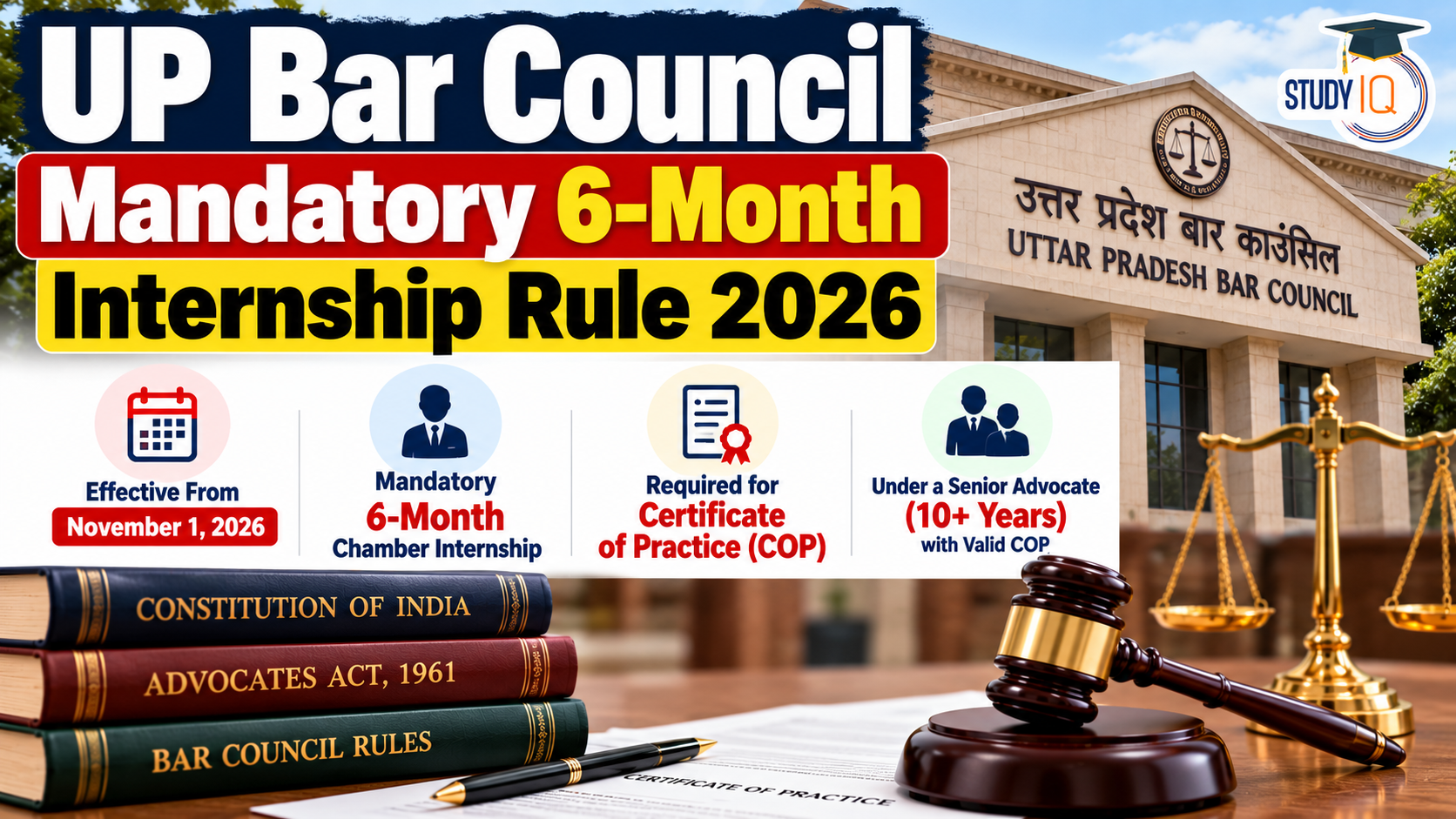
The Bar Council of Uttar Pradesh has announced a mandatory six-month chamber internship for newly enrolled advocates seeking a Certificate of Practice (COP), according to the supplied article. The measure is intended to strengthen practical legal training and prevent fraudulent practice certificates.
-
Issuing Authority: Bar Council of Uttar Pradesh, Prayagraj
-
Announcement Date: October 27, 2026
-
Effective Date: November 1, 2026
-
Mandatory Training: Six months
-
Training Supervisor: Advocate with at least 10 years of practice and a valid COP
-
Maximum Trainees: Two per qualifying advocate per calendar year
-
Certificate Verification: By a member of the UP Bar Council
-
Exemption: Advocates who applied for their COP before November 1, 2026, according to the supplied article.
Key Provisions of the New COP Rule
1. Mandatory Six-Month Chamber Training
-
Newly enrolled advocates must complete six months of supervised chamber training after registration.
-
Training must be completed before applying for a COP.
-
A verified training completion certificate must be uploaded with the COP application.
2. Eligibility of Supervising Advocates
The supervising advocate must:
-
Have at least 10 years of legal practice.
-
Hold a valid Certificate of Practice.
-
Issue the completion certificate on official letterhead.
-
Comply with the annual limit of two trainee certificates.
3. Certificate Verification Process
The prescribed process includes:
-
Complete six months of chamber training.
-
Obtain a completion certificate from the supervising advocate.
-
Get the certificate verified by a member of the Bar Council of Uttar Pradesh.
-
Upload the verified certificate while applying for the COP.
4. Exemption for Existing Applicants
Advocates who submitted their COP applications before November 1, 2026, are stated to be exempt from the new requirement.
Legal Basis: Advocates Act and Supreme Court Judgments
The supplied article discusses several legal provisions and judgments relevant to the rule.
-
Section 24, Advocates Act, 1961: Deals with qualifications for admission to a State Roll.
-
Section 28(2): Relevant to the approval of State Bar Council rules by the Bar Council of India.
-
Section 49(1)(ah): Concerns the Bar Council of India’s authority to prescribe conditions governing the right to practise.
Important judgments discussed include:
-
V. Sudeer v. Bar Council of India (1999): Addressed the legality of mandatory pre-enrolment training rules.
-
Bar Council of India v. Bonnie Foi Law College (2023): Examined the regulatory authority of the Bar Council regarding conditions for practising law.
Important legal clarification: The supplied article states that the UP Bar Council introduced the measure in anticipation of approval from the Bar Council of India. Its final enforceability should therefore be assessed against the official resolution, applicable statutory requirements and any subsequent judicial or regulatory developments.
Impact on Judiciary Aspirants
The proposed training requirement may have practical implications for candidates preparing for judicial services and prosecution examinations.
-
PCS-J aspirants: May need to maintain clear records of enrolment and legal practice, subject to applicable recruitment rules.
-
APO and APP aspirants: Should separately check the experience requirements in their respective recruitment notifications.
-
First-generation lawyers: May face difficulties finding eligible chamber supervisors because of the two-trainee annual cap.
-
New advocates: Should preserve enrolment documents, training records and verified certificates.
The supplied article also discusses the Supreme Court’s Bhumika Trust v. Union of India judgment in relation to judicial service practice requirements. Candidates should verify the applicable judgment and state-specific recruitment rules before relying on these requirements.
Read Also: Judiciary Current Affairs
 UPSC Combined Recruitment Test 2027: Exa...
 RPSC APO Result 2026 Out: Merit List PDF...
 CG ADPO 2026 Answer Key (Set A): Answer ...





 WhatsApp