
Table of Contents
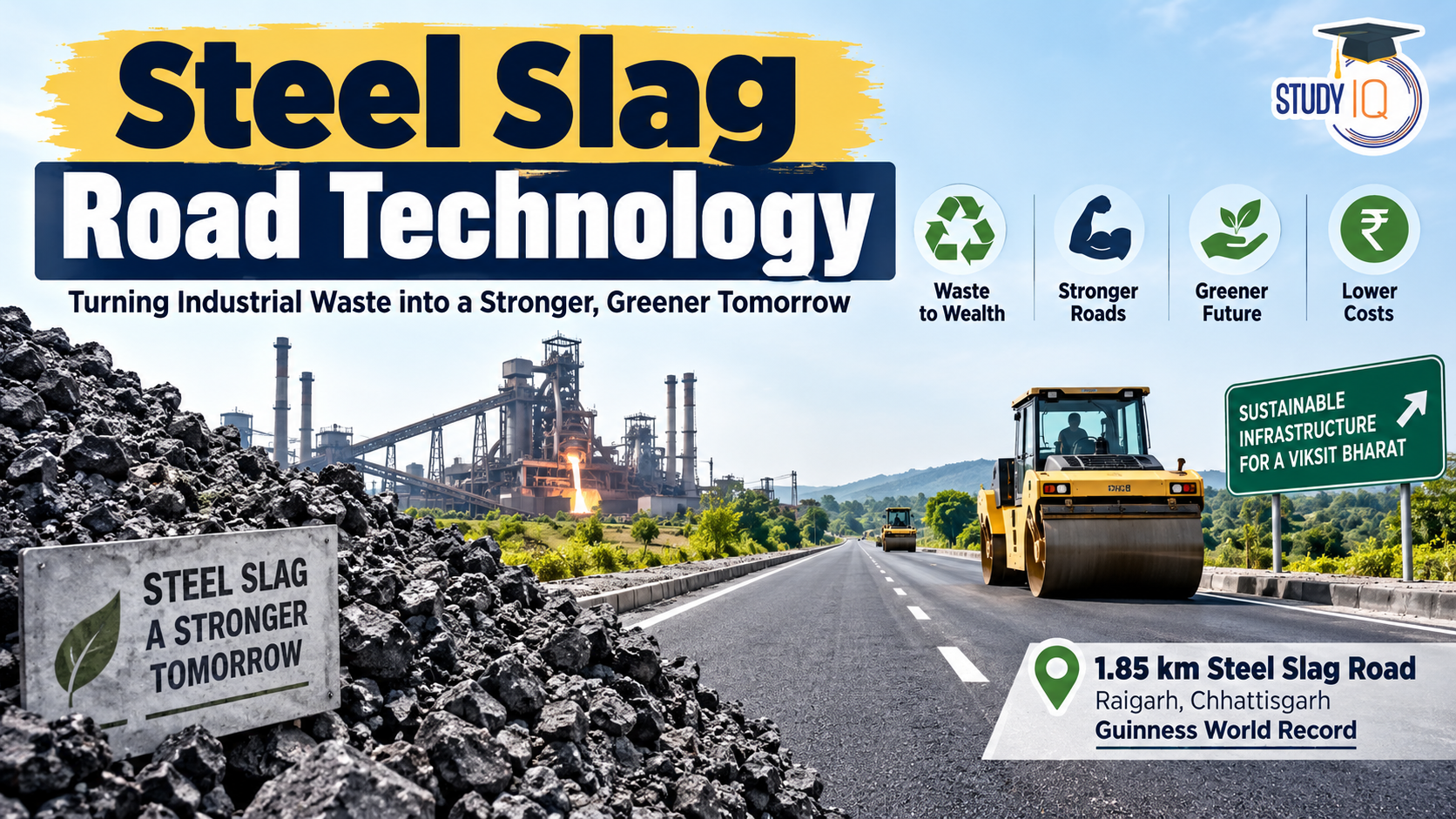
India has achieved a Guinness World Record for the world’s longest steel slag road, marking an important step towards sustainable and resource-efficient infrastructure.
The 1.85-km steel slag road in Raigarh, Chhattisgarh, demonstrates how an industrial by-product of steelmaking can be converted into a useful construction material. The technology supports India’s broader waste-to-wealth approach by reducing dependence on conventional natural aggregates.
Read Also: UPSC Daily Current Affairs 2026
What is Steel Slag?
Steel slag is an industrial by-product generated during the steel manufacturing process. It is produced primarily in:
- Electric Arc Furnaces (EAF)
- Basic Oxygen Furnaces (BOF)
It contains various mineral components, including calcium, magnesium, manganese and aluminium silicates and oxides.
The method and rate of cooling of molten slag influence its physical and chemical properties, thereby determining its suitability for different applications.
What is Steel Slag Road Technology?
Steel Slag Road Technology involves processing and converting steel slag into road aggregates that can substitute conventional natural aggregates used in road construction.
The technology has been developed by the CSIR-Central Road Research Institute (CSIR-CRRI) with participation from the private sector.
Instead of treating steel slag merely as industrial waste, the technology transforms it into a value-added construction material.
Key Features of Steel Slag Roads
1. Reduction in Construction Cost
Steel slag aggregates can help reduce road construction costs by around 40%, depending on project conditions and material availability.
2. Higher Strength
Steel slag roads can provide around four times the strength of conventional roads in suitable applications, making them potentially more durable under heavy traffic.
3. Longer Maintenance Cycle
The maintenance cycle can extend to around 15 years in suitable applications, helping reduce the frequency of road repairs and associated costs.
4. Sustainable Use of Industrial Waste
The technology converts a steelmaking by-product into a useful infrastructure material, supporting the circular economy and the principle of waste-to-wealth.
5. Reduced Dependence on Natural Aggregates
Using processed steel slag can reduce the requirement for conventional natural aggregates, helping conserve natural resources.
Raigarh Steel Slag Road: Why is it Important?
The 1.85-km road in Raigarh, Chhattisgarh, is significant because it demonstrates the potential for large-scale use of processed steel slag in road infrastructure.
The project provides an example of how industrial waste generated by India’s expanding steel sector can be integrated into infrastructure development.
It also highlights the potential convergence of:
Steel Industry → Industrial Waste → Processing → Road Aggregates → Sustainable Infrastructure
Environmental Significance
Steel slag road technology can contribute to sustainable development in several ways:
- Promotes industrial waste utilisation
- Supports resource efficiency
- Reduces dependence on natural aggregates
- Encourages circular economy practices
- Converts waste into an economically useful resource
- Can lower the long-term maintenance burden of roads
Challenges and Limitations
Despite its potential, steel slag cannot be used indiscriminately in every road project. Its composition, cooling process, processing quality and engineering properties need to be carefully evaluated.
Proper treatment and quality control are essential to ensure that the material meets the required standards for road construction.

 World Circular Economy Forum 2026: India...
 SAWEN and Kathmandu Declaration: Strengt...
 Daily Mains Articles 2026 – Updated Da...














 WhatsApp





