
Table of Contents
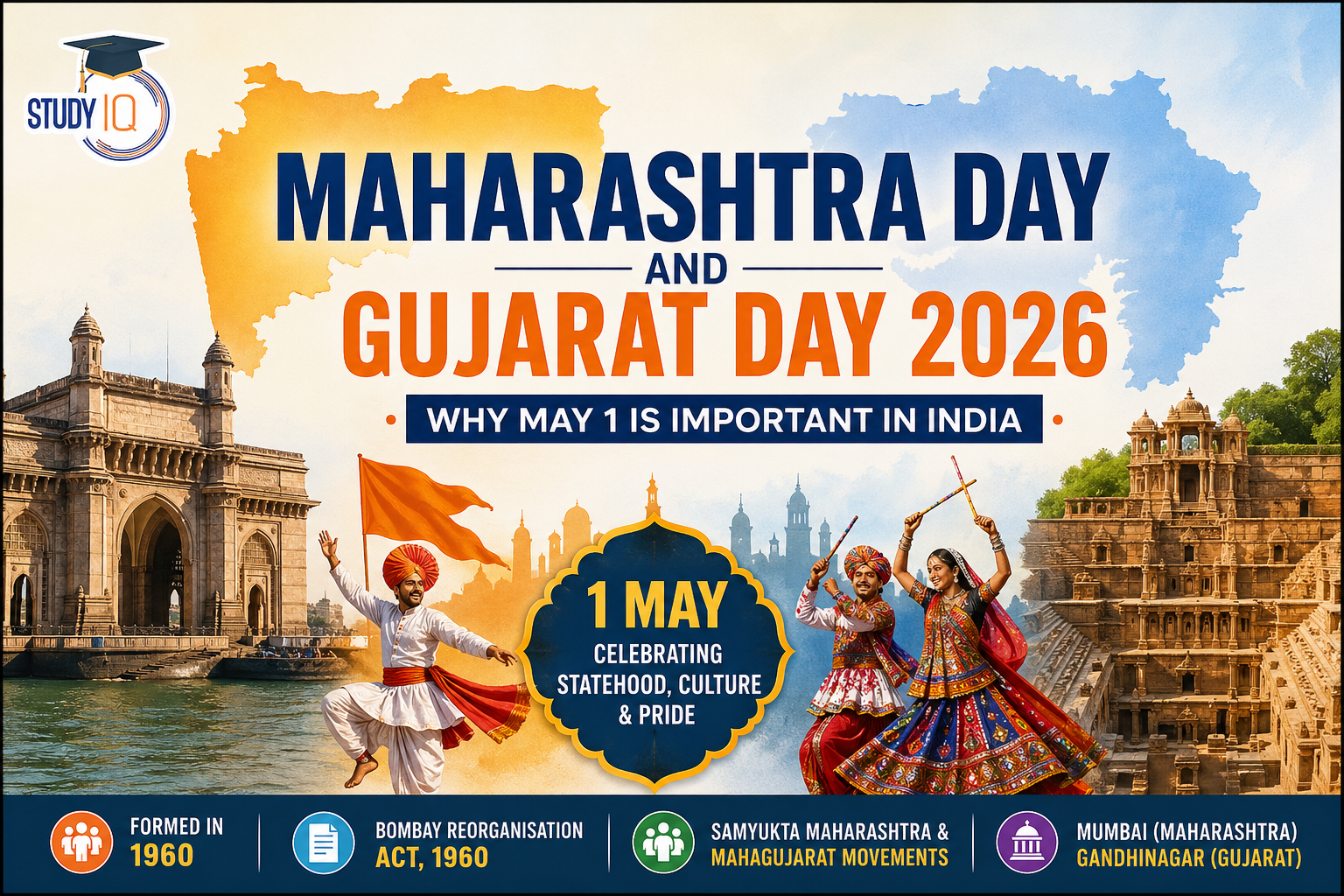
Every year on May 1, India celebrates Maharashtra Day and Gujarat Day, marking the creation of two prominent states—Maharashtra and Gujarat—in 1960. This date is a landmark in India’s political history as it reflects the country’s shift toward linguistic reorganisation of states. The day is not only about statehood but also about cultural pride, democratic aspirations, and administrative efficiency. Adding another layer of importance, May 1 is also observed globally as International Workers’ Day, linking regional celebrations in India with the global recognition of workers’ rights.
UPSC Daily Current Affairs 2026
Historical Background
The Context After Independence
After India gained independence in 1947 and adopted its Constitution in 1950, the newly formed nation faced the challenge of reorganising its internal boundaries. The British-era provinces were not designed with linguistic or cultural coherence in mind. As a result, there was increasing demand across the country for states to be reorganised based on language, which was seen as a natural basis for administrative convenience and cultural representation.
One such complex region was the Bombay State. This state included a diverse population speaking Marathi, Gujarati, Konkani, and Kutchi. While this diversity was culturally rich, it led to administrative inefficiencies and growing dissatisfaction among linguistic groups who felt underrepresented.
Rise of Linguistic Movements
Samyukta Maharashtra Movement
The Samyukta Maharashtra Movement emerged as a powerful force demanding a separate state for Marathi-speaking people. One of its central demands was that Mumbai (then Bombay) should be included in Maharashtra, given its cultural and economic ties with the Marathi population.
The movement witnessed large-scale protests, strikes, and demonstrations. It became a symbol of regional identity and political assertion. Many activists sacrificed their lives during the agitation, making it one of the most significant linguistic movements in India’s history.
Mahagujarat Movement
Parallel to this, the Mahagujarat Movement demanded the creation of a separate state for Gujarati-speaking people. The movement gained momentum through public mobilization, political advocacy, and widespread support from the Gujarati community.
Together, these movements highlighted the growing importance of linguistic identity in India’s democratic framework and forced the central government to reconsider its administrative structure.
The Bombay Reorganisation Act, 1960
The persistent demands of these movements led to the enactment of the Bombay Reorganisation Act, 1960. This law came into effect on May 1, 1960, officially dividing Bombay State into two separate states:
- Maharashtra for Marathi-speaking people
- Gujarat for Gujarati-speaking people
This division was a crucial step in India’s broader process of linguistic reorganisation, which had already begun with the formation of Andhra Pradesh in 1953 and the States Reorganisation Act of 1956.
Capitals and Administrative Evolution
Following the bifurcation:
- Mumbai was designated as the capital of Maharashtra. It remained India’s financial capital and a major cultural hub.
- Ahmedabad initially served as the administrative center of Gujarat.
- Later, a planned city, Gandhinagar, was developed and became the permanent capital of Gujarat.
This administrative restructuring ensured better governance and representation for both linguistic groups.
Significance of Maharashtra Day and Gujarat Day
1. Celebration of Linguistic Identity
The formation of Maharashtra and Gujarat validated the principle that language plays a crucial role in governance and identity. It allowed people to interact with administration in their native language, enhancing accessibility and participation.
2. Strengthening Federalism
The division of Bombay State is a classic example of Indian federalism in action. It demonstrated that the central government could respond to regional aspirations while maintaining national unity.
3. Tribute to People’s Movements
Both days honor the sacrifices of those who participated in the Samyukta Maharashtra and Mahagujarat movements. These movements showed the power of democratic protest in shaping public policy.
4. Cultural Pride and Heritage
Maharashtra Day and Gujarat Day are occasions to celebrate rich cultural traditions:
- Maharashtra showcases Marathi literature, Lavani dance, and historical legacy.
- Gujarat highlights Garba, folk traditions, and vibrant cultural expressions.
These celebrations reinforce cultural identity while promoting unity.
5. Administrative Efficiency
By creating linguistically homogeneous states, governance became more efficient. Policies could be tailored to local needs, improving development outcomes.
6. Link with International Workers’ Day
May 1 is also globally recognized as International Workers’ Day, commemorating the achievements of the labour movement. This adds a broader dimension to the celebrations, connecting statehood with social justice and workers’ rights.
How the Day Is Celebrated
In Maharashtra
- Grand parades in Mumbai
- Cultural performances and traditional attire
- Government ceremonies and awards
- Flag hoisting and public events
In Gujarat
- State-level celebrations and official functions
- Cultural programs showcasing Gujarati traditions
- Public participation in festivals and events
Both states observe the day as a public holiday, with schools, government offices, and many businesses remaining closed.
Maharashtra Day and Gujarat Day 2026: Key Highlights
- Date: May 1, 2026
- Occasion: Formation of Maharashtra and Gujarat
- Law: Bombay Reorganisation Act, 1960
- Basis: Linguistic reorganisation
- Capitals: Mumbai (Maharashtra), Gandhinagar (Gujarat)
- Global Significance: Coincides with International Workers’ Day
Broader Context: Linguistic Reorganisation in India
The creation of Maharashtra and Gujarat was part of a larger trend of linguistic reorganisation in India. The demand for such reorganisation began soon after independence and was fueled by the belief that language is a key factor in identity and governance.
The States Reorganisation Commission (1953–1955) played a crucial role in recommending the reorganisation of states based on linguistic lines. While the commission addressed many regions, the case of Bombay State remained contentious due to competing claims over Mumbai and economic considerations.
The eventual division in 1960 resolved these tensions and set a precedent for accommodating regional aspirations within a unified national framework.
Conclusion
Maharashtra Day and Gujarat Day are more than just anniversaries of state formation. They represent a crucial phase in India’s journey toward a more inclusive and responsive federal structure. The events of May 1, 1960, underscore the importance of linguistic identity, democratic movements, and administrative reform in shaping modern India.
Celebrated alongside International Workers’ Day, this date symbolizes not only regional pride but also the broader ideals of equality, representation, and social justice. As India continues to evolve, the legacy of Maharashtra Day and Gujarat Day serves as a reminder of the nation’s ability to adapt and grow while respecting its rich diversity.
 Daily Current Affairs PDF 2026: Download...
 Asian Elephant: Population, Project Elep...
 International Day for South-South Cooper...









 WhatsApp





