
Table of Contents
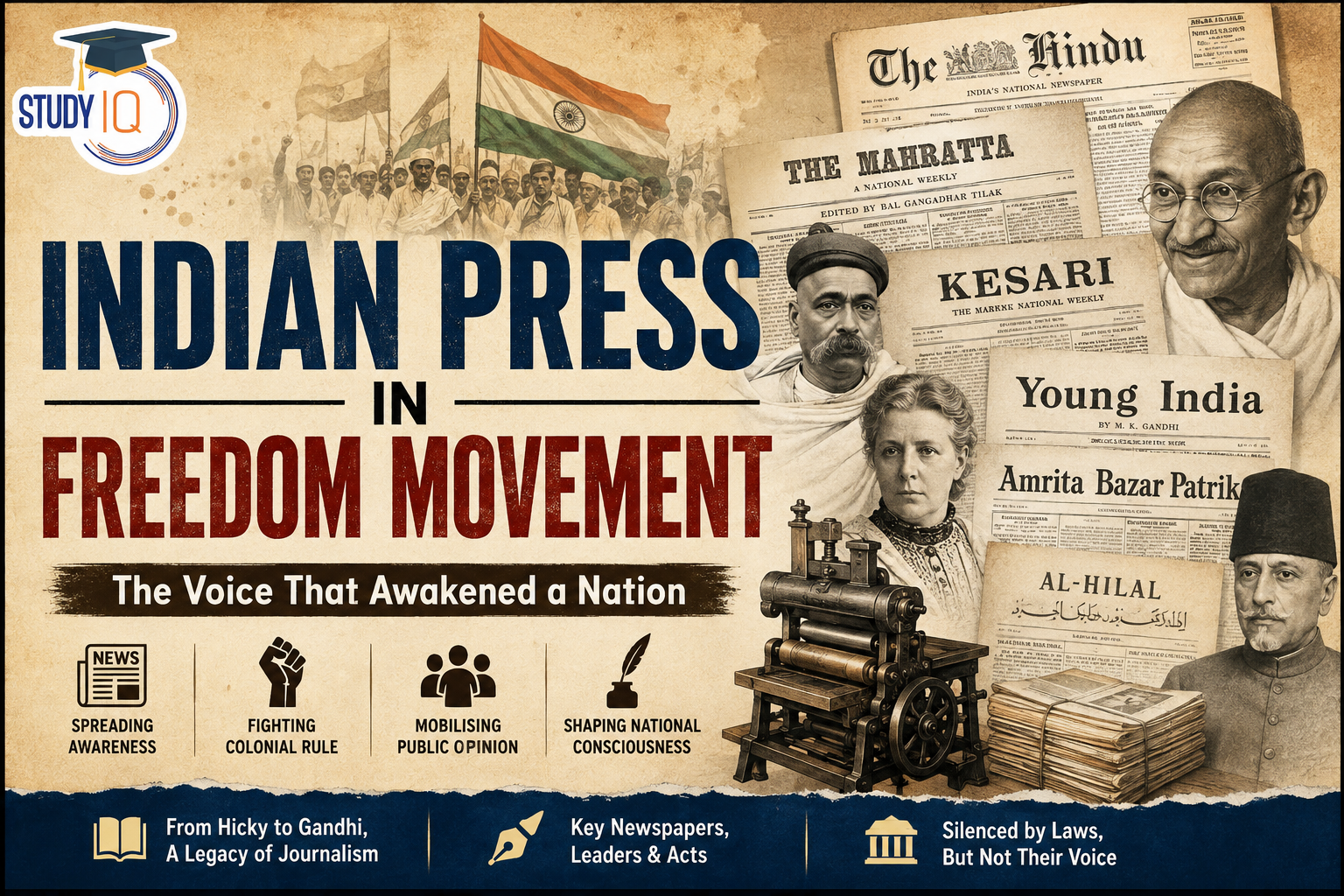
The history of the Indian press and the freedom movement is deeply interconnected. During British rule, newspapers were not simply sources of news. They became platforms for political debate, social reform and resistance to colonial authority.
As literacy and printing expanded during the nineteenth century, newspapers in English as well as Indian languages reached increasingly wider audiences. They discussed issues such as economic exploitation, racial discrimination, excessive taxation, famines, administrative failures and restrictions on civil liberties.
The colonial government recognised the political influence of newspapers and repeatedly attempted to control them through censorship, security deposits, confiscation and prosecution. Official archival material records that books, pamphlets, periodicals, newspapers and handbills were among the publications proscribed by the colonial government.
Thus, the nationalist press became an important weapon in India’s struggle for independence.
Evolution of the Indian Press
The beginning of modern journalism in India is generally associated with Hicky’s Bengal Gazette, established by James Augustus Hicky in 1780. Although it was not a nationalist newspaper in the later sense, its emergence marked an important stage in the development of the Indian newspaper press.
During the nineteenth century, Indian-owned publications gradually became more influential.
Social reformers and early nationalists realised that newspapers could:
- Educate the public
- Criticise colonial policies
- Promote social reform
- Develop political consciousness
- Encourage national unity
- Mobilise people around political causes
The press therefore became an important bridge between political leaders and the wider population.
Important Newspapers and Journals of the Freedom Movement
| No. | Newspaper / Journal | Associated Leader / Founder | Language | Major Role / Significance |
|---|---|---|---|---|
| 1 | Sambad Kaumudi | Raja Rammohan Roy | Bengali | Promoted social reform, political awareness and public debate; an important early platform for developing social and political consciousness. |
| 2 | Mirat-ul-Akhbar | Raja Rammohan Roy | Persian | Raised issues of political reform and freedom of expression; Roy opposed colonial restrictions on the press. |
| 3 | Kesari | Bal Gangadhar Tilak | Marathi | Criticised colonial policies and promoted political awakening, Swaraj and mass mobilisation. |
| 4 | The Mahratta | Bal Gangadhar Tilak | English | Took Tilak’s nationalist ideas to a wider English-reading audience and supported assertive nationalism. |
| 5 | Amrita Bazar Patrika | Sisir Kumar Ghosh & Motilal Ghosh | Bengali → English | Became a major nationalist newspaper; famously switched to English in the context of the Vernacular Press Act, 1878. |
| 6 | The Hindu | G. Subramania Iyer and others | English | Provided a platform for political debate, criticism of colonial policies and public opinion in South India. |
| 7 | The Bengalee | Surendranath Banerjea | English | Promoted political awareness, constitutional reform and greater Indian participation in administration. |
| 8 | Vande Mataram | Sri Aurobindo | English | Represented assertive nationalism and played an important role during the Swadeshi Movement after the Partition of Bengal (1905). |
| 9 | New India | Annie Besant | English | Promoted Home Rule, self-government and political education, particularly during the Home Rule Movement. |
| 10 | Young India | Mahatma Gandhi | English | Communicated ideas of Satyagraha, non-violence, Swaraj, Swadeshi and Civil Disobedience. |
| 11 | Navajivan | Mahatma Gandhi | Gujarati | Communicated Gandhi’s political, social and reformist ideas to Gujarati-speaking readers. |
| 12 | Harijan | Mahatma Gandhi | English | Focused strongly on social reform, removal of untouchability and constructive work, alongside nationalist issues. |
| 13 | Al-Hilal | Maulana Abul Kalam Azad | Urdu | Spread anti-colonial nationalism and political awareness among Urdu-speaking readers; challenged British rule. |
Major Press Laws Under British Rule
The growth of nationalist journalism led the colonial government to introduce several measures to regulate and suppress the press.
1. Censorship of Press, 1799
During the rule of Lord Wellesley, regulations were introduced to control the press.
Newspapers were subjected to restrictions, including pre-publication scrutiny.
The policy reflected the colonial government’s early concern about newspapers becoming sources of political criticism.
2. Licensing Regulations, 1823
Under John Adam, licensing regulations imposed further restrictions on the press.
Indian editors and publishers increasingly viewed such measures as an attack on freedom of expression.
3. Metcalfe Act, 1835
The period of Charles Metcalfe marked a significant relaxation of press restrictions.
The Press Act of 1835, commonly associated with Metcalfe, removed many of the earlier licensing restrictions.
Metcalfe subsequently earned the reputation of being the “Liberator of the Indian Press.”
Vernacular Press Act, 1878
The Vernacular Press Act of 1878 was one of the most important colonial press laws.
It specifically targeted publications in Indian languages and gave the colonial administration greater powers to act against publications considered critical of the government.
The Act reflected British concerns about the growing influence of the vernacular press.
Its significance for UPSC lies in the contrast:
Vernacular Press Act → Restriction of Indian-language newspapers → Growth of nationalist resistance
The Act was repealed in 1881.
Newspapers (Incitement to Offences) Act, 1908
The revolutionary activities of the early twentieth century led the British government to introduce additional restrictions.
The Newspapers (Incitement to Offences) Act, 1908 empowered the colonial authorities to take action against publications considered to encourage violence or revolutionary activity.
This period saw increasing surveillance of nationalist newspapers.
Indian Press Act, 1910
The Indian Press Act of 1910 significantly strengthened government control over newspapers.
The government could demand security deposits from newspapers and printing presses and take action against publications considered objectionable.
A contemporary account preserved by the Nehru Archive notes that the Act authorised securities of up to ₹2,000 from new presses and newspapers and up to ₹5,000 from established ones.
The financial burden of security deposits could put considerable pressure on smaller nationalist publications.
Press Emergency Powers Act, 1931
During the period of the Civil Disobedience Movement, the colonial government introduced the Indian Press (Emergency Powers) Act, 1931.
It provided stronger powers to suppress publications and material connected with nationalist and revolutionary activities.
The atmosphere surrounding journalism during this period was highly restrictive. Jawaharlal Nehru later described Indian journalists as facing press laws involving securities, confiscation and the threat of imprisonment.
Press During the Quit India Movement
The Quit India Movement of 1942 witnessed particularly severe censorship.
With major nationalist leaders arrested, the colonial government attempted to control information about protests, arrests and repression.
However, underground publications and clandestine communication networks continued to circulate information.
This demonstrated that even strict censorship could not completely prevent nationalist communication.
Role of Indian Press in the Freedom Movement
The contribution of the Indian press can be understood through five major functions.
1. Political Education
Newspapers explained colonial policies and introduced ordinary Indians to ideas such as Swaraj, rights, representation and self-government.
2. Exposure of Colonial Exploitation
The nationalist press highlighted issues such as economic exploitation, famines, taxation and discriminatory policies.
3. Mobilisation
During movements such as the Swadeshi Movement, Non-Cooperation Movement and Civil Disobedience Movement, newspapers helped communicate political programmes and encourage participation.
4. Creation of National Consciousness
India’s linguistic and regional diversity created challenges for national mobilisation. Newspapers in different Indian languages helped connect local political experiences with the wider idea of Indian nationalism.
5. Resistance to Colonial Censorship
The repeated introduction of press laws itself demonstrates how seriously the colonial state viewed political journalism.
Archival records show that censorship extended beyond newspapers to books, pamphlets, periodicals, handbills and posters.
Indian Press and the Making of Nationalism
The nationalist press helped transform scattered grievances into a broader political consciousness.
A farmer facing excessive revenue demands, a worker facing economic hardship, a student participating in a boycott and a political activist demanding self-government could all begin to see their experiences as connected to a larger colonial system.
Thus, newspapers helped create the intellectual foundation for the idea of a united Indian nation.
This was particularly important because the freedom movement was not confined to one region or one language.
Bengali, Marathi, Hindi, Urdu, Tamil, Gujarati and English publications all contributed to the spread of nationalist ideas.
Important Newspapers and Leaders: UPSC Quick Revision
| Newspaper/Journal | Associated Leader/Person | Language/Region | Significance |
|---|---|---|---|
| Hicky’s Bengal Gazette | James Augustus Hicky | English | First printed newspaper in India |
| Sambad Kaumudi | Raja Rammohan Roy | Bengali | Social reform and public awareness |
| Mirat-ul-Akhbar | Raja Rammohan Roy | Persian | Political and social commentary |
| Kesari | Bal Gangadhar Tilak | Marathi | Assertive nationalism |
| The Mahratta | Bal Gangadhar Tilak | English | Nationalist political journalism |
| Amrita Bazar Patrika | Sisir Kumar Ghosh & Motilal Ghosh | Bengali/English | Nationalist journalism |
| The Bengalee | Surendranath Banerjea | English | Early nationalist politics |
| Vande Mataram | Sri Aurobindo | English | Swadeshi and assertive nationalism |
| New India | Annie Besant | English | Home Rule movement |
| Young India | Mahatma Gandhi | English | Satyagraha and nationalism |
| Navajivan | Mahatma Gandhi | Gujarati | Political and social mobilisation |
| Harijan | Mahatma Gandhi | English | Social reform and anti-untouchability |
| Al-Hilal | Maulana Abul Kalam Azad | Urdu | Anti-colonial nationalism |
Important Press Acts: UPSC Timeline
1799 → Censorship regulations under Wellesley
1823 → Licensing Regulations
1835 → Metcalfe Press Act
1878 → Vernacular Press Act
1908 → Newspapers (Incitement to Offences) Act
1910 → Indian Press Act
1931 → Indian Press (Emergency Powers) Act
1942 → Intensified censorship during Quit India Movement
Why Was the British Government Afraid of the Press?
The answer lies in the ability of newspapers to influence public opinion.
A newspaper could take an isolated event and connect it to a wider pattern of colonial rule. It could expose repression, explain political programmes and encourage people to participate in movements.
The colonial government’s own response illustrates this concern. During the 1930s, censorship could suppress not only opinions but also news that authorities considered politically inconvenient.
Therefore, controlling the press became an important part of colonial governance.
Conclusion
The Indian press was one of the intellectual and organisational forces behind India’s freedom struggle.
Newspapers did not merely report the national movement; they helped create it. Through political education, criticism of colonial rule, mobilisation and social reform, nationalist journalism connected people across linguistic and regional boundaries.
From Raja Rammohan Roy’s reformist journalism to Tilak’s assertive nationalism, Annie Besant’s Home Rule advocacy, Azad’s Urdu journalism and Gandhi’s mass communication, the press became an essential part of India’s anti-colonial struggle.
The British repeatedly attempted to suppress this voice through laws such as the Vernacular Press Act of 1878 and the Indian Press Act of 1910, but restrictions could not permanently silence nationalist journalism.
The legacy of this struggle is also relevant to independent India, where freedom of speech and expression is constitutionally protected under Article 19(1)(a), subject to reasonable restrictions under Article 19(2).
The history of India’s freedom struggle therefore shows that the battle for political freedom was also, in significant measure, a battle for the freedom to inform, question and organise.
Read Also: UPSC Daily Current Affairs 2026
 16 Mahajanapadas: List, Capitals, Locati...
 Ghaznavid Empire in Punjab: History, Rul...
 Samvatsari Parva 2026: Know the Signific...














 WhatsApp





