Table of Contents
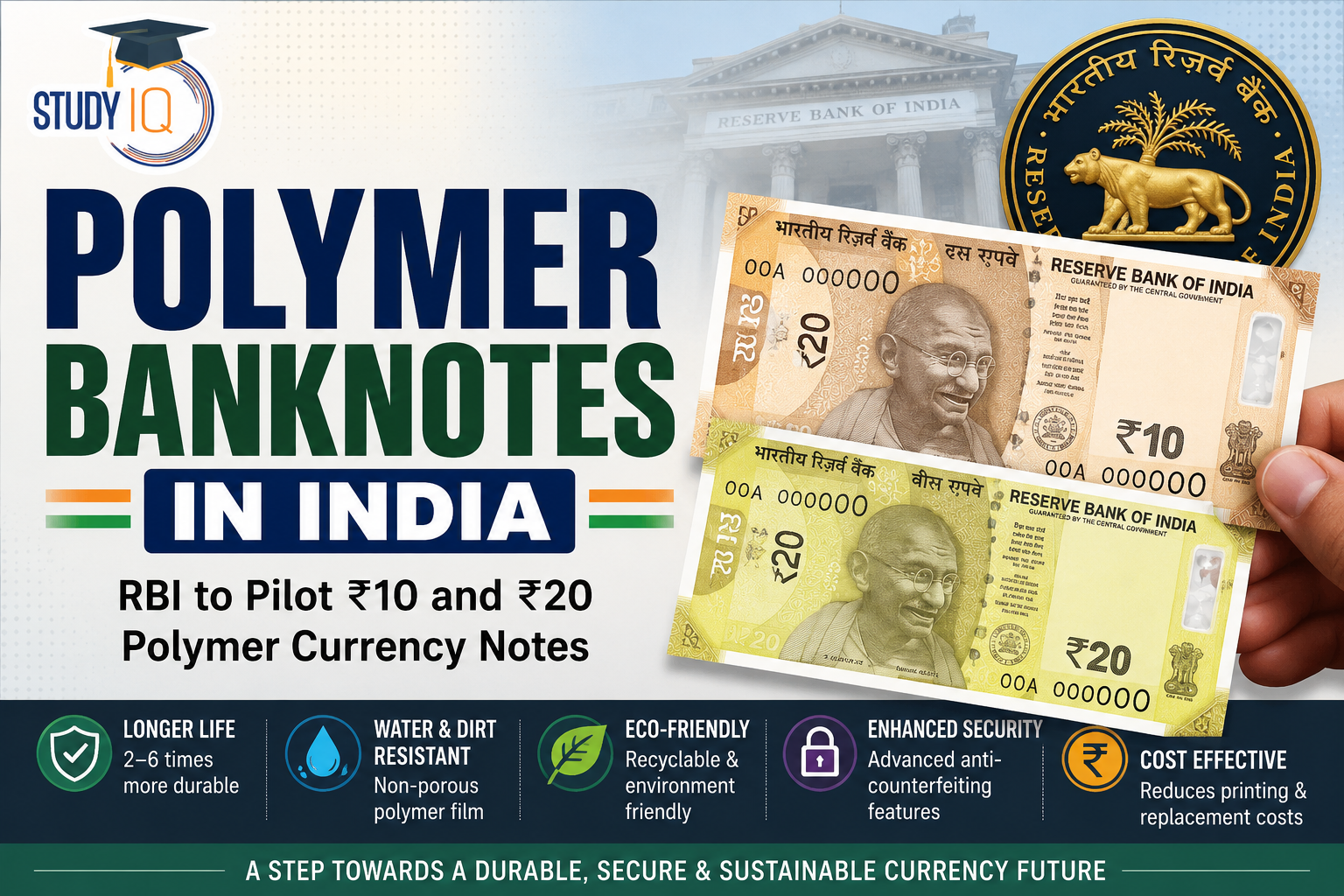
The Union Government has approved the Reserve Bank of India (RBI) to conduct field trials of polymer banknotes in the ₹10 and ₹20 denominations. The initiative aims to enhance the durability of low-denomination currency notes, reduce replacement costs, improve security, and support environmental sustainability.
If the pilot proves successful, India could gradually introduce polymer banknotes alongside existing paper currency, joining several countries that have already adopted this technology.
What are Polymer Banknotes?
Polymer banknotes are currency notes printed on a synthetic polymer substrate rather than the conventional cotton-based paper used in most Indian banknotes.
The polymer substrate is made from a special non-porous plastic film that is resistant to moisture, dirt, grease, and physical wear. As a result, these notes remain cleaner and stay in circulation much longer than traditional paper notes.
Why is India Introducing Polymer Banknotes?
Low-denomination notes such as ₹10 and ₹20 exchange hands frequently, making them vulnerable to:
- Tearing
- Soiling
- Moisture damage
- Folding and wear
The pilot project seeks to determine whether polymer banknotes can:
- Increase currency durability
- Lower printing and replacement costs
- Improve counterfeit resistance
- Reduce environmental impact over the long term
Key Features of Polymer Banknotes
| Feature | Details |
|---|---|
| Material | Synthetic polymer substrate |
| Texture | Smooth, flexible, moisture-resistant |
| Durability | 2–6 times longer lifespan than paper notes |
| Water Resistance | Highly resistant to water and humidity |
| Dirt Resistance | Non-porous surface prevents dirt absorption |
| Security | Advanced transparent windows and anti-counterfeit features |
| Recycling | Can be recycled after use |
Objectives of the RBI Pilot Project
The field trials aim to evaluate the performance of polymer currency under Indian climatic and usage conditions.
The primary objectives include:
- Improving the lifespan of frequently used currency notes
- Reducing the cost of printing replacement notes
- Enhancing resistance to wear and tear
- Lowering environmental impacts through reduced paper consumption
- Testing public acceptance and handling characteristics
How are Polymer Notes Different from Paper Notes?
| Aspect | Polymer Notes | Cotton Paper Notes |
|---|---|---|
| Material | Synthetic polymer | Cotton-based paper |
| Lifespan | 2–6 times longer | Shorter lifespan |
| Moisture Resistance | Excellent | Moderate |
| Dirt Absorption | Very low | High |
| Counterfeit Protection | Advanced security features | Conventional security features |
| Environmental Impact | Recyclable and longer-lasting | Higher replacement frequency |
Advantages of Polymer Banknotes
1. Longer Lifespan
Polymer banknotes can remain in circulation two to six times longer than traditional paper currency, significantly reducing replacement requirements.
2. Lower Printing Costs
Although polymer notes cost more to manufacture initially, their longer lifespan reduces overall printing, transportation, storage, and destruction costs.
3. Improved Security
Polymer notes support sophisticated anti-counterfeiting technologies such as:
- Transparent security windows
- Holographic elements
- Complex micro-printing
- Advanced optical security devices
These features make them harder to counterfeit.
4. Better Hygiene
Because polymer is non-porous, the notes absorb less moisture, dirt, and bacteria, making them cleaner during circulation.
5. Environmental Sustainability
Polymer banknotes require fewer replacements, resulting in:
- Lower paper consumption
- Reduced transportation emissions
- Less waste generation
At the end of their lifecycle, polymer notes can be recycled into plastic products.
Challenges of Polymer Banknotes
Despite their advantages, polymer banknotes also present certain challenges:
- Higher initial production costs
- Requirement for specialised printing infrastructure
- Possible adaptation issues for currency-counting machines
- Public familiarity and acceptance during the transition phase
- Performance testing under India’s diverse climatic conditions
These issues will be assessed during the RBI’s pilot project.
Implementation of the Pilot Project
The pilot programme will be implemented by the Reserve Bank of India (RBI) in collaboration with Bharatiya Reserve Bank Note Mudran Pvt. Ltd. (BRBNMPL).
Initially:
- Polymer notes will be introduced only in ₹10 and ₹20 denominations.
- They will circulate alongside existing paper banknotes.
- Their durability and public acceptance will be monitored before any wider rollout.
Global Experience with Polymer Currency
More than 30 countries have adopted polymer banknotes, including:
- Australia (first country to introduce polymer currency)
- Canada
- United Kingdom
- New Zealand
- Singapore
- Romania
- Vietnam
- Brunei
Many central banks report improved durability, lower replacement costs, and enhanced counterfeit resistance after adopting polymer currency.
Legal Framework for Currency Issuance in India
Under Section 22 of the Reserve Bank of India Act, 1934, the Reserve Bank of India (RBI) has the exclusive authority to issue banknotes in India.
The only exception is the ₹1 note, which is issued by the Ministry of Finance, while the RBI circulates it.
Way Forward
The introduction of polymer banknotes represents an important step towards modernising India’s currency management system. If the pilot project demonstrates improved durability, cost efficiency, and public acceptance, polymer currency could gradually become a larger part of India’s cash ecosystem. The initiative also aligns with broader goals of reducing operational costs, strengthening currency security, and promoting environmental sustainability.
Read Also: UPSC Daily Current Affairs 2026
 Species in News: Asian Wild Pig- Habitat...
 BRICS AI Open-Source Community: China’...
 India’s Artificial Sun: New 82.6 GHz G...














 WhatsApp