
Table of Contents
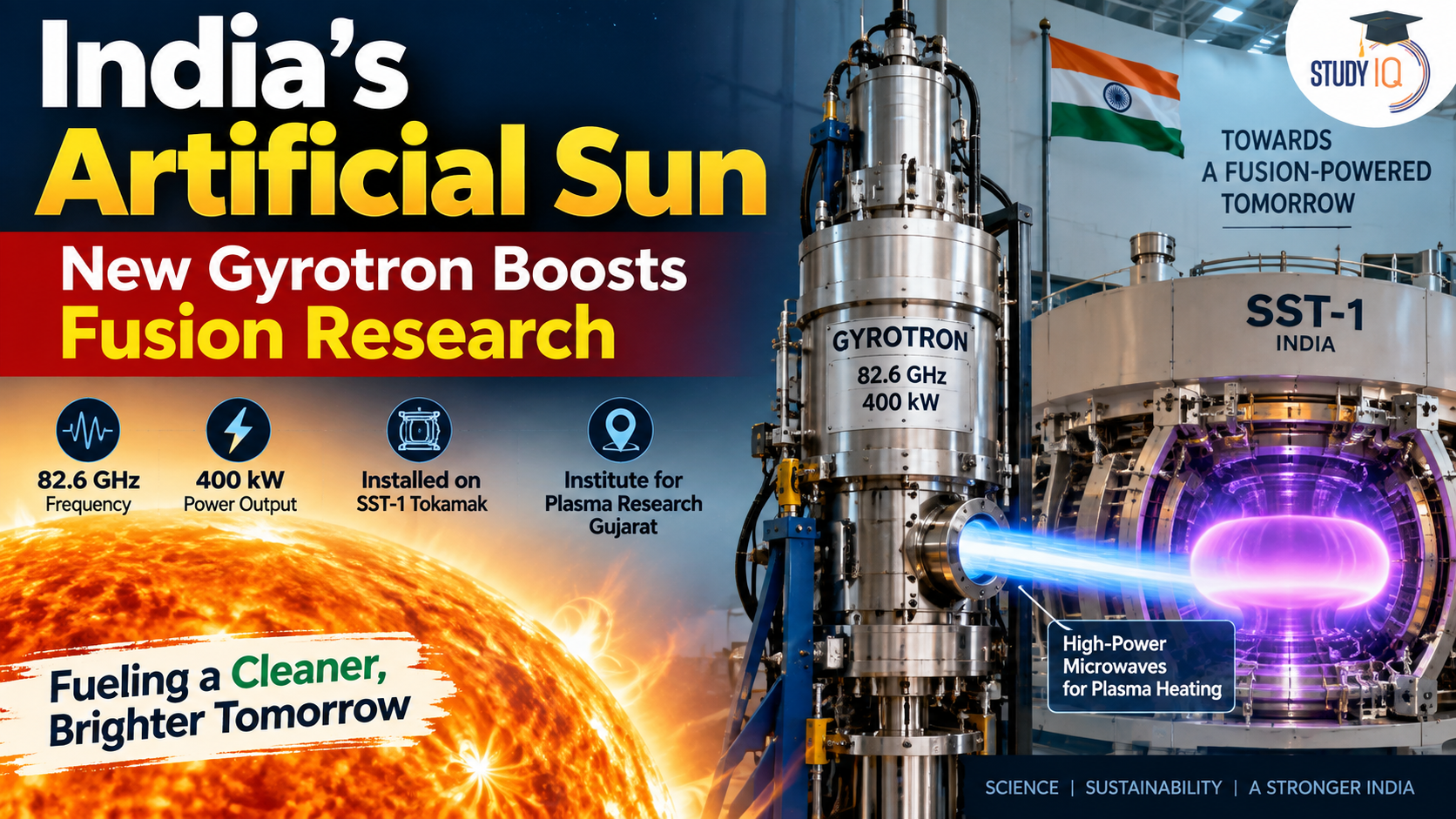
India has achieved a significant milestone in nuclear fusion research with the installation of a new 82.6 GHz, 400 kW gyrotron on the SST-1 (Steady State Superconducting Tokamak) at the Institute for Plasma Research (IPR), Gujarat. The upgrade is expected to strengthen India’s ability to heat and sustain extremely hot plasma for advanced fusion experiments.
Read Also: UPSC Daily Current Affairs 2026
What Is India’s Artificial Sun?
The term “India’s Artificial Sun” is commonly used to describe India’s efforts to recreate the extreme conditions required for nuclear fusion on Earth.
The Sun generates energy through fusion in its extremely hot and dense core. On Earth, scientists attempt to reproduce fusion conditions using devices such as tokamaks, which use powerful magnetic fields to confine ultra-hot plasma.
What Is SST-1 Tokamak?
- SST-1 stands for Steady State Superconducting Tokamak.
- It is an experimental fusion device located at the Institute for Plasma Research, Gujarat.
- It uses magnetic fields to confine plasma inside a doughnut-shaped chamber.
- The objective is to study the conditions required for controlled and sustained nuclear fusion.
- Fusion experiments require plasma to reach temperatures of hundreds of millions of degrees Celsius.
What Is a Gyrotron?
A gyrotron is a high-power microwave device used to heat plasma in fusion experiments.
The newly installed system has:
- Frequency: 82.6 GHz
- Power: 400 kW
- Purpose: Heating and sustaining high-temperature plasma
- Earlier system: 42 GHz gyrotron
The higher-frequency system will enhance India’s ability to conduct advanced plasma-heating experiments.
How Does the New Gyrotron Help Fusion Research?
The process can be understood as:
Gyrotron → Microwave energy → Plasma heating → High-temperature plasma → Fusion experiments
The gyrotron supplies powerful microwave energy to the plasma. This increases the plasma temperature and helps researchers study plasma stability, confinement and steady-state operation.
Nuclear Fusion vs Nuclear Fission
| Nuclear Fusion | Nuclear Fission |
|---|---|
| Light nuclei combine | Heavy nucleus splits |
| Powers the Sun and stars | Used in conventional nuclear reactors |
| Requires extremely high temperatures | Can be initiated under comparatively different conditions |
| Potentially produces low-carbon electricity | Produces significant radioactive waste |
| Major challenge is sustained plasma confinement | Commercial technology is already established |
Why Is the Gyrotron Upgrade Significant?
The new gyrotron can help India:
- Improve plasma heating.
- Maintain extremely high plasma temperatures.
- Study plasma stability and confinement.
- Advance steady-state fusion research.
- Build domestic expertise in sophisticated fusion technologies.
- Strengthen India’s long-term capabilities in clean-energy research.
Why Is Fusion Energy Important?
Nuclear fusion is considered a potentially important future energy source because it could provide low-carbon electricity using abundant fuel resources. Unlike conventional fission reactors, fusion does not rely on a self-sustaining chain reaction.
However, achieving commercially viable fusion remains a major scientific and engineering challenge.
Can India’s Artificial Sun Produce Electricity?
No, not at present.
SST-1 is an experimental fusion research facility, not a commercial electricity-generating fusion power plant. The new gyrotron improves India’s ability to conduct plasma research, but substantial challenges remain before fusion can become a practical source of grid electricity.

 BRICS AI Open-Source Community: China’...
 World Circular Economy Forum 2026: India...
 SAWEN and Kathmandu Declaration: Strengt...














 WhatsApp





