Table of Contents
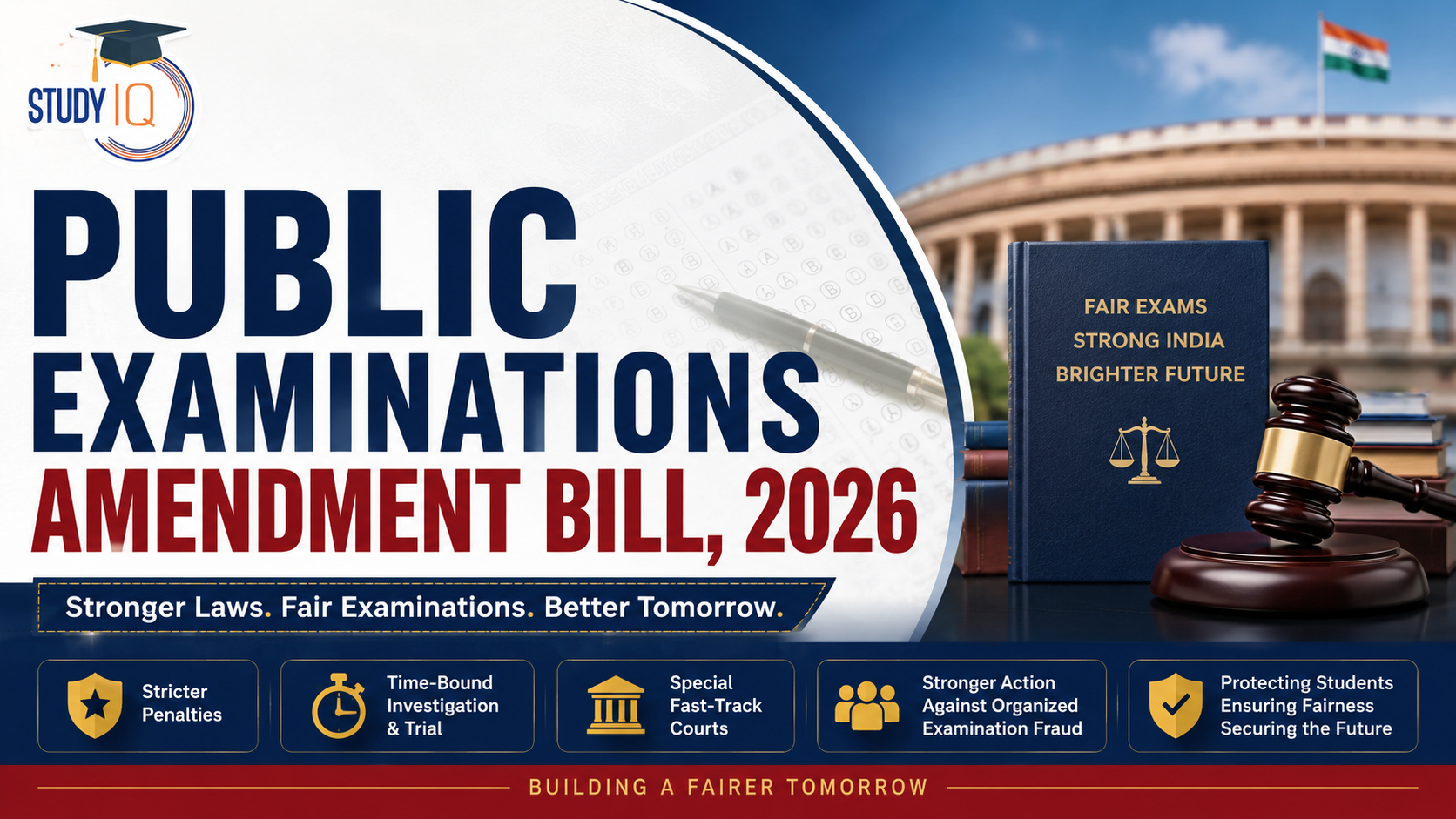
The Public Examinations (Prevention of Unfair Means) Amendment Bill, 2026 marks a major step in India’s efforts to eliminate paper leaks and organized examination fraud. Passed by the Lok Sabha and taken up by the Rajya Sabha for consideration, the Bill strengthens the Public Examinations (Prevention of Unfair Means) Act, 2024 by introducing harsher punishments, faster investigations, special fast-track courts, and stronger accountability for service providers.
The amendments come in the wake of recurring paper leak incidents that have undermined the credibility of competitive examinations and affected millions of students and job aspirants across the country.
Why is the Public Examinations Amendment Bill, 2026 in News?
The Lok Sabha passed the Public Examinations (Prevention of Unfair Means) Amendment Bill, 2026 by a voice vote during the Monsoon Session of Parliament. The Bill was introduced by Union Minister Dr. Jitendra Singh to strengthen India’s anti-paper leak law.
The legislation enhances punishments for individuals, organized criminal syndicates, and examination service providers involved in unfair means during public examinations. It also establishes a time-bound judicial mechanism to ensure speedy investigation and trial of offences.
Background: Public Examinations (Prevention of Unfair Means) Act, 2024
The Public Examinations (Prevention of Unfair Means) Act, 2024 was enacted after several major paper leak incidents exposed weaknesses in India’s examination system.
Before the enactment of this law, India did not have a dedicated central legislation specifically targeting organized examination fraud.
The Act covers examinations conducted by:
- Union Public Service Commission (UPSC)
- Staff Selection Commission (SSC)
- National Testing Agency (NTA)
- Railway Recruitment Boards (RRBs)
- Institute of Banking Personnel Selection (IBPS)
Under the 2024 Act, offences were made:
- Cognizable
- Non-bailable
- Non-compoundable
Why Was the Amendment Necessary?
Although the 2024 Act established a legal framework against examination fraud, the Government felt that stronger measures were required based on implementation experience.
The amendment seeks to:
- Prevent organized paper leak rackets.
- Strengthen deterrence through stricter punishments.
- Ensure faster investigation and speedy disposal of cases.
- Protect the interests of genuine students.
- Improve transparency and credibility of public examinations.
Key Highlights of the Public Examinations Amendment Bill, 2026
| Particular | Details |
|---|---|
| Bill Name | Public Examinations (Prevention of Unfair Means) Amendment Bill, 2026 |
| Passed By | Lok Sabha |
| Maximum Jail Term | Up to 10 years |
| Maximum Fine for Individuals | ₹50 lakh |
| Maximum Fine for Organized Crime | ₹10 crore |
| Investigation Timeline | Within 2 months |
| Trial Timeline | Within 3 months after filing of charge sheet |
| Special Courts | Special Fast-Track Courts |
| Investigation Agency | Special Task Force (STF) |
Major Provisions of the Bill
1. Stricter Punishment for Individuals
The Amendment significantly enhances punishment for those using unfair means in public examinations.
| Provision | Earlier | Amended |
|---|---|---|
| Imprisonment | 3–5 years | 5–10 years |
| Maximum Fine | ₹10 lakh | ₹50 lakh |
The objective is to create a stronger deterrent against paper leaks and cheating.
2. Tougher Punishment for Organized Crime
The Bill specifically targets organized examination mafias.
| Provision | Earlier | Amended |
|---|---|---|
| Imprisonment | 5–10 years | 7–10 years |
| Maximum Fine | ₹1 crore | ₹10 crore |
The law also allows for the seizure of properties of convicted offenders, ensuring that criminal networks cannot retain financial gains from examination fraud.
3. Increased Liability for Service Providers
Service providers responsible for conducting or facilitating public examinations will face stricter penalties if found involved in examination-related offences.
| Provision | Earlier | Amended |
|---|---|---|
| Maximum Fine | ₹1 crore | ₹5 crore |
| Debarment | 4 years | 8 years |
4. Accountability of Directors and Senior Management
The Bill strengthens corporate accountability by increasing punishment for directors and senior management involved in examination fraud.
- Imprisonment: 5–10 years
- Maximum Fine: ₹5 crore
Time-Bound Investigation and Trial
One of the most significant reforms introduced by the Bill is the mandatory timeline for investigation and trial.
Investigation
All investigations into offences under the Act must be completed within two months from the registration of the case.
Trial
The designated court must complete the trial within three months from the filing of the charge sheet.
These provisions aim to prevent prolonged litigation and ensure timely justice.
Establishment of Special Fast-Track Courts
The Bill empowers every State Government and Union Territory Administration to establish Special Fast-Track Courts for offences under the Act.
These courts will:
- Conduct day-to-day hearings.
- Dispose of cases expeditiously.
- Ensure faster convictions in organized examination fraud cases.
Constitution of a Special Task Force (STF)
The Central Government may constitute a Special Task Force (STF) whenever necessary to investigate major paper leak cases involving organized criminal syndicates.
The STF is expected to improve coordination among law enforcement agencies and facilitate more effective investigations.
Government’s Stand
While moving the Bill, Dr. Jitendra Singh stated that the Government is committed to protecting the interests of honest students and maintaining the integrity of public examinations.
According to the Government:
- 52 FIRs have already been registered under the Public Examinations (Prevention of Unfair Means) Act, 2024.
- The amendments are based on practical experience gained from implementing the 2024 Act.
- The objective is to make India’s examination system more transparent, fair, and credible.
Opposition’s Response
Opposition members raised concerns over the handling of recent paper leak incidents, particularly the NEET controversy, and questioned the effectiveness of implementation.
The debate witnessed repeated disruptions before the Bill was eventually passed by the Lok Sabha.
Significance of the Public Examinations Amendment Bill, 2026
The Amendment is expected to have far-reaching implications for India’s examination system.
Key Benefits
- Strengthens the legal framework against paper leaks.
- Acts as a strong deterrent through enhanced penalties.
- Targets organized criminal networks involved in examination fraud.
- Ensures speedy investigation and time-bound trials.
- Improves transparency and accountability in recruitment examinations.
- Restores confidence among students, parents, and job aspirants.
- Promotes merit-based recruitment and admissions.
Challenges Ahead
While the amendments strengthen the legal framework, their success will depend on effective implementation. Some key challenges include:
- Timely establishment of Special Fast-Track Courts across all States and Union Territories.
- Coordination among investigative agencies.
- Adoption of secure digital examination systems.
- Protection against insider collusion and cyber threats.
- Capacity building for law enforcement and judicial officers handling examination-related offences.
Conclusion
The Public Examinations (Prevention of Unfair Means) Amendment Bill, 2026 represents a significant strengthening of India’s anti-paper leak regime. By combining stricter penalties, financial sanctions, property seizure, special investigation mechanisms, and time-bound judicial processes, the legislation aims to safeguard the integrity of public examinations and protect the aspirations of millions of students and job seekers.
Its long-term impact, however, will depend not only on stringent laws but also on robust implementation, technological safeguards, institutional coordination, and continuous reforms to ensure that public examinations remain fair, transparent, and merit-based.
Read Also: UPSC Daily Current Affairs 2026
 Species in News: Asian Wild Pig- Habitat...
 BRICS AI Open-Source Community: China’...
 India’s Artificial Sun: New 82.6 GHz G...










 WhatsApp