
Table of Contents
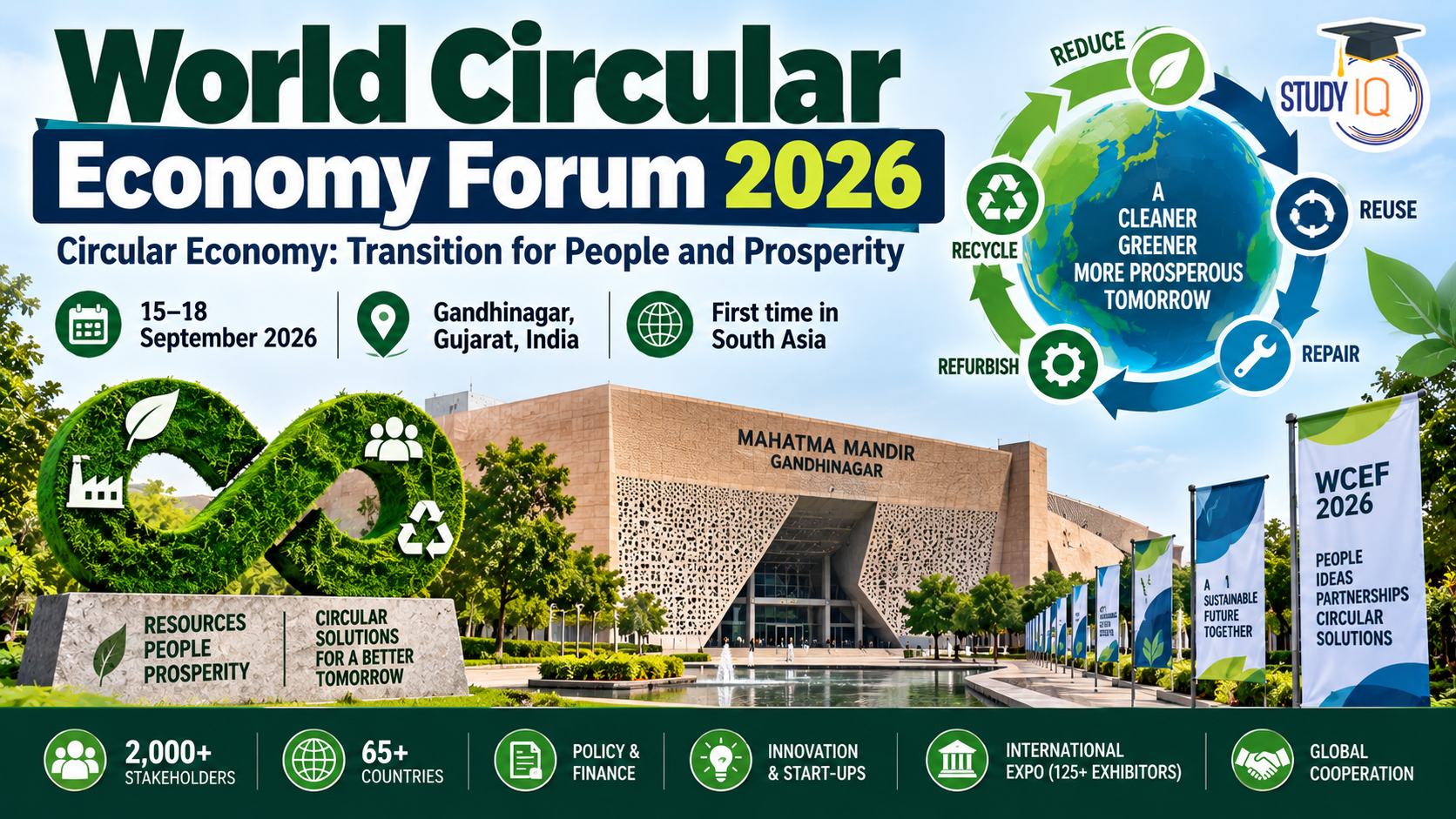
India is hosting the World Circular Economy Forum (WCEF) 2026 in Gandhinagar, Gujarat, from 15–18 September 2026. This is the first time the global forum is being held in South Asia, placing India at the centre of international discussions on circular economy solutions.
The 10th edition of WCEF focuses on how circular approaches can strengthen economic resilience, competitiveness and sustainable growth in a resource-constrained world.
Read Also: UPSC Daily Current Affairs 2026
WCEF 2026: Key Facts
- Venue: Mahatma Mandir Convention Centre, Gandhinagar, Gujarat.
- Dates: 15–18 September 2026.
- Theme: “Circular Economy: Transition for People and Prosperity.”
- Edition: 10th World Circular Economy Forum.
- Significance: First WCEF to be held in South Asia.
- Organisers: Finnish Innovation Fund Sitra and Central Pollution Control Board (CPCB), with support from the Ministry of Environment, Forest and Climate Change (MoEFCC) and the Governments of India and Finland, in coordination with the Government of Gujarat and Gujarat Pollution Control Board.
What is a Circular Economy?
A circular economy is an economic model that seeks to minimise waste and keep products, materials and resources in use for as long as possible.
It moves away from the traditional:
Take → Make → Use → Dispose
model towards:
Reduce → Reuse → Repair → Refurbish → Recycle → Recover
The approach aims to improve resource efficiency, reduce environmental pressures and retain economic value within production and consumption systems.
Major Focus Areas of WCEF 2026
1. Circular Finance and Policy
WCEF 2026 examines how governance frameworks, policy instruments and financial mechanisms can accelerate the transition towards circular business models.
The forum highlights the role of private investment and circular finance in scaling solutions.
2. Innovation and Technology
Technology is a major component of the circular transition, with discussions covering:
- Artificial intelligence
- Digitalisation
- Sustainable product design
- Industrial solutions
- Start-ups
- Digital compliance and traceability
The objective is to move circular economy ideas from experimentation to large-scale implementation.
3. International Cooperation
The forum brings together business leaders, policymakers, investors and innovators from around the world to explore scalable circular solutions.
For developing countries, circularity can also create opportunities to retain more value from natural resources, develop local industries and generate employment.
4. Circular Economy Expo
An expo area at the forum showcases innovative and scalable circular economy solutions from India and other countries.
It provides a platform for businesses and organisations to demonstrate technologies and approaches for resource-efficient production and consumption.
India’s Significance
Hosting WCEF 2026 strengthens India’s position in the global circular economy dialogue.
India faces major challenges related to resource consumption, waste generation, urbanisation and industrial growth. A circular economy approach can help address these challenges while supporting economic development.
India’s participation also highlights the potential of the Global South to develop locally relevant circular solutions rather than simply adopting models designed for advanced economies.
10-Year Framework of Programmes
The 10-Year Framework of Programmes on Sustainable Consumption and Production Patterns (10YFP) is another important element associated with the forum.
Its Board meeting is being held alongside WCEF 2026, with India serving as Co-Chair.
The framework supports the transition towards more sustainable patterns of consumption and production, complementing the broader circular economy agenda.
 India’s Artificial Sun: New 82.6 GHz G...
 SAWEN and Kathmandu Declaration: Strengt...
 Steel Slag Road Technology: India’s 1....



 WhatsApp





