
Table of Contents
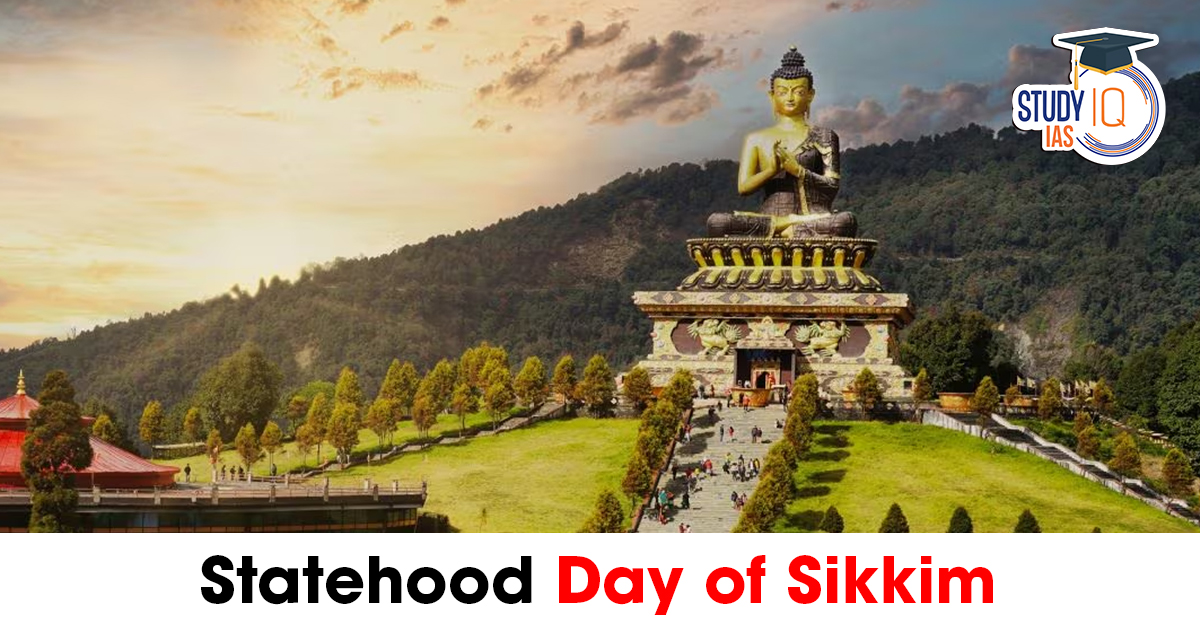
Context: The Prime Minister visited Gangtok to attend the concluding ceremony of Sikkim’s year-long celebrations marking 50 years of statehood.
About the 50th Statehood Celebrations of Sikkim
The celebrations, launched in May 2025, mark five decades since Sikkim became a part of the Indian Union in 1975. The occasion reflects upon Sikkim’s journey from a Himalayan monarchy to a state known for environmental sustainability and inclusive development.
Historical Background of Sikkim
- Formation of the Kingdom: The Kingdom of Sikkim was founded in 1642 under the leadership of Phuntsong Namgyal, who became the first Chogyal, or monarch, of the kingdom.
- British Protectorate: Under the Treaty of Tumlong, signed in 1861, Sikkim came under British protection and functioned as a strategic buffer between China and Nepal.
- Position After Indian Independence: Following India’s independence in 1947, Sikkim did not immediately merge with India. Instead, the Indo–Sikkim Treaty of 1950 made it an Indian protectorate. India assumed responsibility for defence, foreign affairs, and communications, while Sikkim retained internal self-governance.
Developments That Led to Statehood
- Rise of Democratic Demands: During the 1960s and 1970s, popular movements demanding democratic reforms and stronger integration with India gained momentum. Political organisations such as the Sikkim National Congress played a major role in these developments.
- Tripartite Agreement of 1973: Widespread protests against monarchical rule led to the signing of a tripartite agreement in 1973 involving the Chogyal, the Government of India, and key political parties. The agreement aimed to introduce political reforms and ensure greater democratic participation.
- Referendum of 1975: In April 1975, a referendum was conducted in which an overwhelming majority of voters supported the abolition of the monarchy and favoured integration with India.
- Constitutional Recognition: After the referendum, Parliament enacted the 36th Amendment Act, through which Sikkim officially became the 22nd state of India on May 16, 1975.

 Skyroot Vikram-1 Mission Aagaman: India'...
 Oor Pare Prehistoric Site: Location, Roc...
 Assam Election 2026: Exit Poll, Result D...







 WhatsApp





