Table of Contents
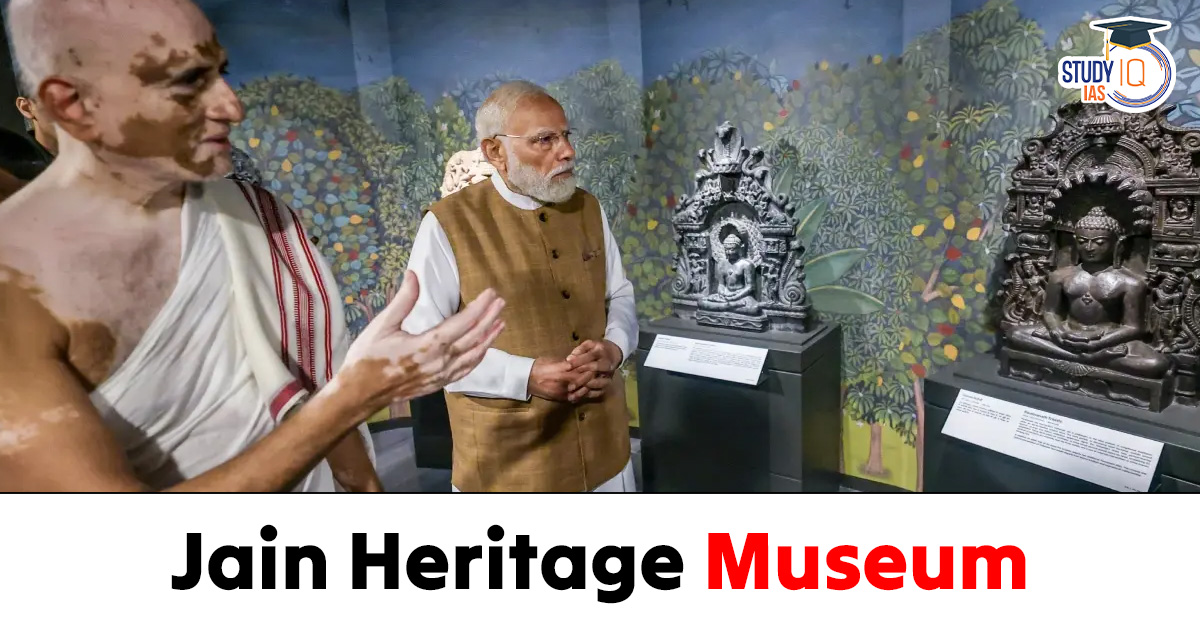
Context: The newly inaugurated Jain Heritage Museum in Ahmedabad, Gujarat, serves as a repository for the Shramana tradition.
ICore Traditions and Figures of Jainism
- Shramana Tradition: A non-Vedic, ancient Indian religious movement that operated parallel to the Vedic religion. It emphasizes self-reliance, asceticism, and the pursuit of liberation through personal effort rather than rituals.
- Tirthankaras: Meaning “Ford-makers,” these are the 24 supreme teachers of Jainism who have conquered the cycle of death and rebirth.
- Rishabhanatha: The first Tirthankara (symbolised by the Bull).
- Mahavira: The 24th and final Tirthankara of the current era (symbolized by the Lion).
- Kevala Jnana: The state of absolute knowledge or omniscience. It is the highest form of perception, where a soul is liberated from all karmic obstructions.
- Ahimsa (Non-violence): The foundational ethical principle of Jainism, involving the total avoidance of harm to any living being (human, animal, insect, or microscopic) in thought, word, or deed.
Art, Iconography, and Literature
- Pratima (Iconography): The physical representation of a Tirthankara. In Jain art, they are depicted in two primary postures:
- Kayotsarga: A standing meditative posture (“dismissing the body”).
- Padmasana: A seated lotus posture.
- Lanchhanas: Specific symbols carved at the base of a Tirthankara’s statue to help identify them (e.g., the Serpent for Parshvanatha).
- Ayagapatas: Ancient “votive tablets” or ornamental slabs used for worship. These were common in the Mathura School of Art and often depicted the Dharmachakra or the Ashtamangala (eight auspicious symbols).
- Kalpa Sutra & Bhagavati Sutra:
- Kalpa Sutra: A sacred text detailing the biographies of the Tirthankaras.
- Bhagavati Sutra: One of the most important Agamas (canonical texts), covering a wide range of philosophical questions and historical records.
Metaphysical and Ethical Frameworks
- Anekantavada: The doctrine of “non-absolutism” or “many-sidedness.” It suggests that truth and reality are complex and have multiple aspects; no single point of view can capture the total truth.
- Syadvada: The logic of “conditional predication.” It complements Anekantavada by using the qualifier “Syat“ (perhaps/maybe) to signify that every statement is true only from a certain perspective.
- Pancha Mahavratas: The five “Great Vows” required for spiritual liberation:
- Ahimsa: Non-violence.
- Satya:
- Asteya: Non-stealing.
- Brahmacharya:
- Aparigraha: Non-attachment/Non-possession.
Regional Sects and Sites
- Digambara (Sky-clad) and Shvetambara (White-clad).
- Palitana & Girnar: * Palitana (Shatrunjaya Hill): Considered the most sacred pilgrimage site for Shvetambaras, featuring over 800 marble temples.
- Girnar: Sacred to both sects, particularly associated with the 22nd Tirthankara, Neminatha.

 List Of Tribal Festivals In India: Compl...
 Skyroot Vikram-1 Mission Aagaman: India'...
 Buddha Purnima 2026: Date, Time, History...











 WhatsApp