
Table of Contents
Context
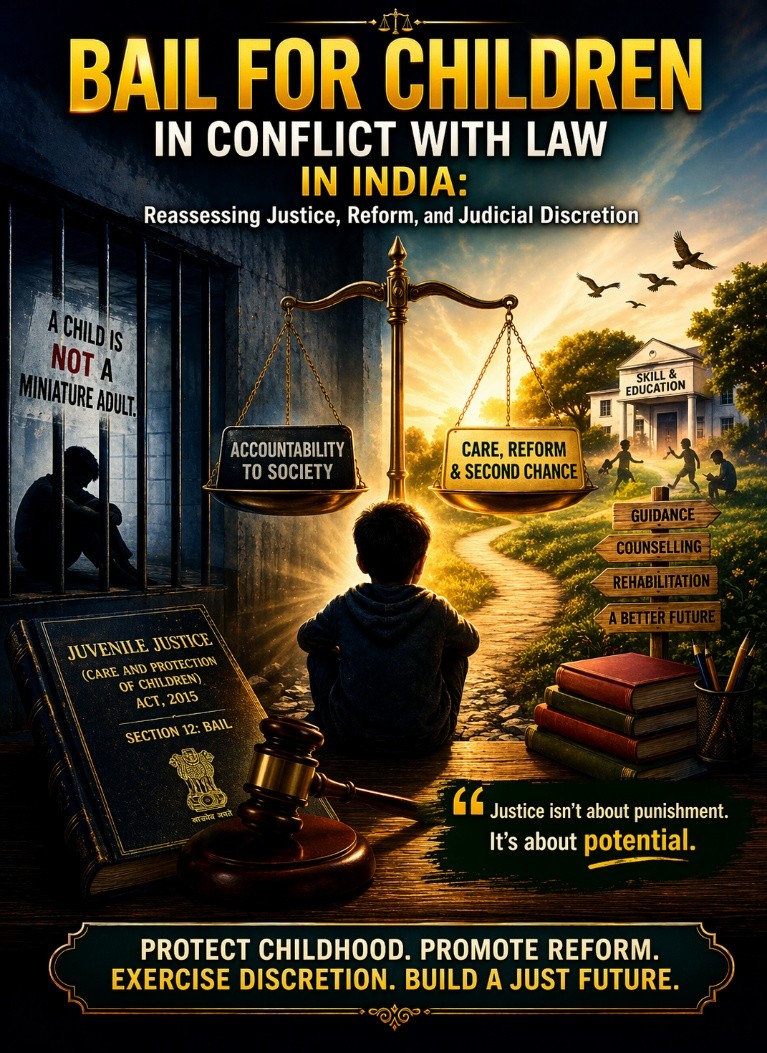
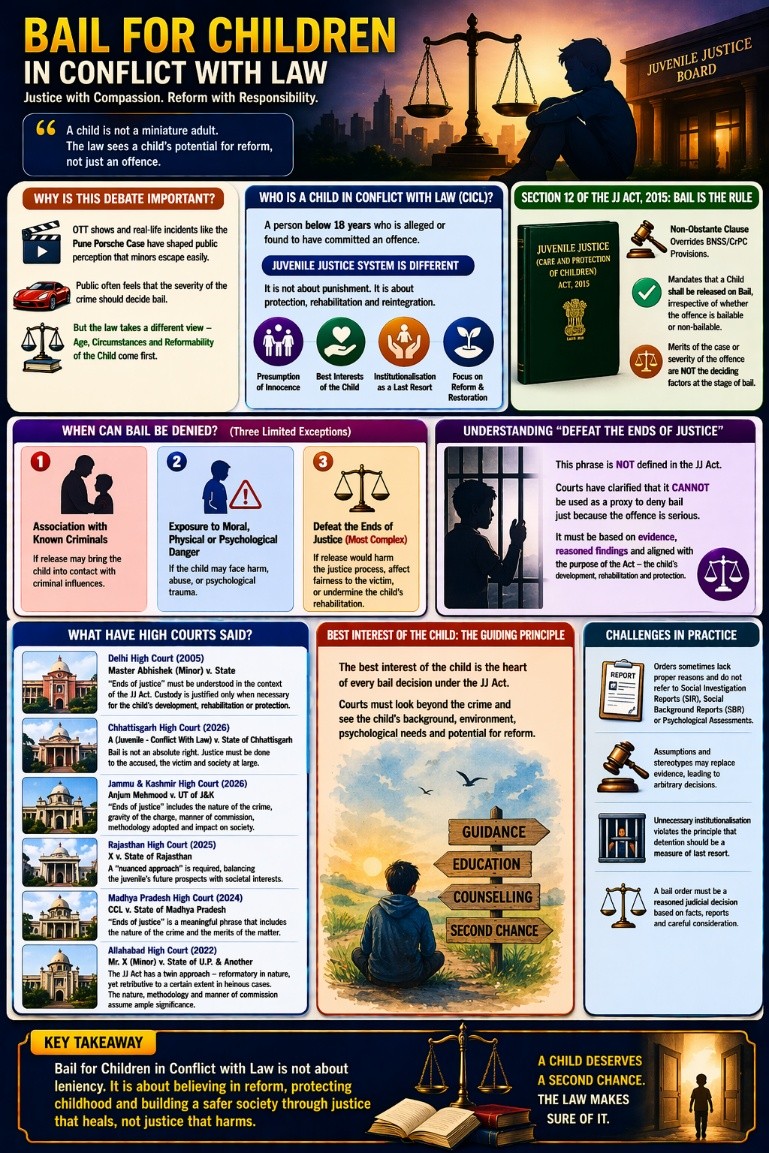
In modern India, the discourse on juvenile justice has become more intricate, shaped by legislative advances and evolving societal views. Prominent incidents and prevalent representations of juvenile crime in digital media have fostered an increasing perception that juveniles engaged in serious acts frequently escape appropriate punishment. This notion has heightened discussions regarding whether the severity of an offence should influence bail decisions for juveniles. Nevertheless, the legal structure in India employs a fundamentally distinct approach, emphasising the reformative potential of children rather than punishing measures.
The Juvenile Justice (Care and Protection of Children) Act, 2015, signifies a fundamental transformation from conventional criminal law concepts. It underscores rehabilitation, reintegration, and the best interests of the child. Section 12 sets out a specific, mandatory structure for bail, distinguishing it from the standard criminal process. The conflict between public aspirations for more responsibility and the law’s rehabilitative philosophy constitutes the essence of this analysis.
Theoretical Underpinnings of Juvenile Justice and Children in Conflict with the Law
The term “Child in Conflict with Law” (CICL) denotes any person under the age of eighteen who is accused or determined to have committed an offence. This classification is essential to the juvenile justice system, which differentiates these children from those requiring care and protection. The system is not just a legal framework but a welfare-focused mechanism aimed at tackling the root causes of delinquency.
The conceptual basis of juvenile justice in India acknowledges that children do not possess complete psychological maturity and are more vulnerable to extrinsic factors such as poverty, abuse, neglect, and insufficient guidance. Thus, the method emphasises rehabilitation rather than retribution. It functions based on concepts like the presumption of innocence, the paramountcy of the child’s welfare, and the recognition that institutionalisation should be employed solely as a last resort. The objective is not to penalise but to rehabilitate and reintegrate the child into society as a responsible member.
The Legislative Framework of Bail Pursuant to Section 12
The framework regulating bail for Children in Conflict with the Law (CICLs) under Section 12 of the Juvenile Justice Act is a notable divergence from the standard bail rules applied to adults under the Bharatiya Nagarik Suraksha Sanhita, 2023. The former grants courts considerable discretion, whereas the JJ Act employs a prescriptive framework that establishes bail as the rule rather than the exception.
Section 12 begins with a non-obstante clause that explicitly supersedes the conditions of ordinary criminal procedure. It stipulates that a child must be granted bail regardless of whether the accused offence is bailable or non-bailable. This statutory mandate demonstrates a legislative aim to prevent the unwarranted deprivation of liberty for children, ensuring they receive rehabilitative options within their community or familial setting.
The merits of the case and the seriousness of the offence are not significant considerations at the bail stage. This represents a purposeful divergence from adult criminal law, in which such variables frequently exert a significant influence. The emphasis in juvenile justice is predominantly on the welfare and developmental requirements of the child.
Restricted Exceptions to the Bail Rule
Notwithstanding the robust presumption in favour of bail, Section 12 delineates three particular conditions under which bail may be refused. These exceptions are specifically defined and must be construed rigorously to avert exploitation.
The initial basis pertains to the potential for the child’s release to result in their interaction with known criminals. This concern is based on the aim of preventing more criminalisation and safeguarding the child from adverse influences. The second reason relates to the potential exposure to moral, physical, or psychological harm, therefore emphasising the child’s safety and well-being. Both grounds are quite uncomplicated and are generally evaluated using factual documents, including Social Investigation Reports and psychological assessments.
The third premise, however, introduces a more intricate complexity. Bail may be refused if releasing the child would “defeat the ends of justice.” This term, not specified in the Act, has become the central issue of judicial interpretation and discourse.
The Ambiguity of “defeat the ends of justice”
The phrase “defeat the ends of justice” signifies the most controversial element in juvenile bail legislation. In contrast to the other two reasons, which rely on objective evaluations, this phrase grants a measure of discretion to judicial authorities. Nonetheless, this discretion is neither unconditional nor capricious. It must be implemented within the confines of recognised legal principles and the primary purposes of the JJ Act.
Judicial discretion must consistently be informed by reason, evidence, and the legislative intent, as underscored by the courts. The phrase cannot be construed in isolation or employed as a handy mechanism to deny bail in critical circumstances. It should be comprehended within the framework of the rehabilitative objectives of juvenile justice.
The difficulty resides in reconciling conflicting factors. On one side, it is essential to provide equity for victims and the community. Conversely, the legislation stipulates that the child’s well-being and prospects for rehabilitation take precedence. This intricate equilibrium has resulted in varied judicial interpretations among different High Courts.
Judicial Interpretations and Emerging Trends
Recent court decisions have sought to elucidate the interpretation and extent of “defeat the ends of justice.” The Chhattisgarh High Court, in A (Juvenile – Conflict With Law) v. State of Chhattisgarh 2026 decision, stated that bail is not an unconditional right and that the notion of justice must include the interests of both the accused and the victim, as well as society at large. The Jammu and Kashmir High Court in Anjum Mehmood v. UT of J&K similarly broadened the interpretation of the phrase to encompass elements such as the type and severity of the offence, the method of its execution, and its societal repercussions.
The Rajasthan High Court has endorsed a nuanced approach in X v. State of Rajasthan, highlighting the necessity of balancing the juvenile’s future chances with societal considerations. The Madhya Pradesh High Court in CCL v. State of Madhya Pradesh has acknowledged the extensive scope of the phrase, indicating that it may encompass factors pertaining to the nature of the offence and the merits of the case. Simultaneously, the Allahabad High Court in Mr. X (Minor) v. State of U.P. has proposed a “twin approach,” integrating reformatory and constrained retributive elements, especially in circumstances of egregious violations.
Although these interpretations offer significant insights, they also demonstrate a lack of consistency. Judicial bodies have embraced a case-specific methodology, resulting in disparate decisions contingent upon the unique facts and circumstances of each case. This diversity highlights the necessity for a more cohesive and principled framework.
The Dangers of Misapplication and Overextension
A notable issue stemming from the existing jurisprudence is the possible exploitation of the “ends of justice” provision. In certain instances, there is a propensity to merge this basis with the severity of the offence, thereby compromising the statutory provisions governing bail. This technique risks converting an exception into a standard, contrary to legislative intent.
Judicial authorities have warned against this inclination, stressing that the word cannot replace the gravity of the offence. Denial of bail must be substantiated by specific, evidence-based findings that illustrate how the child’s release might negatively impact the legal process or the child’s rehabilitation.
The Delhi High Court’s decision in Master Abhishek (Minor) v. State serves as a precedent in this context. The decision of what constitutes a defeat of justice must be based on the objectives of the JJ Act. Custody is warranted just when essential for the child’s development, rehabilitation, or safeguarding.
Practical Obstacles in Execution
Notwithstanding unequivocal legal principles, the pragmatic implementation of Section 12 frequently proves inadequate. Bail orders can lack comprehensive justification and neglect to account for critical documents, such as Social Investigation Reports or psychological evaluations. In certain cases, choices are predicated on assumptions rather than empirical data, resulting in capricious consequences.
These activities not only contravene the legal framework but also infringe upon the rights of the child. A bail order is not simply a procedural formality; it constitutes a substantive judicial determination that must demonstrate meticulous consideration of all pertinent considerations. The lack of justified directives may lead to unwarranted institutionalisation, contradicting the concept that imprisonment ought to be a measure of last resort.
Conclusion
The legislative framework regulating bail for children in conflict with the law exemplifies a progressive and child-focused approach within the Indian legal system. The law aims to safeguard the rights and welfare of children by establishing bail as the rule and limiting its rejection to specific, strictly defined situations, thereby fostering their rehabilitation.
The meaning of the phrase “defeat the ends of justice” remains a considerable challenge. Despite efforts by judicial decisions to elucidate, contradictions persist. A critical necessity exists for a more consistent and principled methodology that conforms with the aims of the JJ Act, ensuring that discretion is applied sparingly and transparently.
The progression of this jurisprudence will ultimately determine whether the juvenile justice system can effectively reconcile the interests of the child, the victim, and society while adhering to its fundamental commitment to reform and reintegration.

 Supreme Court Dowry Enforcement Order 20...
 Supreme Court Modifies 3-Year Practice R...
 Doctrine of Per Incuriam Explained: Supr...








 WhatsApp





