Table of Contents
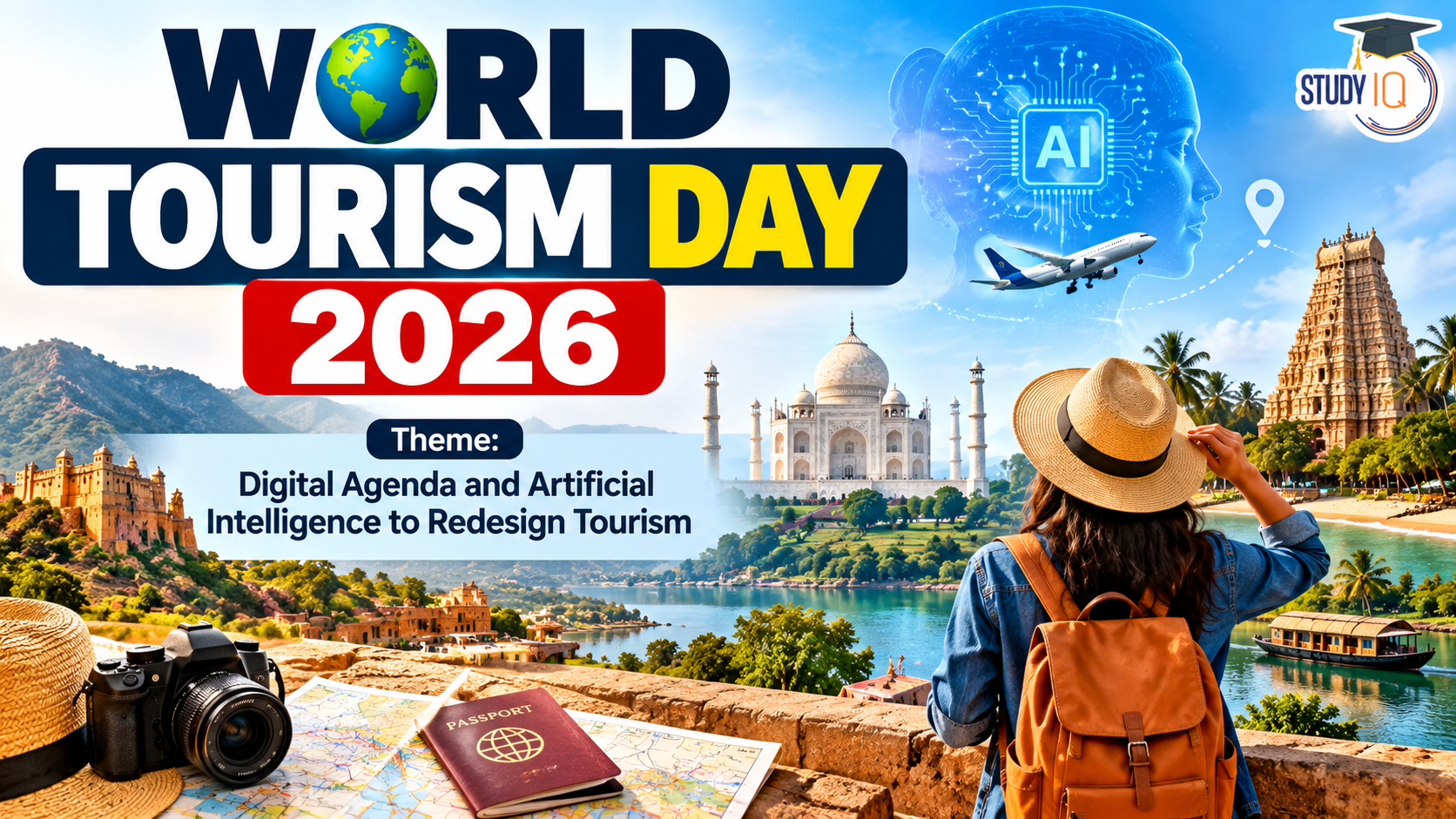
World Tourism Day 2026 is observed on September 27 every year. The 2026 theme is “Digital Agenda and Artificial Intelligence to Redesign Tourism”, highlighting the growing role of artificial intelligence, digital platforms and data-driven technologies in transforming the tourism sector.
The global celebration of World Tourism Day 2026 is being hosted by El Salvador. For India, the occasion highlights the country’s growing tourism economy, digital tourism initiatives, destination development programmes and the use of AI to improve visitor experiences.
Read Also: UPSC Daily Current Affairs 2026
World Tourism Day 2026: Key Facts
| Particular | Details |
|---|---|
| Date | September 27 |
| First celebrated | 1980 |
| Basis | Adoption of the Statutes of the World Tourism Organization in 1970 |
| 2026 Theme | Digital Agenda and Artificial Intelligence to Redesign Tourism |
| 2026 Global Celebration | El Salvador |
| International Organisation | UN Tourism |
The day highlights the contribution of tourism to economic growth, employment, cultural exchange and sustainable development, including its links with the Sustainable Development Goals (SDGs).
The organisation formerly known as UNWTO (United Nations World Tourism Organization) is now known as UN Tourism.
India’s Tourism Sector: Key Economic Data
Tourism has emerged as an important contributor to India’s economy and employment.
According to the latest Tourism Satellite Account figures cited by the Ministry of Tourism, tourism contributed 5.22% to India’s GDP in 2023–24.
Tourism-related employment also increased from 6.94 crore in 2019–20 to 8.46 crore in 2023–24, accounting for around 13.3% of total employment.
India Tourism: Important Numbers
| Indicator | Data |
|---|---|
| Tourism contribution to GDP | 5.22% |
| Tourism employment, 2023–24 | 8.46 crore |
| Domestic tourist visitations, 2025 | 428.55 crore |
| Foreign tourist visitations, 2025 | 2.53 crore |
| Foreign exchange earnings from tourism, 2025 | ₹2,76,831 crore |
These figures demonstrate the importance of tourism not only for foreign exchange earnings but also for employment generation, local entrepreneurship and regional development.
Artificial Intelligence and Digital Tourism in India
The theme of World Tourism Day 2026 places Artificial Intelligence and digital technology at the centre of tourism transformation.
AI can contribute to tourism through:
- Personalised travel recommendations
- AI-assisted itinerary planning
- Destination discovery
- Real-time travel information
- Language and communication assistance
- Data-driven tourism management
- Personalised visitor experiences
Incredible India Digital Platform
The revamped Incredible India Digital Platform (IIDP) uses digital and AI-enabled tools to provide visitors with a more personalised tourism experience.
The platform provides information relating to:
- Culture and heritage
- Adventure tourism
- Food
- Health and wellness
- Arts and crafts
- Rural tourism
- Destinations and attractions
- Essential services
- Weather information
It also facilitates connections between tourists and tourism stakeholders and provides information on registered tourism service providers.
India’s e-Visa Initiative
India introduced its e-Visa scheme in 2014 to simplify international travel.
According to government information cited in the 2026 tourism backgrounder:
- Citizens of 172 countries can use the e-Visa facility.
- The facility is available through 88 designated ports.
- Around 78% of visas are now electronic.
- Around 95% of e-Visa applications are processed within 72 hours.
The initiative demonstrates how digital technology can reduce administrative barriers and improve the ease of international travel.
NIDHI+: National Integrated Database of Hospitality Industry
NIDHI+ stands for National Integrated Database of Hospitality Industry.
It is a digital platform for the registration, recognition and classification of tourism and hospitality service providers.
It covers entities such as:
- Accommodation units
- Convention centres
- Food business operators
- Online travel aggregators
- Tourism service providers
The platform also facilitates electronic delivery of services and provides registered entities with a unique NIDHI ID.
As of September 23, 2026, government data recorded:
| Category | Registered Entities |
|---|---|
| Accommodation units | 63,740 |
| Convention centres | 54 |
| Food business operators | 215 |
| Online travel aggregators | 1,450 |
| Tourism service providers | 15,531 |
India–Google Partnership for Digital Tourism
In June 2026, the Ministry of Tourism entered into an agreement with Google India to promote digital tourism.
The collaboration focuses on areas including:
- Digital technology
- Artificial Intelligence
- Data analytics
- Capacity building
- Digital marketing
- Content creation
- Campaign optimisation
The partnership reflects the increasing role of technology companies in destination promotion and tourism marketing.
Major Government Initiatives for Tourism
1. Swadesh Darshan 2.0
The Swadesh Darshan Scheme was launched in 2014–15 for the development of tourism circuits based on identified themes.
Swadesh Darshan 2.0 adopts a more:
- Destination-centric approach
- Tourist-centric approach
- Sustainable approach
- Responsible tourism model
It focuses on improving destination infrastructure and creating better tourist experiences while promoting local economic development.
2. PRASHAD Scheme
PRASHAD stands for Pilgrimage Rejuvenation and Spiritual, Heritage Augmentation Drive.
The scheme was launched in 2014–15 to improve tourism infrastructure at identified pilgrimage and heritage destinations.
Major areas include:
- Visitor facilities
- Accessibility
- Cleanliness
- Safety
- Destination infrastructure
3. Capacity Building for Service Providers
Tourism requires skilled workers across hospitality, transport, food services, guiding and other allied sectors.
The Capacity Building for Service Providers (CBSP) initiative focuses on:
- Skill development
- Upskilling
- Reskilling
- Improving service quality
The Paryatan Mitra/Paryatan Didi initiative also focuses on developing local tourism service providers, particularly in areas such as hospitality, cleanliness, safety and sustainability.
Major Types of Tourism in India
India’s tourism sector is highly diversified.
Religious and Pilgrimage Tourism
Important destinations include Ayodhya, Varanasi, Bodh Gaya, Amritsar, Tirupati and Puri.
Buddhist Tourism
Important sites include Bodh Gaya, Sarnath and Kushinagar.
Heritage and Cultural Tourism
India’s forts, palaces, temples, museums, handicrafts, festivals and traditional cultural practices form an important part of heritage tourism.
Wellness Tourism
Yoga, Ayurveda and traditional systems of medicine contribute to India’s growing wellness tourism sector.
Nature and Wildlife Tourism
National parks, tiger reserves, wetlands, forests and nature trails support ecotourism and wildlife tourism.
Rural and Community Tourism
Homestays, village experiences, local cuisine and traditional crafts can create livelihood opportunities for local communities.
Cruise Tourism
India has potential for both coastal and inland waterway tourism.
MICE Tourism
MICE refers to:
- Meetings
- Incentives
- Conferences
- Exhibitions
It represents an important segment of business and event tourism.
Tourism, Sustainability and Connectivity
Digital transformation alone cannot drive tourism growth. It needs to be supported by infrastructure, connectivity, sustainability and local participation.
Initiatives such as Swadesh Darshan 2.0 and PRASHAD focus on destination development, while improvements in air, road, rail and water connectivity can bring emerging destinations into the tourism network.
Tourism can also create livelihood opportunities for:
- Artisans
- Local guides
- Homestay operators
- Small businesses
- Transport providers
- Hospitality workers
- Local communities
Therefore, sustainable tourism development requires an integrated approach combining technology + infrastructure + skills + connectivity + community participation.
 UN Charter Enemy State Clauses: Articles...
 Anti-Goonda Bill 2026 Explained: Why Pre...
 Cool Leaders Award 2026: Winners, Global...











 WhatsApp