Table of Contents
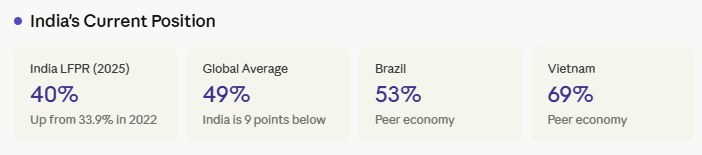
Context: Despite a rising trend in female LFPR, India remains significantly below global averages. The Women’s Reservation Act’s stalled Parliamentary approval has renewed focus on women’s broader economic participation in the workforce, academia, and corporate leadership.
India has seen a significant rise in female workforce participation, as highlighted by Periodic Labour Force Survey (PLFS) data.
What is Female LFPR?
- Definition: Labour Force Participation Rate (LFPR) measures the percentage of the working-age population (15–64 years) that is either employed or actively seeking employment.
- Why it matters: It is a key indicator of how productively a country utilises its human capital. A low female LFPR signals a large untapped economic potential.
- Economic link: The World Bank (2023) noted that India must grow at nearly 8% per year to become a developed economy by 2047, a target that is unachievable with persistently low female workforce participation.
Women Workforce Participation in India: Current Status (PLFS Data)
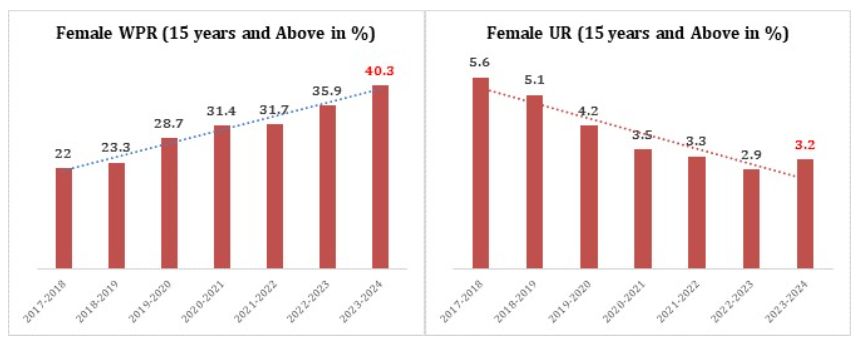
- Workforce Participation Rate (WPR): Women’s WPR rose from 22% in 2017-18 to 40.3% in 2023-24.
- Unemployment Rate (UR): Fell from 6% (2017-18) to 3.2% (2023-24).
- Rural vs Urban: Female employment grew by 96% in rural areas and 43% in urban areas.
- Educated Women Workforce: Employability of female graduates ↑ from 42% (2013) to 47.5% (2024).
- Postgraduates’ WPR ↑ from 5% (2017-18) to 40% (2023-24).
- Entrepreneurial Growth: Share of women-owned MSMEs rose from 17.4% (2010-11) to 26.2% (2023-24), generating 89 lakh jobs (FY21–23).
Why is India’s Female LFPR Low?
Demand-side problem (Primary cause)
- Core issue: India’s low female LFPR is primarily a demand-side problem; there are not enough quality jobs, not just a reluctance to work.
- Labour-abundant economic risk: In India’s informal-sector-dominated economy, simply increasing female labour supply without creating new jobs would only drive wages down further, not improve welfare.
Supply-side barriers (Secondary causes)
- Patriarchal norms: Persistent social expectations restrict women’s mobility and professional aspirations across many regions.
- Institutional barriers: Limited access to formal education, credit, and legal protection constrains women’s economic agency.
- Sector exclusion: Limited opportunities in high-productivity sectors like manufacturing, technology, and finance.
- Decision-making gap: Underrepresentation in leadership and decision-making roles creates a structural self-reinforcing cycle.
| Women in Senior Academic Positions |
IITs (Indian Institutes of Technology)
|
Women in Business and Corporate Leadership
Ownership and Entrepreneurship
- Proprietorship gap: Female-owned establishments account for only 27% of total unincorporated sector enterprises (Statistics Ministry, 2025).
Senior Management
- Stark disparity: For every 100 males working as legislators, senior officials, and managers, only 13 females hold similarly high positions (PLFS, 2025).
- What this means: The gender gap in management is not marginal — it is structural, at a ratio of nearly 8:1.
Corporate Boards
- Nominal compliance: Nearly all leading Indian firms have at least one woman director, but 77% of firms have only 1–2 women directors.
- Leadership void: Only 7% of BSE 200 and 5% of NSE 500 board chairpersons are women.
- Tokenism concern: The “one-woman director“ mandate is widely treated as the maximum rather than the minimum, reducing it to a box-ticking exercise rather than genuine inclusion.
| Steps Taken by the Government to Enhance Female Labour Force Participation |
| ● Maternity Benefit (Amendment) Act, 2017: Increased paid maternity leave to 26 weeks, with provisions for work-from-home options and mandatory crèche facilities for large establishments.
● Anganwadi Centres under ICDS: Provide nutritional security, early childhood education, and a safe environment to support women in returning to the workforce. ● National Food Security Act (NFSA), 2013: Cash transfer of ₹ 6,000 to pregnant and lactating women to alleviate the pressure of early re-entry to work. ● Stand Up India Scheme: Facilitates bank loans (₹ 10 lakh to 1 crore) for women entrepreneurs in sectors like manufacturing, services, and agri-allied activities. ● Sexual Harassment of Women at Workplace Act, 2013: Ensures workplace safety for women by providing legal recourse against harassment. ● Mahatma Gandhi National Rural Employment Guarantee Scheme (MGNREGS): 55% female participation, enhancing livelihood security for rural women. ● Factories Act, 1948 (Night Shift Provisions): Lifting of the night shift ban for women, with safety and transport provisions to increase job opportunities. ● Mahila Shakti Kendra (MSK): Empowers rural women through skill development and employment opportunities. |
Government Initiatives to Increase Women’s Participation
| Scheme / Initiative | Focus Area | Impact on Women |
| Deendayal Antyodaya Yojana: NRLM | Rural livelihoods, SHGs | Created 87 lakh+ women SHGs, promoted entrepreneurship at the grassroots |
| Skill India Mission | Skill development | Job-ready skills for women in new sectors (IT, healthcare, manufacturing) |
| Namo Drone Didi | Technology in agriculture | Training women to use drones for agri-services, enhancing rural incomes |
| PM Mudra Yojana | Microfinance & credit | 68% of loans sanctioned to women; supported small-scale businesses |
| Stand-Up India | Entrepreneurial loans | Bank loans for women (and SC/ST), boosting business ownership |
| PM SVANidhi | Street vendors support | 44% beneficiaries are women; access to working capital loans |
| Startup India | Innovation & startups | ~50% of registered startups have at least one woman director |
| EPFO Payroll Expansion | Formal sector jobs | 1.56 crore women added to the formal workforce in the last 7 years |
| e-Shram Portal | Unorganised sector workers | 16+ crore women registered; enabled access to social security schemes |
| Maternity Benefit Act, 2017 | Workplace support | Extended paid leave to 26 weeks; better work–life balance |
| Gender Budgeting | Resource allocation | ↑ 429% in the last decade; ₹4.49 lakh crore allocated in FY 2025–26 |
| Beti Bachao, Beti Padhao | Education & awareness | Increased girl enrollment in schools, empowering the future workforce |
Significance of Rising Women Workforce Participation
- Economic Growth & Productivity: Greater female participation expands India’s labour pool, raising productivity.
- Equal participation could boost India’s GDP by nearly 27% (World Bank).
- Social Empowerment: Women’s earnings improve family nutrition, education, and healthcare.
- Enhances women’s voice and decision-making power in households and society.
- Gender Equality & Inclusiveness: Marks a shift from women as beneficiaries to women as drivers of development.
- Increasing representation in startups, corporates, and MSMEs helps break gender stereotypes.
- National Development Goals: Rising participation strengthens India’s march towards Viksit Bharat 2047 (70% women workforce participation).
- Contributes directly to achieving Sustainable Development Goals (SDG 5: Gender Equality & SDG 8: Decent Work and Growth).

 Right to Education (RTE) Act 2009 and So...
 Women’s Representation on Corporate Bo...
 Why Women’s Reservation Alone Is Not E...














 WhatsApp