
Table of Contents
Context: Recently, scientists have engineered a pacemaker smaller than a grain of rice.
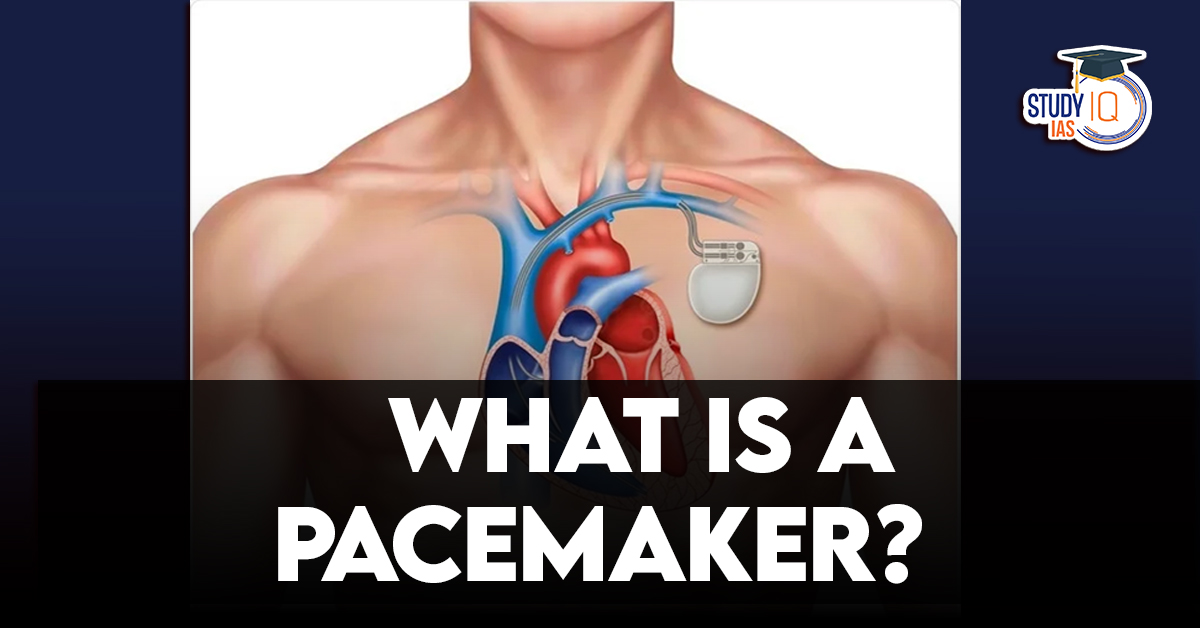
What Is a Pacemaker?
- A pacemaker is a small medical device that helps the heart beat at a normal rate.
- It sends electrical signals to the heart muscles when the heartbeat is too slow, irregular or has stopped.
- Pacemakers are used in people with heart conditions such as bradycardia (slow heart rate), especially after surgery or in infants with congenital (from birth) heart disease.
About Newly Discovered Pacemaker
- Ultra-Tiny Pacemaker is smaller than a grain of rice.
- It is 2.5 times smaller than the previous smallest pacemaker created by Oklahoma University.
- It can be injected directly into the heart using a needle — no surgery is needed.
- Traditional temporary pacemakers require open-heart or endovascular surgery to put in and later remove the device.
Key Features
- It is made of Bioresorbable Materials, which naturally dissolve in the body after a certain time. So, there is no need to remove it after use.
- No Battery or External Power Source (Self-powered):
- The pacemaker has two electrodes at the bottom.
- These electrodes interact with the body’s fluids (like blood) to produce electricity, similar to a small chemical battery.
- It is controlled by an external patch. The patient wears a small patch on the chest (outside the body) which monitors the heart rate.

 Krakatau Volcano Eruption 2026: Why Is I...
 Reverse Vaccinology: How Genome-Based Te...
 India-Belgium Relations 2026: Why Belgiu...














 WhatsApp





