Table of Contents
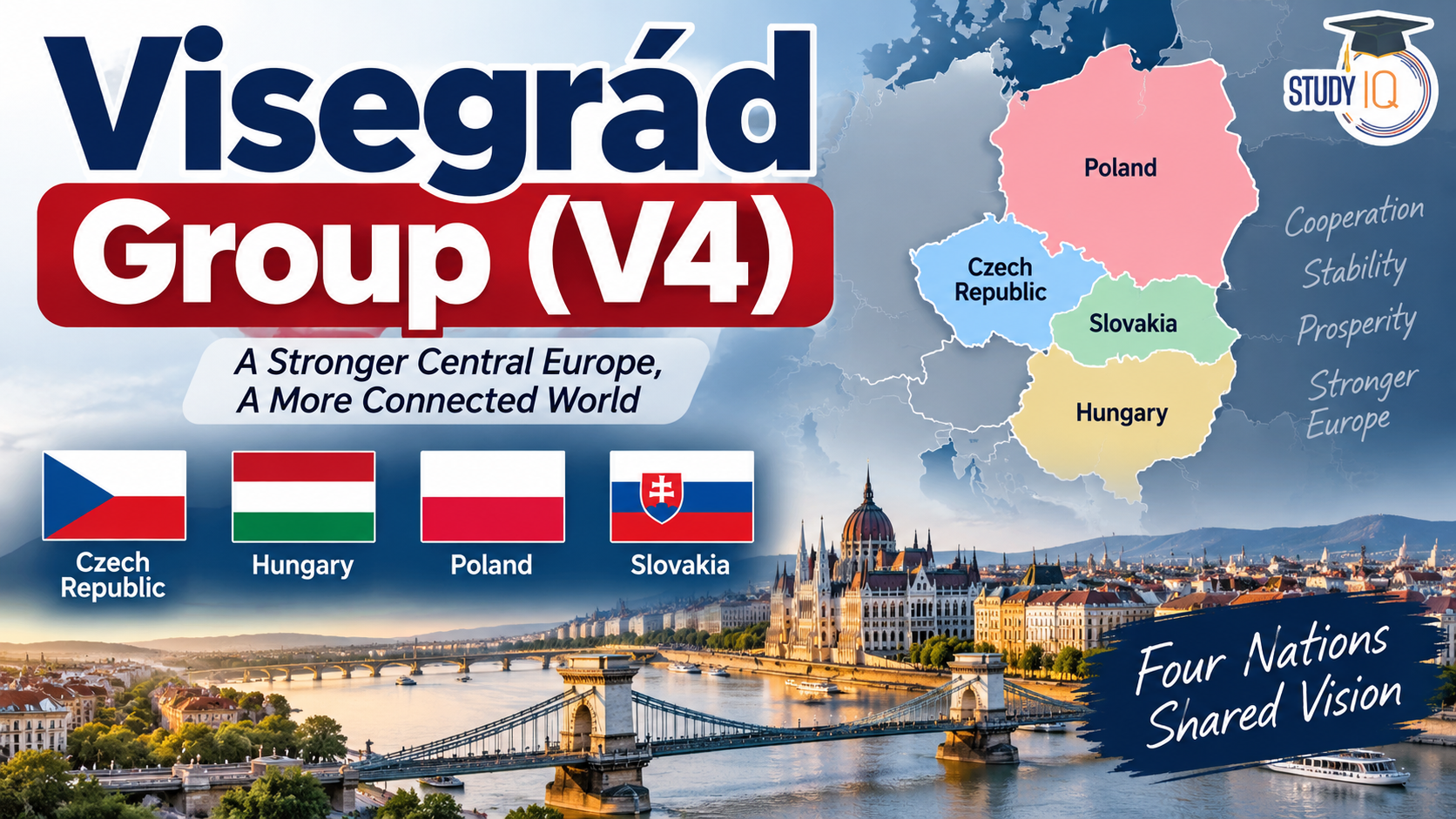
Recently, the four members of the Visegrád Group—Czech Republic, Hungary, Poland and Slovakia—supported India’s bid for a permanent seat on the United Nations Security Council (UNSC) during their first Foreign Ministers’ meeting with India.
The development is significant for India’s efforts to promote UNSC reform and greater representation of developing countries in global governance.
Read Also: UPSC Daily Current Affairs 2026
What is the Visegrád Group?
The Visegrád Group, also called the Visegrád Four (V4), is an informal regional cooperation platform in Central Europe.
It was established in 1991 to promote cooperation among its members in political, economic, cultural, security and other areas.
Visegrád Group Members
The four members are:
- Czech Republic
- Hungary
- Poland
- Slovakia
History of the Visegrád Group
The group was established in 1991, when the leaders of Poland, Czechoslovakia and Hungary met in the Hungarian town of Visegrád.
The grouping sought to strengthen cooperation among the Central European states following the end of the Cold War and the dissolution of the Warsaw Pact.
After Czechoslovakia split into the Czech Republic and Slovakia in 1993, the grouping became known as the Visegrád Four (V4).
How Does the Visegrád Group Work?
The V4 is an informal intergovernmental forum rather than a formal international organisation.
Key features include:
- Decisions are generally taken through consensus.
- It has no permanent institutional structure.
- The presidency rotates annually among the four members.
- The presidency sets the priorities and agenda for cooperation.
- Meetings are organised at different levels, including:
- Heads of State
- Prime Ministers
- Foreign Ministers
- Ministers for European Affairs
- Technical ministries
The group also cooperates with other countries through the “V4+” format.
Areas of Cooperation
The Visegrád Group promotes cooperation in areas such as:
- Economic cooperation
- Defence and security
- Energy
- Culture
- Political cooperation
- European affairs
- Regional and international issues
Visegrád Group and India
The V4 countries’ support for India’s permanent membership of the UNSC is important in the context of India’s long-standing demand for reform of the UN Security Council.
For India, engagement with the V4 provides an additional platform for strengthening relations with Central and Eastern Europe and building support for a more representative multilateral system.
Significance
The Visegrád Group is relevant to UPSC International Relations through the following themes:
- Regional groupings in Europe
- India–Europe relations
- UN Security Council reform
- Multilateralism
- Global governance
- Central and Eastern Europe
- Consensus-based intergovernmental cooperation
Key Facts at a Glance
| Feature | Details |
|---|---|
| Full/Popular Name | Visegrád Group / Visegrád Four |
| Established | 1991 |
| Members | Czech Republic, Hungary, Poland, Slovakia |
| Region | Central Europe |
| Nature | Informal intergovernmental forum |
| Decision-making | Consensus |
| Presidency | Rotates annually |
| Permanent Structure | No |
| Cooperation Format | V4+ |
| Current Relevance for India | Support for India’s permanent UNSC membership |
Sharing is caring!
 UNGA 2026: India, Reformed Multilaterali...
 Hurricane Polo 2026: Category 5 Storm, E...
 East Sea (Sea of Japan): Location, Count...


 WhatsApp