Table of Contents
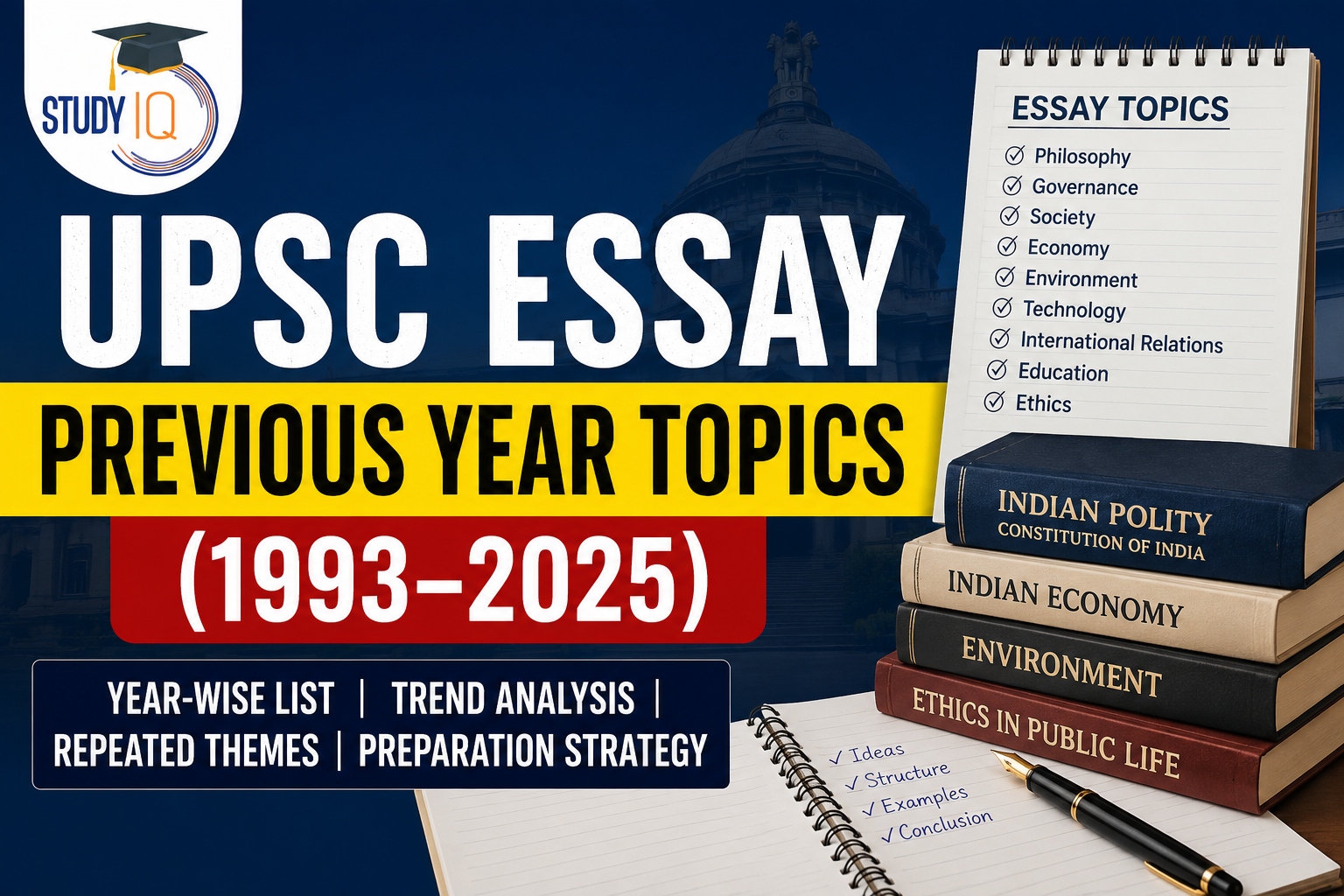
The UPSC Civil Services Mains Essay Paper is one of the most scoring yet challenging papers in the examination. Carrying 250 marks, it often becomes the deciding factor between an average rank and a top rank. Unlike General Studies papers, the Essay paper has no fixed syllabus, making Previous Year Topics (PYQs) the best source to understand UPSC’s expectations.
An analysis of UPSC Essay Previous Year Topics from 1993 to 2025 reveals recurring themes, evolving priorities, and the changing nature of questions. Over the last three decades, UPSC has gradually shifted from governance and development-based essays to philosophical, multidisciplinary, and quote-based topics, while continuing to test candidates on society, economy, technology, environment, and ethics.
This article provides a comprehensive analysis of UPSC Essay Previous Year Topics, major trends, recurring themes, decade-wise evolution, and preparation strategies for UPSC Mains 2026.
The essay paper requires candidates to remain close to the topic, organize ideas logically, write concisely, and demonstrate effective expression, as highlighted by UPSC’s evaluation approach and reflected in previous years’ papers.
UPSC Essay Paper Pattern
| Feature | Details |
|---|---|
| Paper | Essay |
| Marks | 250 |
| Duration | 3 Hours |
| Essays to be Written | 2 |
| Marks per Essay | 125 |
| Word Limit | Around 1000–1200 words |
| Questions | 8 (Choose 1 from each section) |
Why Analyze UPSC Essay Previous Year Topics?
Studying previous year essay topics helps aspirants:
- Understand UPSC’s changing approach.
- Identify high-frequency themes.
- Develop interdisciplinary thinking.
- Build content repositories.
- Improve essay structuring.
- Predict emerging themes.
- Enhance answer-writing confidence.
UPSC Essay Previous Year Paper PDF
UPSC Essay Trend Analysis (1993–2025)
Over the last 33 years, UPSC has significantly changed the nature of essay topics.
Phase I (1993–2002): Nation Building & Governance
Major focus areas included:
- Democracy
- Women Empowerment
- Indian Society
- Liberalisation
- Globalisation
- Education
- Culture
- Public Administration
Technology-related essays were relatively limited during this period.
Phase II (2003–2012): Governance Meets Globalisation
New themes emerged:
- Terrorism
- Judicial Activism
- Climate Change
- Internet
- Media
- Public-Private Partnership
- Science & Mysticism
- Indian Economy
The essay paper became more analytical.
Phase III (2013–2025): Philosophy Dominates
Since 2013, UPSC has increasingly emphasized:
- Abstract thinking
- Ethical reasoning
- Philosophical quotations
- Social justice
- Artificial Intelligence
- Climate Change
- Digital Economy
- Human Values
Recent papers have featured a balanced mix of philosophical reflections and applied contemporary issues.
Topic-wise Distribution of UPSC Essay Previous Year Topics
| Theme | Approximate Frequency |
|---|---|
| Philosophy & Ethics | 40+ |
| Society & Social Justice | 20+ |
| Governance & Administration | 14+ |
| Economy & Development | 14+ |
| Science & Technology | 14+ |
| Education | 13+ |
| Women Empowerment | 12+ |
| International Relations | 12+ |
| Environment | 10+ |
| Democracy & Constitution | 10+ |
| Culture | 10+ |
| Media | 9+ |
| Globalisation | 9+ |
| Ethics in Governance | 8+ |
| Federalism | 7+ |
| Internal Security | 5+ |
| Agriculture | 4+ |
Most Repeated UPSC Essay Themes
1. Philosophy & Ethics
The most frequently asked category includes themes such as:
- Truth
- Happiness
- Wisdom
- Simplicity
- Character
- Courage
- Leadership
- Gratitude
- Knowledge
- Human Values
This category has become the hallmark of the Essay paper.
2. Society
Repeated topics include:
- Women Empowerment
- Patriarchy
- Social Justice
- Equality
- Diversity
- Education
- Youth
- Family
3. Economy
UPSC increasingly links economic growth with:
- Inclusiveness
- Sustainability
- Human Development
- Employment
- Innovation
- Welfare
4. Science & Technology
Frequently tested areas include:
- Artificial Intelligence
- Digital Economy
- Social Media
- Internet
- Cyber Security
- Innovation
- Technology and Ethics
5. Environment
Growing emphasis on:
- Forests
- Climate Change
- Sustainable Development
- Ecology
- Water
- Renewable Energy
Decade-wise Evolution of Essay Topics
| Period | Major Focus |
|---|---|
| 1993–2000 | Democracy, Society, Liberalisation |
| 2001–2010 | Governance, Media, Terrorism, Globalisation |
| 2011–2020 | Technology, Ethics, Federalism, Education |
| 2021–2025 | Philosophy, AI, Climate Change, Society |
Philosophy-Based Essays: The New UPSC Favourite
Between 2020 and 2025, almost every paper included multiple quote-based essays.
Examples include:
- Truth knows no color.
- Contentment is natural wealth.
- Happiness is the path.
- Thought creates the world.
- Mathematics is the music of reason.
- The doubter is a true man of science.
This trend indicates UPSC’s preference for evaluating original thinking, clarity of ideas, and multidimensional analysis over rote learning.
Emerging Themes in Recent Years
Recent essay papers suggest increasing emphasis on:
- Artificial Intelligence
- Digital Society
- Climate Justice
- Mental Health
- Women-led Development
- Social Media
- Sustainable Development
- Innovation
- Ethical Leadership
Declining Themes
Compared to the early 2000s, some themes appear less frequently:
- Globalisation
- Terrorism
- Liberalisation
- Privatization
- Cold War Politics
However, they remain relevant for broader understanding.
What Does UPSC Evaluate in Essays?
The Essay paper is not a test of factual knowledge alone. Examiners primarily assess:
- Understanding of the topic
- Logical flow of ideas
- Analytical depth
- Original thinking
- Multidimensional perspective
- Constitutional values
- Clarity of language
- Balanced arguments
- Effective conclusion
Preparation Strategy Based on Previous Year’s Topics
1. Classify Essays by Theme
Prepare separate notes for:
- Philosophy
- Society
- Economy
- Environment
- Technology
- Governance
- International Relations
2. Build a Content Repository
Collect:
- Constitutional provisions
- Committee recommendations
- Government schemes
- Reports
- Supreme Court judgments
- Quotations
- Statistics
- Case studies
- Historical examples
3. Practice Weekly
Aim to write:
- One philosophical essay
- One contemporary issue-based essay
every week.
4. Develop Flexible Frameworks
Instead of memorizing essays, master adaptable structures that can be applied across topics.
5. Learn Effective Introductions
Use:
- Anecdotes
- Historical events
- Constitutional values
- Current affairs
- Short stories
- Quotes
- Real-life examples
Expected High-Priority Themes for UPSC Mains 2026
Based on long-term trends, aspirants should prioritize:
- Truth and Ethics
- Artificial Intelligence & Society
- Climate Change
- Women-led Development
- Digital Public Infrastructure
- Inclusive Growth
- Leadership
- Mental Health
- Innovation
- Constitutional Morality
- Sustainable Development
- Human Values
- Critical Thinking
- Global Governance
- Green Economy
These are preparation priorities inferred from historical trends rather than predictions of exact questions.
Common Mistakes Aspirants Make
Avoid these errors:
- Treating essays like General Studies answers.
- Writing one-dimensional arguments.
- Ignoring philosophical topics.
- Overusing quotations without analysis.
- Weak introductions.
- Abrupt conclusions.
- Lack of examples.
- Poor paragraph transitions.
- Exceeding the word limit.
- Skipping regular writing practice.
Key Takeaways
- Philosophy has emerged as the most dominant theme in UPSC Essay papers over the last decade.
- Society, technology, environment, economy, and governance remain consistently important.
- AI, climate change, and digital transformation are increasingly prominent.
- UPSC rewards balanced, analytical, and multidimensional essays rather than fact-heavy answers.
- Regular analysis of previous year topics helps aspirants identify recurring patterns, refine their writing approach, and prepare strategically for the Mains examination.
Latest UPSC Updates
| Resource | Link |
|---|---|
| UPSC Prelims Result 2026 | Check Here |
| UPSC Exam Calendar 2027 | View Calendar |
| UPSC Question Paper 2026 | Download PDF |
| UPSC Prelims Answer Key 2026 | Check Answer Key |
| UPSC Cut Off 2026 | View Cut Off |
| UPSC Syllabus 2026 | Read Syllabus |
| Daily Current Affairs 2026 | Read Updates |
| StudyIQ UPSC IAS Foundation 2027 (English) | Join Course |
| StudyIQ UPSC IAS Foundation 2027 (Hindi) | Join Course |
| StudyIQ UPSC IAS Foundation 2027 (Bilingual) | Join Course |
 UPSC EPFO Previous Year Question Papers ...
 UPSC EPFO Question Paper 2025 PDF Downlo...
 UPSC EPFO APFC Exam Date 2026 Out: Check...











 WhatsApp