Table of Contents
Context
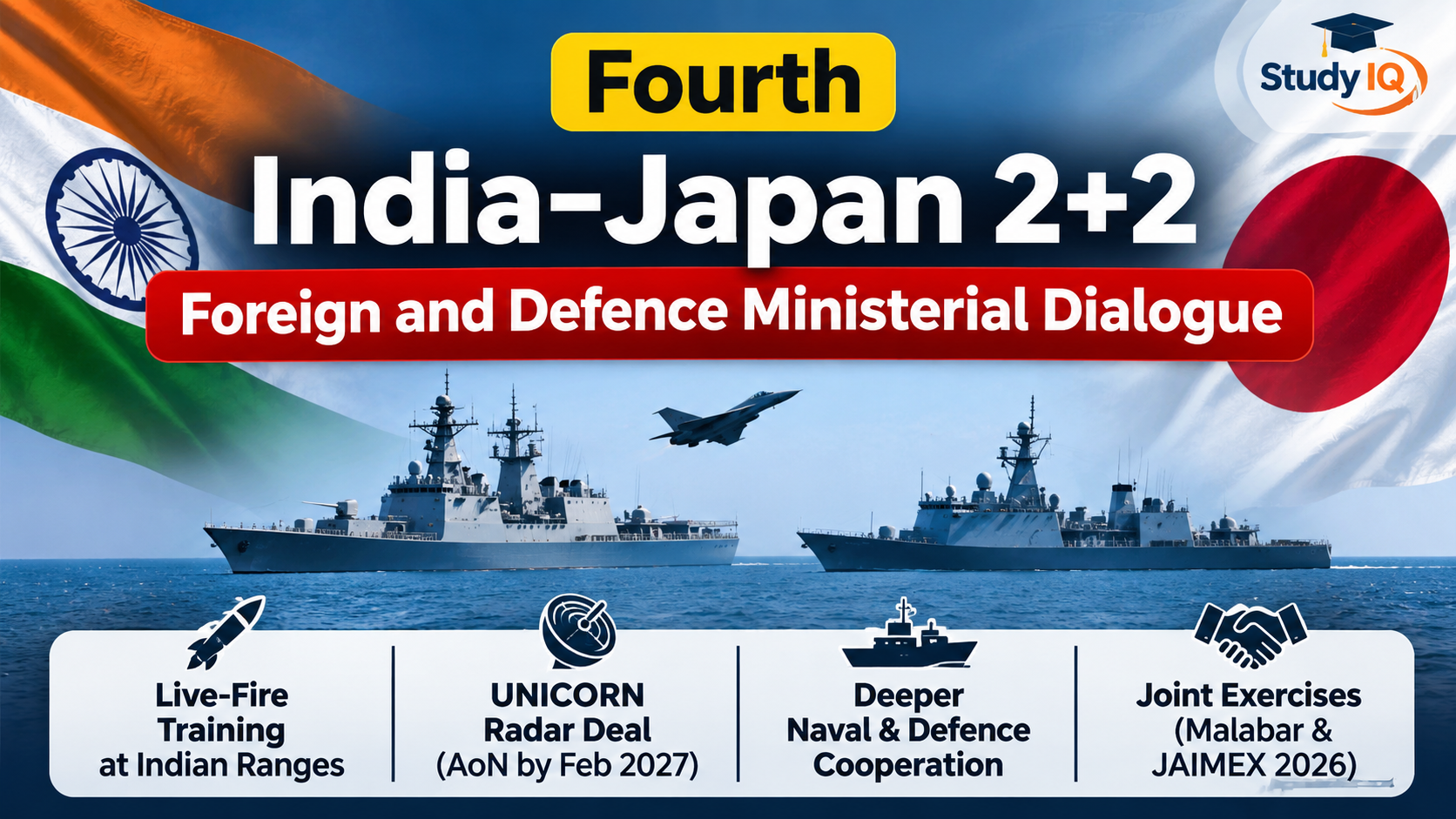
India and Japan held the fourth “2+2” Foreign and Defence Ministerial Dialogue in Tokyo on 19 November 2026. They welcomed a Letter of Intent (LoI) that allows Japan’s Self-Defence Forces, for the first time, to conduct live-fire training, including with surface-to-ship missiles, at Indian firing ranges.
About the India–Japan 2+2 Dialogue
- Origin: the first India–Japan 2+2 meeting was held in New Delhi on 30 November 2019, followed by Tokyo (September 2022) and New Delhi (August 2024).
- Strategic framework: ties were elevated to a Special Strategic and Global Partnership through the Tokyo Declaration of September 2014.
Key Outcomes
- UNICORN radar: progress was noted on India receiving Japan’s Unified Complex Radio Antenna (UNICORN) naval system. An early “Acceptance of Necessity” (AoN) is on track by February 2027.
- Naval cooperation: the two sides discussed mine countermeasures and joint development in naval shipbuilding and design. They agreed to deepen information-sharing between the Japan Maritime Self-Defence Force and the Indian Navy.
- Exercises: they welcomed participation in Malabar 2026 and JAIMEX 2026, and agreed to expand exercises and exchanges between their Special Operations Forces.
- Defence technology: collaboration between the DRDO and Japan’s Acquisition, Technology and Logistics Agency (ATLA) will advance work on advanced missile and defence technologies. They will also cooperate on air domain awareness.
- Evacuation preparedness: consular authorities will hold a dialogue and a tabletop exercise (TTX) to plan the evacuation of Indian and Japanese nationals in emergencies.
- Japan’s security reforms: Japan briefed India on revisions to its National Security Strategy, National Defence Strategy and Defence Buildup Program under Prime Minister Sanae Takaichi, amid the wars in West Asia and Ukraine.
- Wider agenda: talks covered economic security; government-to-government, business-to-business and people-to-people links; the Indo-Pacific; regional hotspots; and multilateral cooperation. Both sides seek a free and open Indo-Pacific alongside their Quad partners.
Key Terms
- UNICORN: an integrated mast that combines multiple antennas into a single structure to improve stealth. It is fitted on the Japan Maritime Self-Defense Force’s Mogami-class frigates.
- Acceptance of Necessity (AoN): the in-principle approval for a defence acquisition. It is granted by the Defence Acquisition Council (DAC), chaired by the Defence Minister.

 MPPSC Exam Calendar 2027 Out: Check Exam...
 Air Pollution in India: Causes, Challeng...
 UP PCS J Notification 2026 Out: 365 Vaca...













 WhatsApp