
Table of Contents
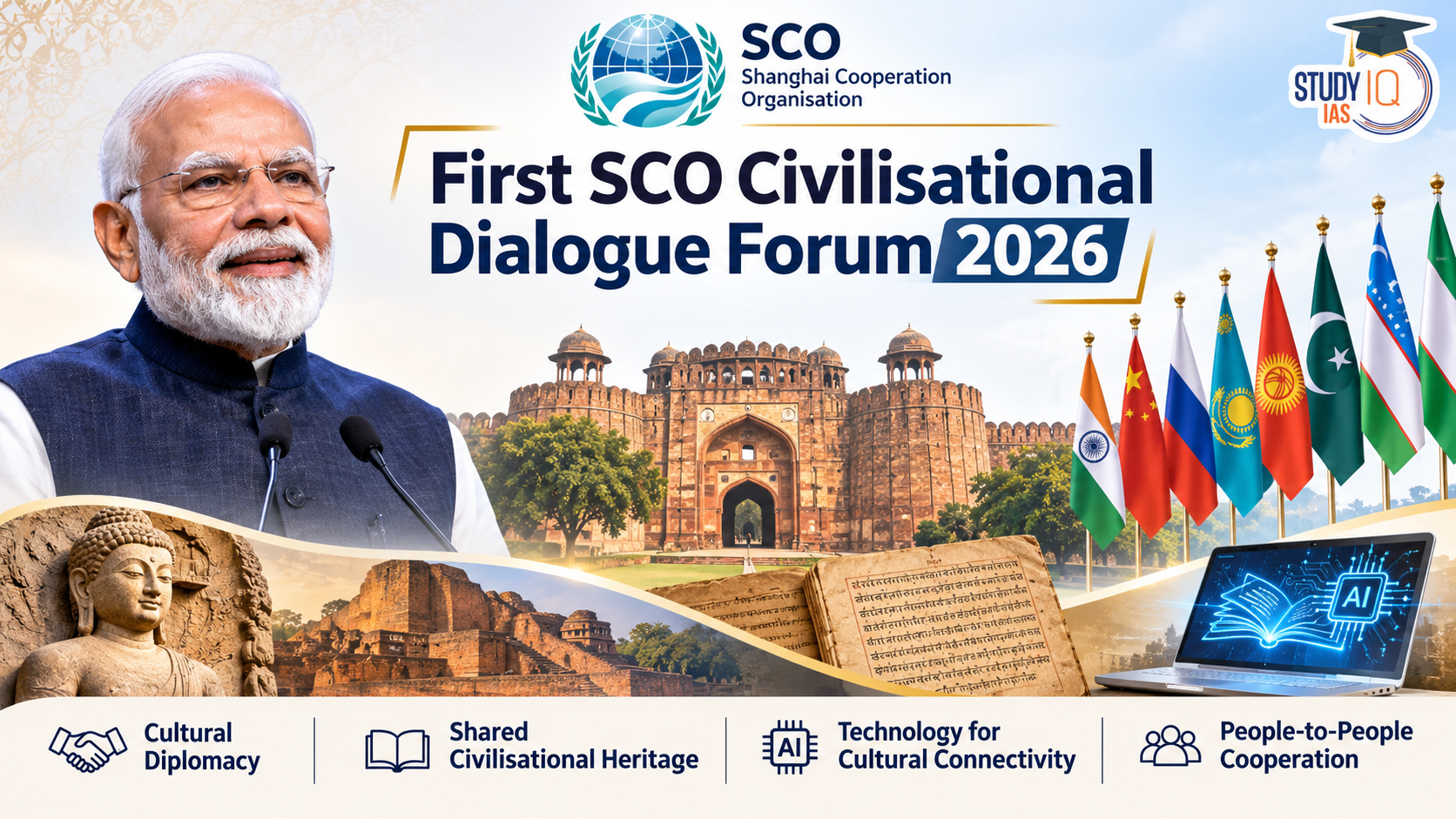
Prime Minister Narendra Modi inaugurated the First Shanghai Cooperation Organisation (SCO) Civilisational Dialogue Forum on 20 November 2026 at Purana Qila, New Delhi. The initiative aims to strengthen cultural cooperation, preserve shared heritage and promote mutual understanding among SCO member countries.
At a time when the world is witnessing geopolitical tensions, conflicts and regional instability, the forum highlights the importance of civilisational dialogue as an instrument of peace, trust and international cooperation.
The initiative also builds on the 25th anniversary of the Shanghai Cooperation Organisation and seeks to complement its existing cooperation in security, economy and connectivity.
Key Highlights of the SCO Civilisational Dialogue Forum 2026
1. Cultural Diplomacy for Global Peace
-
PM Modi emphasised that civilisational dialogue can contribute to global peace and mutual understanding.
-
He highlighted that while empires have changed geographical boundaries, civilisational exchanges have transformed and enriched human thought.
-
Cultural cooperation can strengthen diplomatic relations beyond traditional political and economic partnerships.
2. Historical Civilisational Connections
-
The Indus Valley Civilisation maintained trade links with Mesopotamia around 5,000 years ago.
-
The Silk Routes connected India, China, Central Asia and Eurasia.
-
Buddhist monks and scholars such as Faxian, Xuanzang, Yijing and Kumarajiva facilitated the exchange of knowledge, languages and religious ideas.
-
Ancient institutions such as Nalanda and cultural centres like Kucha and Dunhuang played an important role in intellectual exchanges.
3. Shared Cultural and Intellectual Heritage
The Prime Minister highlighted several examples of cultural exchange across Asia:
-
Panchatantra: Indian stories travelled to Persia and the Arab world as Kalila wa Dimna.
-
Ramayana: Its influence spread across Southeast Asia, including Cambodia, where it is known as Reamker.
-
Mathematics: The mathematical contributions of Indian scholar Brahmagupta reached Baghdad and influenced scholars such as Al-Khwarizmi.
-
Music: Central Asian Maqam traditions share connections with Indian Raga traditions.
-
Architecture: Central Asian garden traditions influenced the development of the Charbagh style in India.
Role of Technology in Promoting Cultural Connectivity
The Prime Minister highlighted the transformative role of 21st-century technology in strengthening cultural relations among SCO countries.
Key initiatives include:
-
Digitisation of Heritage: Digitising ancient manuscripts, historical documents, artefacts and rare texts preserved in museums, libraries and archives.
-
AI-based Translation: Using Artificial Intelligence (AI) to translate ancient literary and intellectual works into multiple languages.
-
Digital Knowledge Sharing: Developing digital platforms for international academic collaboration and cultural exchange.
-
Joint Research: Encouraging collaborative research projects to explore shared historical and civilisational connections.
These initiatives can make cultural heritage more accessible to younger generations across the world.
Significance of the SCO Civilisational Dialogue Forum for India
1. Strengthening India’s Cultural Diplomacy
The forum provides India with an opportunity to showcase its civilisational heritage, philosophical traditions and cultural contributions to the world.
2. Strengthening Regional Cooperation
Cultural engagement can complement economic and security cooperation among SCO member countries and create stronger people-to-people connections.
3. Promoting India’s Soft Power
India’s traditions of Buddhism, Yoga, Ayurveda, literature, music and philosophy can strengthen its international influence through cultural diplomacy.
4. Preserving Shared Heritage
Joint efforts in digitisation, translation and historical research can protect valuable cultural resources and promote their global accessibility.
5. Promoting Tourism and Connectivity
Heritage circuits connecting Silk Route and Buddhist heritage sites can encourage cultural tourism and strengthen regional economic opportunities.
6. Building Mutual Trust
Cultural exchanges can reduce misunderstandings, promote respect for diversity and create opportunities for dialogue even when political relations face challenges.
India’s Civilisational Philosophy: Vasudhaiva Kutumbakam
An important theme of the forum was India’s ancient philosophy of Vasudhaiva Kutumbakam, meaning the World Is One Family.
The philosophy highlights:
-
Universal brotherhood and global welfare.
-
Respect for cultural and religious diversity.
-
Peaceful coexistence among nations.
-
Collective responsibility towards humanity.
-
Mutual trust and understanding as foundations of global harmony.
PM Modi also invoked the Vedic mantra:
Sangachchhadhwam Samvadadhwam Sam Vo Manansi Janatam.
It means walk together, communicate together and let our minds be in harmony.
The mantra reflects the importance of dialogue, cooperation and collective action in building peaceful societies.
Way Forward
To translate the objectives of the SCO Civilisational Dialogue Forum into meaningful outcomes, the following steps are important:
-
Institutional Cooperation: Establish regular cultural dialogue mechanisms among SCO member countries.
-
Digital Preservation: Create collaborative digital repositories of ancient manuscripts, historical documents and cultural artefacts.
-
Academic Exchanges: Promote student, scholar and university exchange programmes.
-
Cultural Tourism: Develop heritage circuits connecting Buddhist sites, Silk Route destinations and historical monuments.
-
Youth Participation: Encourage young artists, writers, filmmakers and researchers to promote shared cultural heritage.
-
AI and Innovation: Use emerging technologies for translation, documentation and preservation of endangered languages and historical knowledge.
-
People-to-People Connectivity: Organise joint cultural festivals, exhibitions and artistic performances.
Conclusion
The First SCO Civilisational Dialogue Forum 2026 represents an important step towards strengthening cultural diplomacy and regional cooperation. It recognises that shared historical experiences, intellectual exchanges and cultural traditions can provide a strong foundation for international peace.
For India, the initiative offers an opportunity to promote its civilisational values, strengthen its soft power and contribute to a more inclusive and harmonious international order.
As reflected in the philosophy of Vasudhaiva Kutumbakam, global welfare is closely connected with mutual understanding, cooperation and respect for diversity.
 Core Sector Growth October 2026: ICI Rec...
 World Fisheries Day 2026: Theme, History...
 ULLAS Scheme: 11 States and UTs Declared...





 WhatsApp






