Table of Contents
World Fisheries Day 2026 is observed on 21 November to highlight the importance of sustainable fisheries, aquatic biodiversity and the livelihoods of fishing communities. The fisheries sector plays a crucial role in India’s food security, employment generation, rural development and export earnings. It is also an important pillar of India’s Blue Economy.
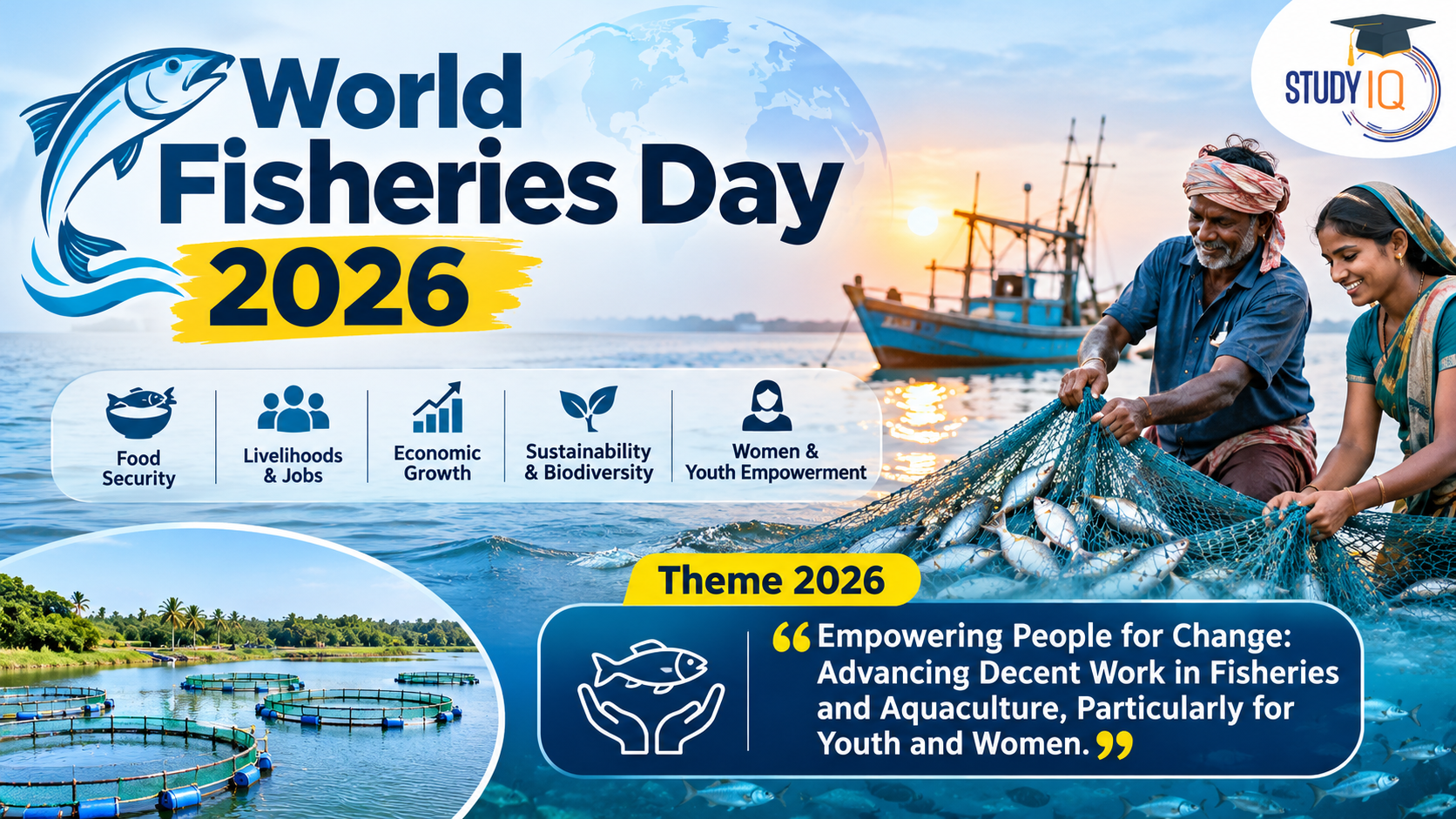
The 2026 observance focuses on empowering people working in fisheries and aquaculture, particularly women and youth, while promoting decent working conditions and sustainable resource management.
World Fisheries Day 2026: Key Highlights
| Particulars | Details |
|---|---|
| Date | 21 November 2026 |
| First Observed | 21 November 1997 |
| Origin | New Delhi, India |
| Theme 2026 | Empowering People for Change: Advancing Decent Work in Fisheries and Aquaculture, Particularly for Youth and Women |
| Related SDG | SDG 14 – Life Below Water |
| Main Focus | Sustainable fisheries and livelihoods |
History of World Fisheries Day
World Fisheries Day was first celebrated on 21 November 1997 in New Delhi, India. Representatives from 18 countries participated in the gathering, which led to the establishment of the World Forum of Fish Harvesters and Fish Workers.
The initiative provided an international platform for fishing communities to discuss their challenges, promote cooperation and advocate sustainable fisheries management. Since then, the day has been observed annually to recognise the contribution of fishing communities to food security and economic development.
Theme of World Fisheries Day 2026
The theme for World Fisheries Day 2026 is “Empowering People for Change: Advancing Decent Work in Fisheries and Aquaculture, Particularly for Youth and Women.”
The theme highlights the need to improve working conditions, ensure fair wages, strengthen occupational safety and expand social protection for fisheries workers.
It also emphasises women’s economic empowerment, youth participation, skill development and entrepreneurship in fisheries and aquaculture.
India’s Fisheries Sector: Key Statistics
India is the world’s second-largest fish producer and contributes approximately 8% to global fish production.
According to the figures provided for 2024–25, India’s fish production increased to 197.75 lakh tonnes from 95.79 lakh tonnes in 2013–14, representing growth of approximately 106%.
Other important statistics include:
-
Livelihoods: Around 3 crore people depend on the fisheries sector.
-
Seafood Exports: ₹62,408 crore in 2024–25.
-
Fisheries Allocation: ₹2,761.80 crore in the 2026–27 Budget.
-
Major Sources: Marine fisheries, inland fisheries and aquaculture.
The sector contributes to nutritional security, rural employment, foreign exchange earnings and the development of coastal communities.
Major Government Schemes for Fisheries Development
The Government of India has introduced several initiatives to modernise fisheries infrastructure and improve the income of fishers.
1. Pradhan Mantri Matsya Sampada Yojana (PMMSY): Launched in September 2020, it aims to increase fish production, improve productivity, modernise infrastructure and promote sustainable fisheries development.
2. Fisheries and Aquaculture Infrastructure Development Fund (FIDF): Established in 2018–19, it provides concessional finance for fishing harbours, hatcheries, cold storage and other fisheries infrastructure.
3. PM Matsya Kisan Samridhi Sah-Yojana (PM-MKSSY): Launched in 2024, it promotes formalisation, financial inclusion, insurance coverage and the development of micro and small fisheries enterprises.
4. Kisan Credit Card (KCC): Provides institutional credit to eligible fishers and fish farmers for their working capital requirements.
5. Blue Revolution Scheme: Promotes integrated fisheries development, higher production, infrastructure improvement and better livelihoods.
Challenges Facing India’s Fisheries Sector
Despite significant growth, the sector faces several challenges:
-
Overfishing: Excessive fishing pressure threatens fish stocks and marine biodiversity.
-
Climate Change: Rising ocean temperatures, ocean acidification and extreme weather events affect aquatic ecosystems.
-
Marine Pollution: Plastic waste, industrial discharge and untreated sewage damage marine habitats.
-
Infrastructure Gaps: Inadequate cold storage, transportation and processing facilities increase post-harvest losses.
-
Financial Constraints: Small-scale fishers often face difficulties accessing institutional credit and insurance.
-
Occupational Risks: Unsafe working conditions and inadequate social protection affect fishing communities.
Way Forward for Sustainable Fisheries
India needs an integrated approach to balance economic growth with ecological conservation. Promoting climate-resilient aquaculture, modern cold-chain infrastructure, scientific fish farming and sustainable fishing practices is essential.
Greater investment in research, digital monitoring, women’s participation and youth entrepreneurship can strengthen the sector. Effective regulation against illegal, unreported and unregulated fishing is equally important.

FAQs on World Fisheries Day 2026
Q1. When is World Fisheries Day celebrated?
It is celebrated every year on 21 November.
Q2. What is the theme of World Fisheries Day 2026?
Empowering People for Change: Advancing Decent Work in Fisheries and Aquaculture, Particularly for Youth and Women.
Q3. When was World Fisheries Day first celebrated?
21 November 1997, in New Delhi, India.
Q4. Which SDG is associated with World Fisheries Day?
SDG 14 – Life Below Water.
Q5. Which is India’s flagship fisheries development scheme?
Pradhan Mantri Matsya Sampada Yojana (PMMSY).
 First SCO Civilisational Dialogue Forum ...
 Core Sector Growth October 2026: ICI Rec...
 ULLAS Scheme: 11 States and UTs Declared...












 WhatsApp