
Table of Contents
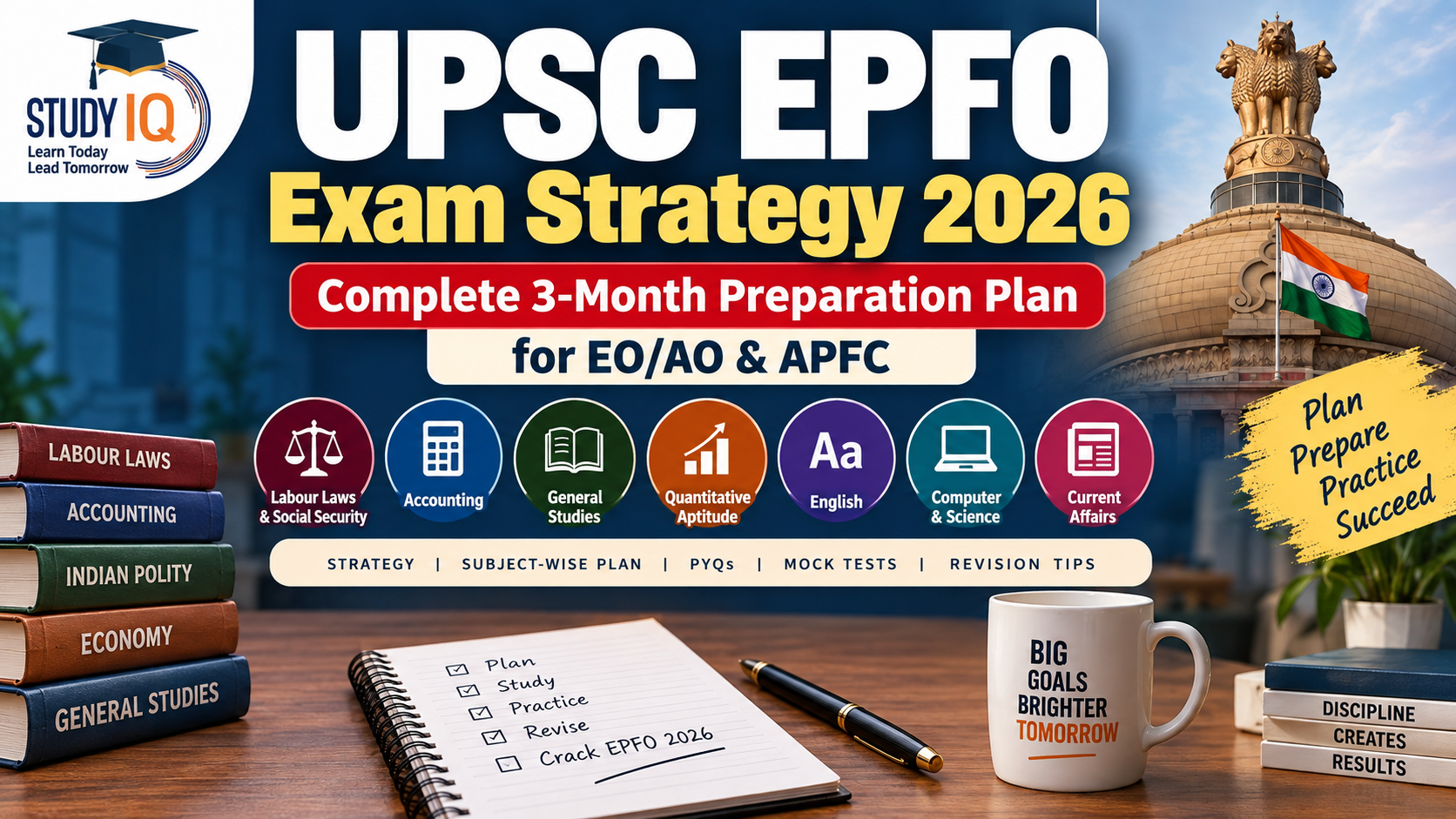
The UPSC EPFO Exam 2026 is an important opportunity for candidates preparing for the posts of Enforcement Officer/Accounts Officer (EO/AO) and Assistant Provident Fund Commissioner (APFC). The syllabus covers multiple subjects, including Labour Laws, Social Security, Accounting, General Studies, English, Quantitative Aptitude, Current Affairs, Science and Computer Applications.
With around three months available, candidates should avoid trying to complete every book and PDF. The focus should instead be on high-priority topics, Previous Year Questions (PYQs), conceptual clarity, regular revision and mock tests.
UPSC EPFO 2026 Preparation Strategy
The most effective preparation cycle is:
Understand Syllabus → Analyse PYQs → Prioritise Topics → Study Concepts → Practise Questions → Revise → Take Mocks
A candidate should divide the syllabus into three categories: high-priority, important and selective. This prevents valuable preparation time from being wasted on topics that have limited relevance.
| Preparation Area | Priority |
|---|---|
| Labour Laws & Industrial Relations | Very High |
| Social Security | Very High |
| Accounting | High |
| General English | High |
| Indian Polity | High |
| Economy | High |
| Current Affairs | High |
| Quantitative Aptitude | Moderate-High |
| Modern History | Moderate |
| Science | Moderate |
| Computer | Moderate |
1. Labour Laws and Industrial Relations
Labour Laws should be one of the core areas of UPSC EPFO preparation. Candidates should develop conceptual understanding rather than simply memorising provisions.
Important areas include:
- Trade Unions
- Collective Bargaining
- Industrial Disputes
- Strikes and Lockouts
- Labour Welfare
- Workers’ Participation
- Grievance Handling
- Dispute Settlement
- Industrial Relations
Candidates should also understand the framework of the four Labour Codes:
- Code on Wages, 2019
- Industrial Relations Code, 2020
- Code on Social Security, 2020
- Occupational Safety, Health and Working Conditions Code, 2020
Focus on objectives, important definitions, applicability, institutions and major provisions.
2. Social Security: A Key EPFO Area
Social Security deserves dedicated preparation because of its direct connection with the functioning of EPFO.
Important topics include:
- Employees’ Provident Fund
- Employees’ Pension Scheme
- Employees’ Deposit Linked Insurance
- Employees’ State Insurance
- Gratuity
- Maternity benefits
- Employees’ compensation
- Social security for unorganised workers
- Pension and welfare schemes
For every major scheme, prepare a short note covering:
Objective → Beneficiaries → Implementing institution → Key features → Recent developments
This format makes last-minute revision much easier.
3. Accounting: Don’t Ignore This Section
Accounting is often considered difficult by candidates without a Commerce background. However, strong fundamentals can make the subject much more manageable.
Focus on:
- Basic accounting principles
- Journal and Ledger
- Trial Balance
- Capital and Revenue Expenditure
- Depreciation
- Financial Statements
- Final Accounts
- Ratio Analysis
- Cash Flow Statement
- Inventory
- Basic Auditing
The ideal approach is:
Learn the concept → Solve examples → Attempt PYQs → Practise MCQs → Revise
Do not spend disproportionate time on advanced topics before completing the fundamentals.
4. General Studies: Use an Integrated Approach
Indian Polity
Focus on:
- Constitution
- Preamble
- Fundamental Rights
- DPSPs
- Fundamental Duties
- Parliament
- President and Governor
- Supreme Court
- Constitutional Bodies
- Emergency Provisions
- Election Commission
- Finance Commission
- Panchayati Raj
Indian Economy
Important areas include:
- GDP and National Income
- Inflation
- Unemployment
- Poverty
- Monetary Policy
- Fiscal Policy
- Banking
- Government Budget
- Balance of Payments
- Exchange Rates
- Economic Reforms
- Industrial Growth
Candidates should connect Economy with employment, labour markets, wages and social security.
5. Modern History and Freedom Struggle
Modern Indian History should be prepared selectively.
Important topics include:
- British expansion
- Revolt of 1857
- Socio-religious reform movements
- Formation of INC
- Swadeshi Movement
- Gandhian movements
- Revolutionary activities
- Tribal and peasant movements
- Constitutional developments
- Quit India Movement
- Independence and Partition
A timeline-based approach can help candidates quickly revise important events and their chronology.
6. English and Quantitative Aptitude
English should be studied consistently throughout the preparation period.
Important areas include:
- Reading Comprehension
- Vocabulary
- Synonyms and Antonyms
- Idioms and Phrases
- Error Detection
- Sentence Improvement
- Tenses
- Prepositions
- Subject-Verb Agreement
- Active and Passive Voice
For Quantitative Aptitude, prioritise:
- Percentage
- Ratio and Proportion
- Average
- Number System
- Profit and Loss
- Simple and Compound Interest
- HCF and LCM
- Time and Work
- Time, Speed and Distance
- Basic Mensuration
The goal should be accuracy and speed rather than learning hundreds of complicated shortcuts.
7. Current Affairs, Science and Computer
Current Affairs should be prepared according to the EPFO syllabus instead of attempting to cover every event.
Give priority to:
- Labour and Employment
- Social Security
- Government Schemes
- Economy
- Government Reports
- Important Indices
- Science & Technology
- International Organisations
- Major national developments
For General Science, cover basic Physics, Chemistry, Biology, Biotechnology and important scientific developments.
For Computer Applications, focus on:
- Hardware and Software
- Memory
- Operating Systems
- Internet
- Networking
- Databases
- MS Office
- Cybersecurity
- Encryption
- Digital Technologies
UPSC EPFO 3-Month Study Plan
A practical three-month plan can be structured as follows:
| Month | Main Focus | Additional Work |
|---|---|---|
| Month 1 | Labour Laws, Social Security, Accounting, Quant, English | PYQs + Current Affairs |
| Month 2 | Polity, Economy, History, Science, Computer | Revision of Month 1 |
| Month 3 | Full Revision, PYQs, Mock Tests, Current Affairs | Error Book + Short Notes |
Month 1: Build the Foundation
The first month should establish strong command over Labour Laws, Social Security and Accounting. Quant and English should be practised regularly rather than postponed.
Month 2: Complete General Studies
Complete Polity, Economy, Modern History, Science and Computer while continuing weekly revision of Labour Laws and Social Security.
Month 3: Enter Examination Mode
The final month should focus primarily on PYQs, mock tests, revision and error correction. Avoid constantly adding new resources.
Why PYQs Are So Important
PYQs should not be treated as a final-stage activity. They should influence your preparation from the beginning.
Use this cycle:
Topic → PYQs → Analyse Questions → Identify Gaps → Revise
PYQs help determine:
- Frequently tested topics
- Required depth of preparation
- Factual versus conceptual questions
- Your weak areas
- Question-solving speed
Before spending several hours on a topic, ask:
“What is the actual question potential of this topic?”
Mock Test Strategy
Mock tests are essential during the final phase. However, simply attempting tests is not enough.
After every mock, classify your mistakes:
| Mistake Type | Corrective Action |
|---|---|
| Conceptual | Re-study the topic |
| Factual | Add to short notes |
| Calculation | Practise more questions |
| Silly mistake | Improve concentration |
| Time management | Change attempt strategy |
Maintain an EPFO Error Book and revise it regularly.
Common Mistakes to Avoid
- Trying to complete every available book
- Ignoring Labour Laws until the final month
- Avoiding Accounting because of a non-Commerce background
- Collecting too many Current Affairs PDFs
- Memorising schemes without understanding them
- Starting mock tests too late
- Taking mocks without analysing mistakes
- Spending excessive time on difficult Quant
- Studying new material during the final revision phase

 Census Town in India: Criteria, Meaning ...
 OneTag Facility 2026: How to Change FAST...
 U.S. Sanctioning Act 2026: Impact on Ind...











 WhatsApp





