Table of Contents
Context
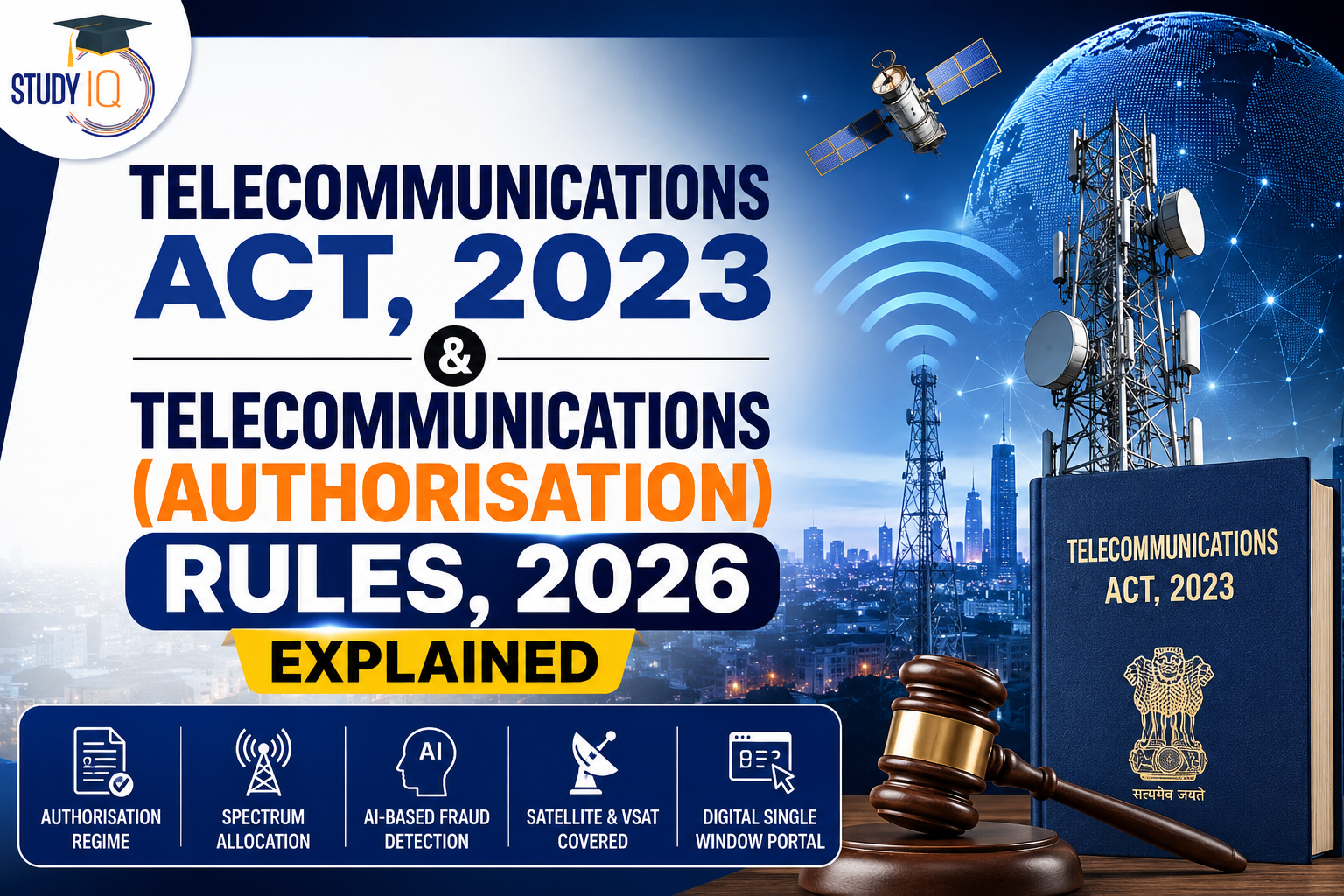
The Government has notified the Telecommunications (Authorisation) Rules, 2026, operationalising the Telecommunications Act, 2023 through a new authorisation-based regulatory framework.
Highlights of the Telecommunications (Authorisation) Rules, 2026
- Authorisation Regime: Replaces the legacy licence-based framework under the Indian Telegraph Act, 1885 with a unified statutory authorisation system for telecom, internet, and long-distance services at the national or telecom circle level.
- Validity: Authorisations are granted for a maximum period of 20 years.
- Statutory Definitions: Introduces legal definitions for key telecom infrastructure and operational terms, including access spectrum, captive non-public networks, cable landing stations, and core telecom networks.
- Requires telecom operators to deploy Artificial Intelligence (AI) and big data analytics for fraud detection and prevention, while complying with data localisation
- Brings satellite networks, earth stations, and Very Small Aperture Terminal (VSAT) services within the authorisation framework; however, separate approvals remain mandatory for spectrum assignment and gateway permissions.
- Clarifies that non-telecom revenues are excluded from the computation of Adjusted Gross Revenue (AGR).
- Designates the Telecom eServices Portal as the official single-window digital platform for processing telecom authorisations.
About Telecommunications Act, 2023
- Modernise India’s telecom regulatory framework by repealing the colonial-era Indian Telegraph Act, 1885, Indian Wireless Telegraphy Act, 1933, and Telegraph Wires (Unlawful Possession) Act, 1950.
- Provides for administrative allocation of spectrum for specified satellite communication services, instead of auction.
- Establishes a uniform, non-discriminatory Right of Way framework for telecom infrastructure.
- Empowers the Government to prescribe identity verification mechanisms, including biometric verification, for telecom subscribers.
- Civil Penalty Framework
- Introduces a civil penalty mechanism adjudicated by designated authorities.
- Appeals lie before the Designated Appeals Committee and subsequently the Telecom Disputes Settlement and Appellate Tribunal (TDSAT).
Latest UPSC Updates
| Resource | Link |
|---|---|
| UPSC Prelims Result 2026 | Check Here |
| UPSC Exam Calendar 2027 | View Calendar |
| UPSC Question Paper 2026 | Download PDF |
| UPSC Prelims Answer Key 2026 | Check Answer Key |
| UPSC Cut Off 2026 | View Cut Off |
| UPSC Syllabus 2026 | Read Syllabus |
| Daily Current Affairs 2026 | Read Updates |
| StudyIQ UPSC IAS Foundation 2027 (English) | Join Course |
| StudyIQ UPSC IAS Foundation 2027 (Hindi) | Join Course |
| StudyIQ UPSC IAS Foundation 2027 (Bilingual) | Join Course |
 Gandhi Jayanti 2026: History, Significan...
 Right to Vote in India: Constitutional S...
 Daily Mains Articles 2026 – Updated Da...














 WhatsApp