Table of Contents
Context
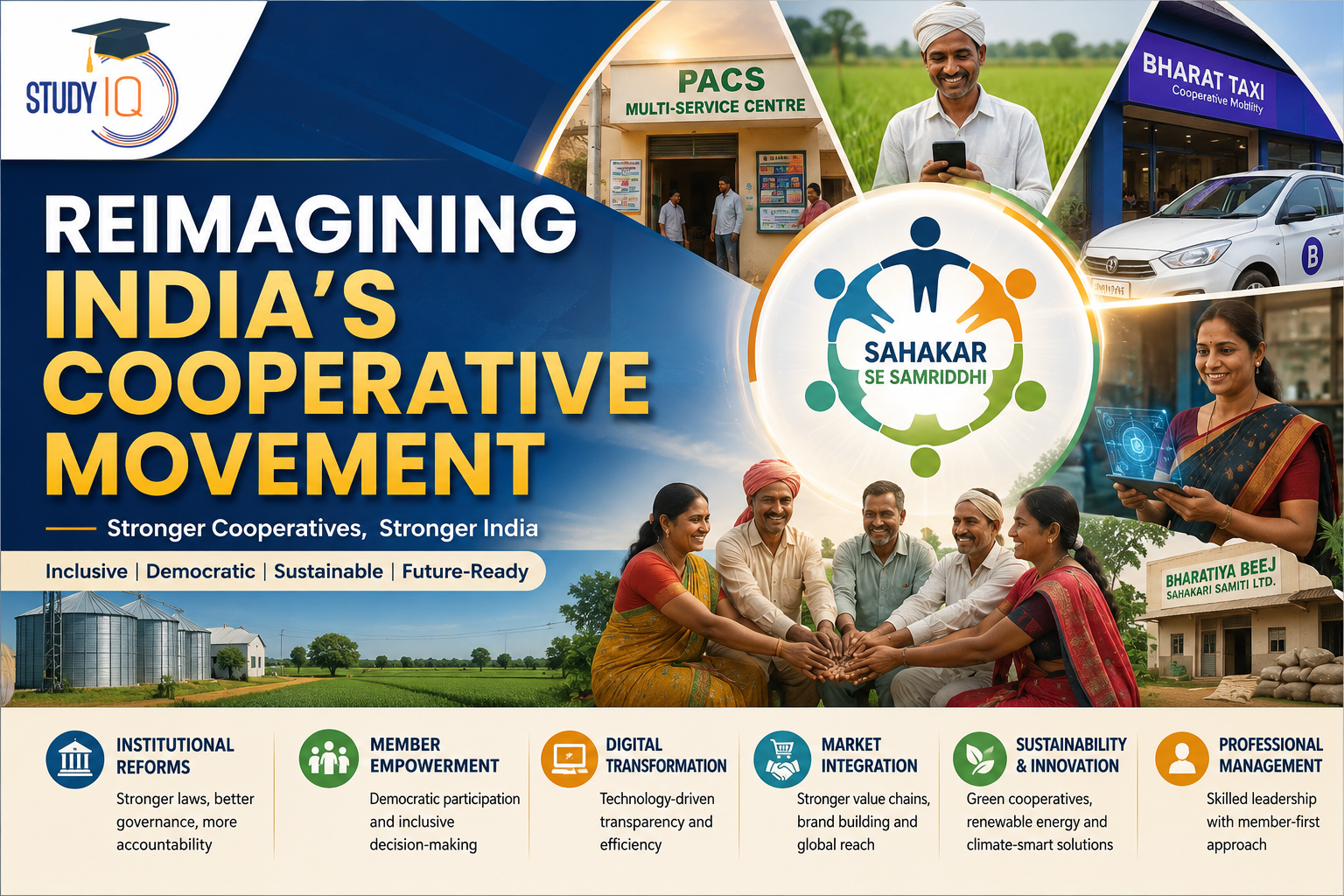
As the Ministry of Cooperation completes five years of its establishment, it is an appropriate moment to assess not only what has been achieved but also what should define the next phase of India’s cooperative movement.
How has India’s Cooperative Movement Evolved in the Last Five Years?
- Institutional Reforms and Policy Support: The Ministry of Cooperation has strengthened the cooperative ecosystem through legal, institutional and fiscal reforms, enhancing governance and ease of doing business.
- g. Over 152 initiatives have been launched, including tax rationalisation and the establishment of new national cooperative institutions such as National Cooperative Exports Limited and Bharatiya Beej Sahakari Samiti Limited.
- Transformation of PACS into Multi-Service Institutions: Primary Agricultural Credit Societies (PACS) have evolved beyond rural credit institutions into integrated service centres delivering financial, agricultural, healthcare and digital services.
- g. Model bye-laws now enable PACS to undertake 25+ business activities, while thousands function as PM Kisan Samriddhi Kendras, CSCs and Jan Aushadhi Kendras.
- Digitalisation of Cooperative Governance: Technology has improved transparency, operational efficiency and service delivery through end-to-end digital transformation of cooperative institutions.
- g. More than 63,000 PACS have adopted ERP software, with online audits and multilingual digital platforms supporting governance reforms.
- Diversification and Market Integration: Cooperatives have expanded beyond traditional credit and dairy into exports, organic farming, seed production, logistics and platform-based services, strengthening value chains.
- g.National Cooperative Exports Limited has exported cooperative products to 38 countries, while Bharat Taxi has emerged as India’s first cooperative-based mobility platform.
- Strengthening Rural Infrastructure and Farmer Collectives: The cooperative movement has enhanced rural infrastructure, storage capacity and producer organisations to improve agricultural productivity and farmer incomes.
- g. Decentralised grain storage through PACS, expansion of FPOs, and White Revolution 2.0 have strengthened agricultural value chains.
What are the Key Challenges Facing India’s Cooperative Sector?
- Weak Member Participation and Elite Capture: Passive membership has weakened democratic control, enabling elite capture by political actors, local elites and intermediaries. This undermines the cooperative principle of member ownership and weakens the disintermediation of middlemen.
- g. In several Maharashtra sugar cooperatives, politically influential elites captured cooperative boards, diverting benefits meant for small sugarcane farmers and undermining the cooperative objective of disintermediating middlemen.
- Governance Deficit and Regulatory Complexity: Political interference, delayed elections and overlapping regulatory oversight have weakened professional governance and accountability, particularly in cooperative banking institutions.
- g. The PMC Bank crisis exposed weaknesses arising from dual regulation, leading to stronger RBI oversight under the Banking Regulation (Amendment) Act, 2020.
- Weak Financial Sustainability and Erosion of Credit Discipline: Poor governance, low capital formation and repeated farm loan waivers have weakened repayment incentives, increased NPAs and constrained the financial health of cooperative credit institutions.
- g. Several DCCBs in Odisha continue to report Gross NPAs above 5%, reflecting persistent recovery challenges.
- Weak Forward and Backward Linkages: Limited access to quality inputs, storage, processing, logistics and marketing reduces value addition and market competitiveness.
- g. Around 92% of India’s cold-storage capacity is privately owned, while nearly 75% is devoted to potatoes, limiting diversified agricultural value chains.
- Professional and Technological Deficit: Inadequate managerial capacity and uneven digital adoption reduce operational efficiency and competitiveness.
- g. State-level apex weavers’ societies such as UPICA (Uttar Pradesh) have faced inventory pile-ups and financial losses due to the slow adoption of ERP systems and e-commerce.
- Uneven Political Economy of Cooperative Development: The success of cooperatives varies across regions due to differences in commodity structures, market linkages and institutional ecosystems, resulting in uneven cooperative growth.
- g. Dairy and sugar cooperatives in Gujarat and Maharashtra benefit from regular cash flows and integrated value chains, whereas cereal-dominated regions often remain dependent on intermediaries and state support.
Way Forward: Reimagining India’s Cooperative Movement
- Strengthen Democratic Governance and Institutional Autonomy: Restore member-driven governance through independent elections, professional management and reduced political interference to curb elite capture.
- g. Implement the Vaidyanathan Committee recommendations, establish an Independent Cooperative Election Authority, and separate the functions of the elected Board of Directors from the professional Board of Management.
- Deepen Digital Transformation and Financial Inclusion: Complete the digitisation of cooperative institutions to improve transparency, financial access and service delivery through interoperable digital platforms.
- g. Complete PACS computerisation, integrate cooperatives with the National Cooperative Database and leverage the JAM Trinity for seamless financial transactions.
- Strengthen Cooperative Value Chains and Market Access: Improve forward and backward linkages by promoting branding, processing, storage and direct market access, enabling cooperatives to realise economies of scale.
- g. Integrate cooperatives with ONDC and strengthen Farmer Producer Organisations (FPOs) to facilitate direct inter-cooperative trade.
- Promote Green and Technology-Enabled Cooperatives: Diversify rural incomes by integrating renewable energy, climate-smart agriculture and shared agricultural infrastructure into the cooperative ecosystem.
- g. Transform PACS into renewable energy hubs under PM-KUSUM, establish Custom Hiring Centres (CHCs), and leverage initiatives such as Namo Drone Didi.
- Professionalise Cooperative Management: Build a specialised talent pipeline and strengthen managerial capacity to improve efficiency while preserving democratic ownership.
- g. Recruit professionals from IRMA Anand, VAMNICOM, and IIMs, while strengthening continuous capacity building through the National Council for Cooperative Training (NCCT).
Latest UPSC Updates
| Resource | Link |
|---|---|
| UPSC Prelims Result 2026 | Check Here |
| UPSC Exam Calendar 2027 | View Calendar |
| UPSC Question Paper 2026 | Download PDF |
| UPSC Prelims Answer Key 2026 | Check Answer Key |
| UPSC Cut Off 2026 | View Cut Off |
| UPSC Syllabus 2026 | Read Syllabus |
| Daily Current Affairs 2026 | Read Updates |
| StudyIQ UPSC IAS Foundation 2027 (English) | Join Course |
| StudyIQ UPSC IAS Foundation 2027 (Hindi) | Join Course |
| StudyIQ UPSC IAS Foundation 2027 (Bilingual) | Join Course |
 World Food Day 2026: Strengthening Nutri...
 International Day for the Eradication of...
 India’s Ramsar Sites Reach 103: Sukhna...














 WhatsApp