
Table of Contents
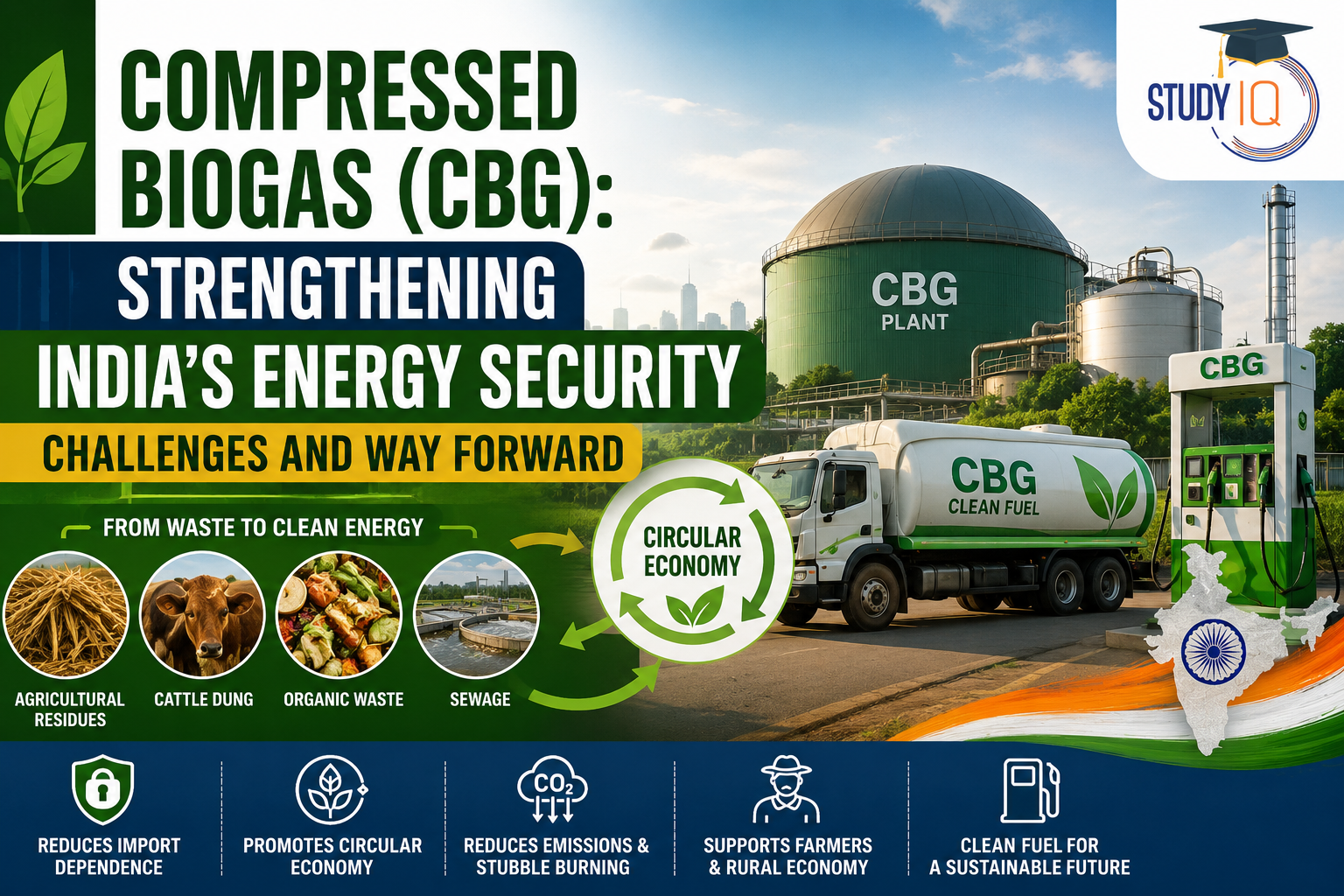
Escalating geopolitical tensions in West Asia have heightened concerns over India’s energy security, particularly as nearly 90% of its LPG imports transit through the Strait of Hormuz, prompting renewed emphasis on domestic alternatives such as Compressed Biogas (CBG).
How Does CBG Support Circular Economy?
- Advances Urban Waste-to-Energy Systems: CBG converts municipal solid waste and sewage into clean energy, reducing landfill dependence while recovering valuable resources from urban waste streams.
- g. Under the Swachh Bharat Mission and SATAT, urban organic waste is increasingly being processed into CBG instead of being dumped in landfills.
- Promotes Closed-Loop Nutrient Cycling: The by-product of CBG production, Fermented Organic Manure (FOM), returns essential nutrients to agricultural fields, reducing dependence on chemical fertilisers and improving soil health.
- g.The inclusion of Fermented Organic Manure (FOM) under the Fertilizer Control Order (FCO) and the Market Development Assistance (MDA) encourage its commercial use, enabling nutrients recovered from organic waste to be recycled back into agricultural soils.
- Reduces Emissions through Biomass Utilisation: CBG creates an economic use for agricultural biomass that would otherwise be burnt or left to decompose, reducing greenhouse gas emissions and air pollution.
- g.By procuring over 1 lakh tonnes of paddy straw annually, the Sangrur CBG Plant (Punjab) converts a major source of stubble-burning emissions into renewable fuel, demonstrating how CBG can simultaneously address air pollution and climate change.
- Supports Energy Security through Import Substitution: By replacing fossil-based CNG and LPG with domestically produced renewable gas, CBG reduces dependence on imported fuels and strengthens India’s long-term energy resilience.
- g. The SATAT (Sustainable Alternative Towards Affordable Transportation) initiative promotes CBG as a substitute for imported natural gas in the transport sector.
- Strengthens Agrarian Circular Bioeconomy: CBG integrates crop residues, cattle dung and other agricultural biomass into a closed-loop rural production system, creating new revenue streams while improving resource efficiency across the farm economy.
- g. The GOBARdhan scheme enables farmers to monetise cattle dung and agricultural residues by supplying them to CBG plants, transforming farm waste into an additional source of rural income.
What are the Key Challenges in Scaling Up India’s Compressed Biogas Ecosystem?
- Weak Feedstock Supply Chain: Fragmented biomass availability, inadequate mechanisation and high transportation costs make feedstock aggregation economically challenging, particularly for crop-residue-based CBG plants.
- g. A Centre for Science and Environment (CSE) 2026 study found that Punjab’s paddy straw is available only for 30–40 days after harvest, whereas CBG plants require a continuous year-round feedstock supply, necessitating costly aggregation, storage and transportation infrastructure.
- Financing Constraints: High capital costs, uncertain gas pricing and the lack of assured long-term off-take agreements reduce project bankability and discourage private investment.
- g. Despite support under SATAT and GOBARdhan, many projects struggle to secure credit due to uncertain gas procurement and limited commercial viability of by-products.
- Inadequate Gas Infrastructure: Limited pipeline connectivity, synchronisation hurdles for grid injection and inadequate gas distribution infrastructure restrict the commercial scalability of CBG.
- g. Despite the launch of the Development of Pipeline Infrastructure (DPI) Scheme, many CBG plants remain unconnected to the City Gas Distribution (CGD) network due to pipeline connectivity and grid-synchronisation challenges, limiting commercial offtake.
- Policy and Regulatory Bottlenecks: Fragmented implementation, multiple statutory approvals and procedural delays increase project timelines and discourage private investment in the CBG sector.
- g. Delays in obtaining statutory clearances, including approvals from the Petroleum and Explosives Safety Organisation (PESO), have slowed project execution. Consequently, against the SATAT target of 5,000 CBG plants, only about 132 had been commissioned by June 2026.
- Failure of By-product Monetisation: The financial viability of CBG plants depends not only on gas sales but also on the successful marketing of Fermented Organic Manure (FOM). However, weak farmer acceptance and competition from subsidised chemical fertilisers limit its commercial uptake.
- g. Despite the ₹1,500 per tonne Market Development Assistance (MDA), many CBG plants continue to face difficulties in marketing FOM, affecting overall project profitability.
Way Forward
- Strengthen Biomass Supply Chains: Develop decentralized biomass aggregation, storage and logistics systems through FPOs and cooperatives while improving access to farm mechanisation for efficient feedstock collection.
- g. Leverage the Agriculture Infrastructure Fund (AIF) to provide interest-subvention loans for FPOs to procure biomass balers, pelletisers and storage infrastructure, reducing feedstock aggregation costs.
- Create a Bankable CBG Investment Ecosystem: Improve investor confidence through assured demand, long-term offtake agreements and stable pricing mechanisms to attract institutional finance.
- g. Effectively implement the CBG Blending Obligation (CBO), which mandates City Gas Distribution (CGD) entities to blend CBG with natural gas, ensuring predictable demand and improving project bankability.
- Expand Gas Infrastructure and Market Integration: Accelerate pipeline connectivity and simplify grid-injection standards to facilitate seamless integration of CBG into the national gas network.
- g. Fast-track the Development of Pipeline Infrastructure (DPI) Scheme to connect CBG plants with the City Gas Distribution (CGD) network.
- Develop a Sustainable Market for Fermented Organic Manure (FOM): Strengthen commercial demand for FOM through market-based interventions that complement existing certification and subsidy mechanisms.
- g. Introduce mandatory co-marketing (bundling) of FOM with subsidised chemical fertilisers through existing fertiliser distribution networks to improve market absorption and plant viability.
- Streamline Regulatory and Institutional Framework: Establish a single-window clearance mechanism and strengthen inter-agency coordination to reduce project delays and improve ease of doing business.
- g. Integrate approvals from PESO, State Pollution Control Boards and other agencies through a dedicated digital single-window clearance portal for CBG projects.
Latest UPSC Updates
| Resource | Link |
|---|---|
| UPSC Prelims Result 2026 | Check Here |
| UPSC Exam Calendar 2027 | View Calendar |
| UPSC Question Paper 2026 | Download PDF |
| UPSC Prelims Answer Key 2026 | Check Answer Key |
| UPSC Cut Off 2026 | View Cut Off |
| UPSC Syllabus 2026 | Read Syllabus |
| Daily Current Affairs 2026 | Read Updates |
| StudyIQ UPSC IAS Foundation 2027 (English) | Join Course |
| StudyIQ UPSC IAS Foundation 2027 (Hindi) | Join Course |
| StudyIQ UPSC IAS Foundation 2027 (Bilingual) | Join Course |
 World Food Day 2026: Strengthening Nutri...
 International Day for the Eradication of...
 India’s Ramsar Sites Reach 103: Sukhna...














 WhatsApp





