Table of Contents
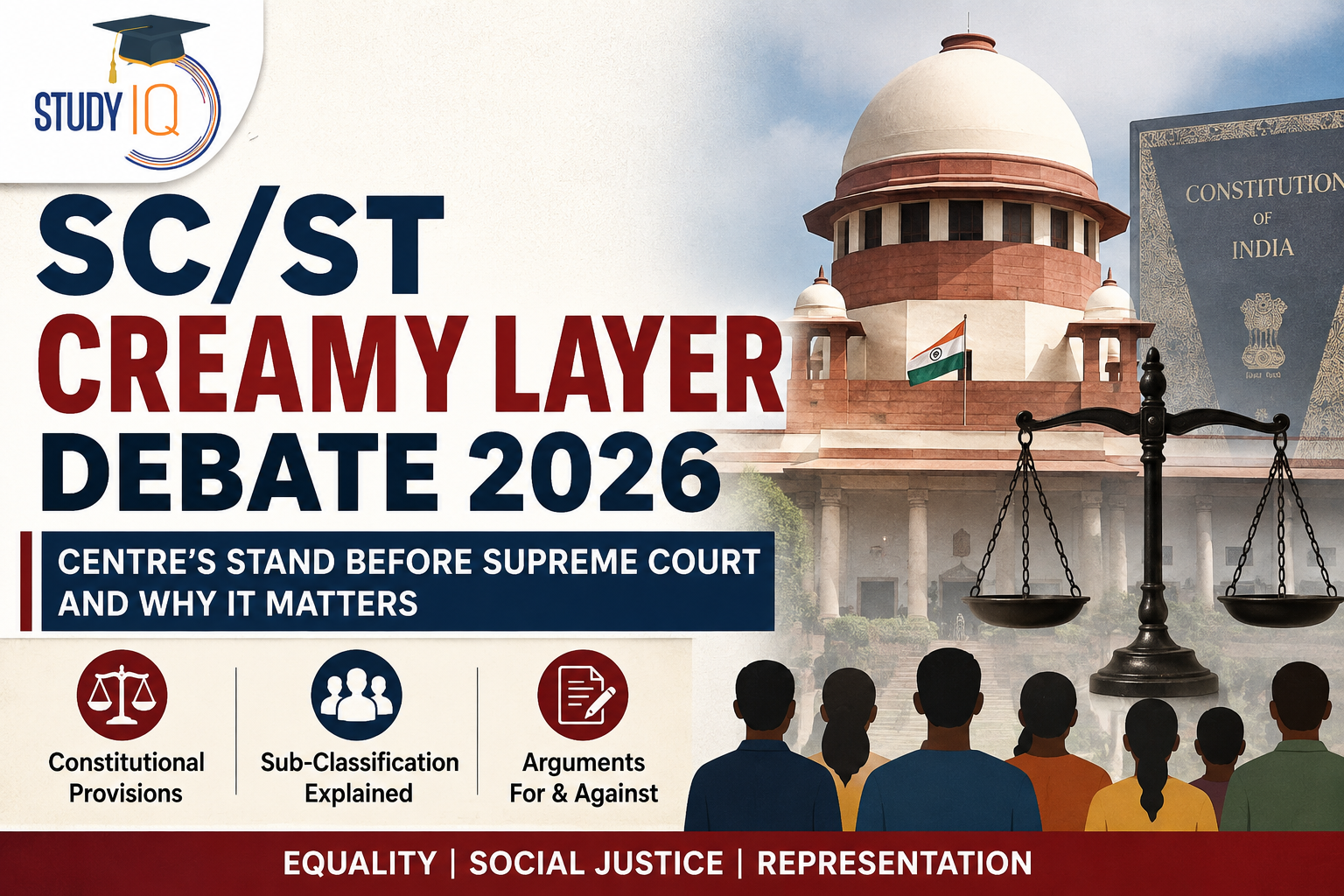
The debate over applying the creamy layer principle to Scheduled Castes (SCs) and Scheduled Tribes (STs) has returned to the centre of India’s reservation discourse.
In August 2026, the Union Government told the Supreme Court that the creamy layer principle should not simply be extended to SC/ST reservations in the manner in which it operates for Other Backward Classes (OBCs).
The Centre has argued that any such policy would require a comprehensive empirical study and holistic policy review and cannot be imposed through a judicial direction. The government has also maintained that the petition seeking such a direction essentially asks the Court to compel the executive to formulate a reservation policy in a particular manner.
The controversy is particularly significant because it comes after the Supreme Court’s landmark 2024 judgment permitting sub-classification within the Scheduled Castes.
What Is the Creamy Layer Principle?
The creamy layer principle seeks to exclude relatively advanced sections of a backward class from reservation benefits so that affirmative action reaches those who remain disadvantaged.
The principle is principally associated with OBC reservation and the Supreme Court’s decision in Indra Sawhney v. Union of India (1992).
The Supreme Court’s jurisprudence has treated creamy-layer exclusion as connected to the constitutional objective of preventing unequals from being treated as equals within a backward class. The Court has subsequently reiterated that the principle was developed in the context of identifying backward classes and ensuring that reservation benefits reach those who genuinely require them.
However, the question is more complicated when it comes to SCs and STs.
Why Does the Centre Oppose SC/ST Creamy Layer?
The government’s argument essentially rests on the distinct constitutional rationale of SC/ST reservation.
SC/ST reservation is not merely a response to low income or educational disadvantage. It is linked to historical forms of caste-based exclusion, untouchability, social discrimination, structural disadvantage and inadequate representation.
Therefore, the Centre’s position is that economic advancement cannot automatically be treated as evidence that an individual has escaped the social disadvantages associated with caste or tribal identity.
The government has argued that introducing a creamy-layer mechanism for SCs/STs would require a detailed empirical exercise rather than simply applying the existing OBC framework.
This distinction is central to understanding the debate.
The 2024 Supreme Court Judgment: Where the Debate Began
The current controversy cannot be understood without examining State of Punjab v. Davinder Singh (2024).
A seven-judge Constitution Bench of the Supreme Court held, by a 6:1 majority, that States can undertake sub-classification within the Scheduled Castes for the purpose of ensuring that reservation benefits reach relatively more disadvantaged groups.
The judgment overruled the earlier approach in E.V. Chinnaiah v. State of Andhra Pradesh (2004), which had treated the Scheduled Caste list as a homogeneous class for this purpose.
The Court, however, did not give States an unrestricted power to divide SCs.
Sub-classification must be supported by empirical evidence and cannot be arbitrary.
Sub-Classification vs Creamy Layer: The Key Difference
One of the most important points for UPSC aspirants is that SC/ST sub-classification and creamy-layer exclusion are not the same thing.
| Sub-classification | Creamy Layer |
|---|---|
| Works within the recognised SC/ST category | Excludes relatively advanced individuals |
| Focuses on relative disadvantage among communities | Focuses on exclusion of advanced sections |
| Seeks to give greater preference to more disadvantaged groups | Removes certain individuals from reservation benefits |
| Requires evidence of differential disadvantage | Traditionally associated with OBC reservation |
| Community/group-oriented approach | Individual-oriented exclusion |
| Does not alter the Presidential SC list | Does not itself alter the SC/ST list |
The Supreme Court’s 2024 judgment expressly distinguished the two concepts. It noted that economic advancement does not necessarily eliminate social discrimination faced by SCs, while sub-classification seeks to identify groups facing greater disadvantage within the constitutional category.
This distinction is crucial because the 2024 verdict did not simply establish an income-based creamy layer for SCs/STs.
What Did Justice B.R. Gavai Say About Creamy Layer?
The controversy gained additional importance because Justice B.R. Gavai, in his separate but concurring opinion in the 2024 judgment, favoured developing a mechanism to identify the creamy layer even among SCs and STs.
He reasoned that excluding advanced sections could help achieve what he described as real equality.
In 2026, the Supreme Court also sought the Centre’s response regarding action taken following the 2024 SC sub-classification judgment. Reporting on that development highlighted Justice Gavai’s observation concerning the need for a policy to identify the creamy layer within SC/STs.
However, this is an important legal distinction:
A judge’s opinion supporting such a policy is not the same as a binding constitutional rule automatically creating an SC/ST creamy layer.
The 2026 proceedings therefore raise the separate question of whether such exclusion should be developed through executive policy, legislation, judicial directions, or a combination of constitutional and empirical processes.
Constitutional Provisions Behind the Debate
The controversy touches several important provisions of the Constitution.
| Constitutional Provision | What It Provides | Relevance to SC/ST Creamy Layer & Reservation Debate |
|---|---|---|
| Article 14 | Guarantees equality before law and equal protection of laws. | Forms the broader constitutional foundation of equality. Reservation is viewed as an instrument of substantive equality, allowing differential treatment to address historical disadvantage. |
| Article 15(1) | Prohibits discrimination by the State on grounds only of religion, race, caste, sex or place of birth. | Establishes the general rule of non-discrimination, against which affirmative-action provisions operate as constitutional exceptions/enabling provisions. |
| Article 15(4) | Enables the State to make special provisions for the advancement of socially and educationally backward classes, SCs and STs. | Provides a major constitutional basis for affirmative action in education. The debate concerns whether economic advancement of some SC/ST members should affect access to such benefits. |
| Article 15(5) | Allows special provisions for advancement of socially and educationally backward classes, SCs and STs regarding admission to educational institutions, including private educational institutions, except minority institutions under Article 30(1). | Expands the constitutional framework for affirmative action in education. |
| Article 16(1) | Guarantees equality of opportunity in matters of public employment. | Provides the general constitutional principle against which reservation policies are assessed. |
| Article 16(4) | Permits reservation of appointments/posts for a backward class of citizens that, in the State’s opinion, is not adequately represented in State services. | One of the key constitutional foundations of reservation in public employment. The concept of adequate representation is particularly relevant to the SC/ST sub-classification debate. |
| Article 16(4A) | Enables reservation in promotion for SCs/STs where they are not adequately represented in services. | Recognises the continuing need to address inadequate representation of SCs/STs, including at higher levels of public employment. |
| Article 16(4B) | Allows unfilled reserved vacancies of a particular year to be treated as a separate class of vacancies and carried forward to subsequent years. | Helps operationalise reservation by permitting carry-forward of backlog vacancies. |
| Article 17 | Abolishes untouchability and forbids its practice in any form. | Provides direct constitutional recognition of the historical social discrimination faced particularly by communities formerly subjected to untouchability. This strengthens the argument that SC reservation cannot be viewed solely through an economic lens. |
| Article 46 | Directs the State to promote the educational and economic interests of weaker sections, particularly SCs and STs, and protect them from social injustice and exploitation. | A key Directive Principle supporting affirmative action. Its language goes beyond income and explicitly refers to social injustice and exploitation. |
| Article 335 | Requires that the claims of SCs/STs to services and posts be considered consistently with the maintenance of administrative efficiency. | Creates a balance between affirmative action and administrative efficiency. The proviso allows relaxation in qualifying marks/standards or evaluation criteria for SC/STs in certain circumstances. |
| Article 338 | Establishes the National Commission for Scheduled Castes (NCSC). | Provides an institutional mechanism for monitoring safeguards for SCs and investigating complaints relating to constitutional/legal safeguards. |
| Article 338A | Establishes the National Commission for Scheduled Tribes (NCST). | Provides institutional oversight of safeguards and development-related issues concerning STs. |
| Article 341 | Provides the constitutional procedure for specifying Scheduled Castes. The President specifies SCs for a State/UT after consultation with the Governor, and Parliament can include/exclude groups by law. | Highly relevant to the sub-classification debate. States cannot independently alter the Presidential SC List. The 2024 judgment distinguished altering the list from distributing reservation benefits among recognised communities. |
| Article 342 | Provides the procedure for specifying Scheduled Tribes. The President specifies STs for a State/UT, while Parliament can include/exclude groups by law. | Relevant to any discussion of ST reservation and sub-classification. Like Article 341, the constitutional list cannot simply be altered by State executive action. |
| Article 330 | Provides reservation of seats for SCs and STs in the Lok Sabha. | Demonstrates that affirmative action for SCs/STs extends beyond employment and education to political representation. |
| Article 332 | Provides reservation of seats for SCs and STs in State Legislative Assemblies. | Ensures political representation of historically disadvantaged communities at the State level. |
| Article 334 | Deals with the period for which reservation of seats for SCs/STs in legislatures and special representation provisions operate. | Relevant to the constitutional evolution and extension of political reservation for SCs/STs. |
| Article 243D | Provides reservation of seats in Panchayats for SCs/STs in proportion to their population, along with reservation for women. | Extends affirmative political representation to grassroots local government. |
| Article 243T | Provides reservation of seats in Municipalities for SCs/STs in proportion to their population, along with reservation for women. | Extends representation to urban local bodies. |
| Article 366(24) | Defines Scheduled Castes for constitutional purposes by reference to Article 341. | Helps establish the constitutional meaning of the SC category. |
| Article 366(25) | Defines Scheduled Tribes for constitutional purposes by reference to Article 342. | Establishes the constitutional framework for the ST category. |
Why Is the Creamy Layer Debate So Controversial?
At the heart of the controversy is a difficult question:
Does economic advancement eliminate social disadvantage?
There are two competing approaches.
Argument 1: Economic Advancement Is Not Enough
Supporters of the Centre’s position argue that a financially successful SC/ST individual may continue to face discrimination because of caste or tribal identity.
Under this view, using income as a decisive exclusion criterion could confuse economic status with social status.
A person may become economically prosperous without completely escaping social discrimination.
Argument 2: Benefits Must Reach the Most Disadvantaged
The opposing argument is based on intra-group inequality.
If certain relatively advanced families or communities repeatedly access reservation benefits, the weakest sections may remain under-represented.
From this perspective, affirmative action should not merely create representation within a broad category but should ensure equitable distribution of benefits.
This is one reason the 2024 judgment recognised the possibility of evidence-based sub-classification.
Why Empirical Data Matters
The strongest common thread between the Centre’s 2026 position and the Supreme Court’s 2024 judgment is the importance of evidence.
A creamy-layer framework for SC/STs would raise difficult questions:
- What income threshold should be used?
- Should parental occupation matter?
- Should education be considered?
- Should government employment status matter?
- How should caste discrimination be measured?
- Should the criterion differ between SC and ST communities?
- Should rural and urban disadvantage be treated differently?
- How should intersectional disadvantage be measured?
These questions demonstrate why a simple income ceiling may not adequately capture the complexity of social disadvantage.
The Centre has therefore argued that any such policy would require comprehensive empirical assessment rather than an immediate judicially imposed formula.
SC/ST Reservation vs OBC Reservation
| Feature | SC/ST | OBC |
| Constitutional identification | Articles 341 & 342 | Different constitutional/statutory framework |
| Historical basis | Caste/tribal exclusion and structural discrimination | Social and educational backwardness |
| Creamy layer | No uniform central SC/ST creamy-layer exclusion currently established | Creamy-layer exclusion is an established feature |
| Sub-classification | Permitted subject to constitutional conditions after 2024 judgment | Different legal framework |
| Core objective | Representation + overcoming historical discrimination | Advancement of backward classes |
| Current debate | Whether and how advanced sections should be excluded | How creamy-layer criteria should operate |
Arguments in Favour of SC/ST Sub-Classification
- Equitable distribution: Ensures reservation benefits reach the most disadvantaged communities within SC/ST categories.
- Intra-group inequality: Recognises that all SC/ST communities do not face the same degree of backwardness.
- Effective representation: Helps address unequal representation of certain communities in education and public employment.
- Substantive equality: Moves beyond formal equality by providing greater support to more disadvantaged groups.
- Evidence-based policy: Allows reservation benefits to be allocated using quantifiable socio-economic and representation data.
- Prevents benefit concentration: Reduces the possibility of reservation benefits being repeatedly accessed by relatively better-represented groups.
- Constitutional validity: The 2024 Supreme Court judgment in State of Punjab v. Davinder Singh recognised the constitutional permissibility of SC sub-classification, subject to evidence and safeguards.
- Targeted affirmative action: Makes reservation more focused, inclusive and outcome-oriented.
Arguments Against SC/ST Creamy Layer
- Caste discrimination persists: Economic advancement does not necessarily eliminate caste-based discrimination and social exclusion.
- Income ≠ social status: An income-based test may fail to capture the structural disadvantages faced by SCs/STs.
- Historical injustice: SC/ST reservation addresses centuries of social discrimination, not merely economic backwardness.
- Risk of exclusion: Relatively better-off SC/ST individuals may still face discrimination despite economic mobility.
- Complex measurement: Determining a “creamy layer” requires reliable data on income, occupation, education, social status and representation.
- Risk of weakening affirmative action: A rigid creamy-layer rule could reduce the protective scope of SC/ST reservation.
- Inter-generational discrimination: Social disadvantages can continue across generations even after economic improvement.
- Tribal context differs: Applying a uniform income criterion to diverse ST communities and remote tribal populations may be inappropriate.
- Potential fragmentation: Creamy-layer exclusion could create intra-community divisions within SC/ST groups.
- Constitutional rationale differs: SC/ST reservation has a distinct basis linked to Articles 15(4), 16(4), 17 and 46, unlike a purely economic criterion.
- Need for empirical study: Any such policy should be based on comprehensive evidence, rather than a simple income threshold.
What Does the 2026 Debate Actually Mean?
The current debate should not be interpreted as the Supreme Court having already introduced a creamy layer for SC/ST reservations.
The Centre has opposed the demand and has argued that such a major policy change requires empirical examination and falls substantially within the executive’s policy domain.
At the same time, the 2024 judgment and Justice Gavai’s opinion have placed the issue of intra-category inequality and equitable distribution of reservation benefits firmly within the constitutional debate.
Thus, three separate questions must be distinguished:
- Can SCs/STs be sub-classified? — The 2024 Supreme Court majority said yes, subject to constitutional safeguards and evidence.
- Does the 2024 judgment automatically impose an SC/ST creamy layer? — No.
- Can India develop a policy to exclude relatively advanced SC/ST sections in the future? — This remains a contested constitutional and policy question requiring further consideration.
Way Forward
A sustainable approach should combine social justice with evidence-based targeting.
First, the government should strengthen collection of reliable socio-economic and representation data.
Second, any sub-classification should satisfy constitutional requirements and be based on demonstrable differences in disadvantage.
Third, an SC/ST creamy-layer framework, if ever considered, should not rely solely on income. It would need to examine the broader dimensions of social, educational, occupational and institutional advancement.
Fourth, policymakers must ensure that affirmative action continues to address the structural discrimination for which SC/ST safeguards were constitutionally designed.
The larger goal should be substantive equality rather than merely numerical equality.
UPSC Perspective
Prelims
Remember:
- Indra Sawhney case — 1992: Key judgment associated with OBC reservation and creamy-layer exclusion.
- State of Punjab v. Davinder Singh — 2024: Seven-judge Constitution Bench; SC sub-classification permitted subject to constitutional conditions.
- Majority in Davinder Singh: 6:1.
- Article 341: Scheduled Castes.
- Article 342: Scheduled Tribes.
- Article 335: Claims of SCs/STs in services.
- Article 15(4): Special provisions for advancement of SEBCs and SCs/STs.
- Article 16(4): Reservation in public employment for inadequately represented backward classes.
Mains
GS Paper II — Polity & Governance
Possible question:
“The debate over creamy-layer exclusion among SCs and STs reflects the tension between substantive equality and targeted affirmative action. Discuss.”
Conclusion
The SC/ST Creamy Layer Debate 2026 is ultimately not just about an income ceiling. It is about how India should balance two constitutional objectives: protecting communities from continuing structural discrimination and ensuring that affirmative-action benefits reach those who remain most disadvantaged.
The Centre’s latest position stresses that SC/ST reservation cannot simply be treated like OBC reservation and that any change requires comprehensive empirical study. The Supreme Court’s 2024 sub-classification judgment, meanwhile, has recognised that disadvantage within the SC category is not necessarily uniform.
The way forward therefore lies in better data, evidence-based policy, constitutional safeguards and a nuanced understanding of social disadvantage—rather than assuming that either caste or income alone can fully capture the complex reality of inequality in India.
Read Also: UPSC Daily Current Affairs 2026
 East Sea (Sea of Japan): Location, Count...
 WMO State of Global Water Resources 2025...
 FCRA Amendment Bill 2026: Key Provisions...








 WhatsApp