Table of Contents
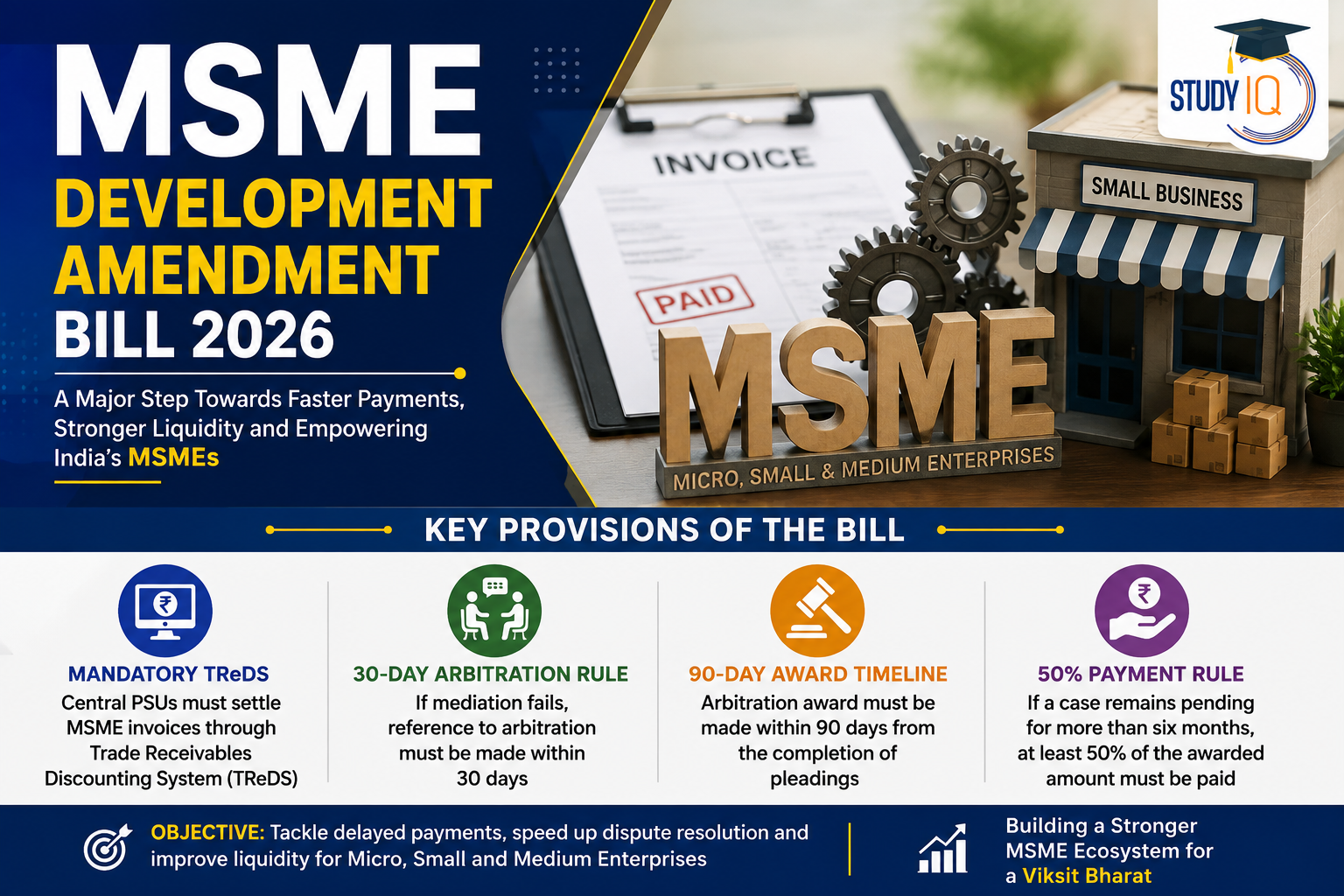
MSME Development Amendment Bill 2026: Parliament has cleared the Micro, Small and Medium Enterprises Development (Amendment) Bill, 2026, marking a significant step towards addressing the long-standing problem of delayed payments to MSMEs. The legislation seeks to improve liquidity, accelerate dispute resolution and strengthen digital financing of trade receivables.
The Rajya Sabha passed the Bill on August 3, 2026, followed by the Lok Sabha on August 7, 2026. The Bill amends the Micro, Small and Medium Enterprises Development Act, 2006.
Why is the MSME Amendment Bill 2026 in News?
Delayed payments remain a major challenge for India’s MSME sector. When buyers do not make timely payments, smaller businesses can face a severe working-capital crunch, affecting their ability to pay employees, suppliers, lenders and operational expenses.
The new legislation attempts to address this issue through a combination of TReDS-based financing, time-bound dispute resolution and a 50% payment provision for prolonged cases.
Key Provisions of MSME Development Amendment Bill 2026
1. Mandatory TReDS Mechanism
The Bill provides that Central Public Sector Enterprises must settle invoices relating to procurement of goods or services from MSMEs through the Trade Receivables Discounting System (TReDS).
TReDS enables MSMEs to obtain financing against eligible trade receivables, helping them access funds without waiting for the buyer’s payment cycle to end.
2. 30-Day Arbitration Rule
The legislation introduces a time-bound mechanism for payment disputes.
If mediation fails, the dispute must be referred to arbitration within 30 days from the termination of mediation.
This seeks to prevent disputes from remaining stuck at the pre-arbitration stage.
3. 90-Day Deadline for Arbitration Award
The Bill further provides that an arbitration award must be made within 90 days from the completion of pleadings.
This is aimed at making the dispute-resolution process more predictable and reducing prolonged uncertainty for MSME suppliers.
4. 50% Payment Rule
One of the most important provisions concerns cases where an award in favour of an MSME supplier is challenged.
If the case remains pending for more than six months, at least 50% of the awarded amount must be paid to the supplier.
For cash-strapped MSMEs, this provision can provide crucial liquidity even while the legal dispute continues.
What is TReDS?
Trade Receivables Discounting System (TReDS) is an electronic platform that facilitates financing against MSME trade receivables.
The basic process is:
MSME supplies goods/services → Invoice generated → Buyer accepts invoice → Receivable listed on TReDS → Financier discounts receivable → MSME gets funds earlier
Thus, TReDS can help convert future receivables into immediate working capital.
Why is the Bill Important for MSMEs?
The amendment is significant because delayed payments can create a vicious cycle:
Delayed payment → Cash-flow crisis → Borrowing pressure → Difficulty paying suppliers/workers → Lower investment and expansion
By improving payment recovery and access to receivables financing, the Bill seeks to strengthen the financial resilience of smaller enterprises.
It can also support ease of doing business, formal financing, entrepreneurship, employment generation and supply-chain participation.
UPSC Prelims Facts
| Parameter | Key Fact |
|---|---|
| Parent legislation | MSMED Act, 2006 |
| Amendment | MSME Development (Amendment) Bill, 2026 |
| Core issue | Delayed payments to MSMEs |
| Digital mechanism | TReDS |
| Arbitration referral | Within 30 days after failed mediation |
| Arbitration award | Within 90 days after completion of pleadings |
| Prolonged pendency | More than 6 months |
| Minimum payment | 50% of awarded amount |
| UPSC relevance | GS Paper III – Indian Economy |
UPSC Mains Analysis
The Bill addresses an important structural challenge in India’s MSME ecosystem: access to timely working capital. While bank credit is important, timely realization of trade receivables is equally critical for business continuity.
The combination of TReDS, time-bound arbitration and the 50% payment provision can reduce liquidity stress and improve confidence among MSME suppliers.
However, effective implementation will depend on greater awareness and adoption of TReDS, timely invoice acceptance, adequate financing participation and efficient dispute-resolution institutions.
Conclusion
The MSME Development Amendment Bill 2026 represents a shift towards ensuring not merely that MSMEs eventually receive their dues, but that they have faster access to liquidity while payment disputes are being resolved.
For UPSC aspirants, the Bill is relevant to GS Paper III topics including MSMEs, ease of doing business, access to finance, financial inclusion, employment and economic growth.
Read Also: UPSC Daily Current Affairs 2026
 East Sea (Sea of Japan): Location, Count...
 WMO State of Global Water Resources 2025...
 FCRA Amendment Bill 2026: Key Provisions...












 WhatsApp