
Table of Contents
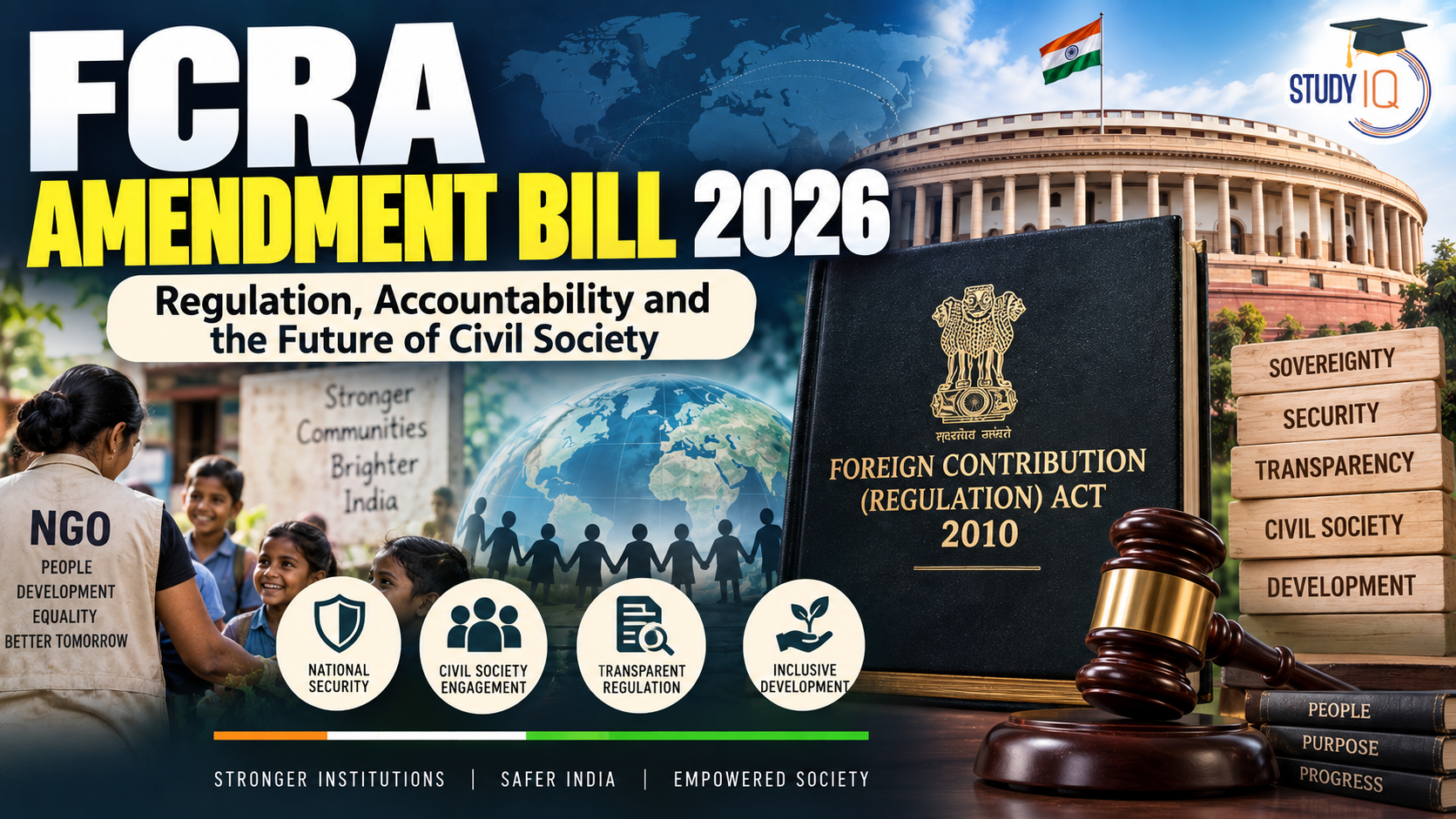
The Foreign Contribution (Regulation) Amendment Bill, 2026 seeks to amend the Foreign Contribution (Regulation) Act (FCRA), 2010, India’s principal law governing foreign contributions received by individuals, associations and NGOs. Introduced in the Lok Sabha on 25 March 2026, the Bill is currently under parliamentary scrutiny through a 31-member Joint Parliamentary Committee (JPC).
The proposed amendments have generated debate over how India can balance national security, financial transparency and accountability with the autonomy and functioning of civil society organisations.
Read Also: UPSC Daily Current Affairs 2026
What is the FCRA?
The FCRA, 2010 regulates the acceptance and utilisation of foreign contributions and foreign hospitality. It is administered by the Ministry of Home Affairs (MHA).
The legislation requires eligible organisations seeking foreign contributions to obtain FCRA registration or prior permission. Its stated objective is to prevent foreign contributions from being used in activities detrimental to national interest while ensuring regulatory oversight of foreign-funded organisations.
The framework was strengthened through the 2020 amendments, which, among other changes, restricted transfer of foreign contributions between organisations and reduced the permissible administrative expenditure ceiling from 50% to 20%.
Why is the FCRA Amendment Bill 2026 Significant?
The most important proposed change concerns the foreign-funded assets of organisations whose FCRA registration ceases.
Under the Bill, an organisation may cease to hold an FCRA certificate if its registration is cancelled, surrendered, or if its renewal is not applied for, is denied, or is not obtained before expiry.
1. Designated Authority
The Bill proposes a Designated Authority to supervise, manage and dispose of foreign contributions and assets in such cases.
Foreign-funded assets would initially be provisionally vested with the Authority. If the organisation subsequently restores its FCRA registration within the prescribed period, the assets and unutilised funds are to be returned. If registration is not restored, permanent vesting may follow.
2. Disposal of Assets
Where permanent vesting occurs, assets may be transferred to government ministries, departments or agencies, or disposed of through permitted processes. Sale proceeds would be credited to the Consolidated Fund of India.
The Bill also specifically requires the religious character of a place of worship to be maintained.
3. Judicial Recourse
The proposed framework provides an appeal against an order of the Designated Authority to the District Judge within 90 days. This introduces a formal judicial avenue against administrative decisions.
4. Rationalisation of Penalties
The Bill proposes reducing the maximum imprisonment for specified FCRA violations from five years to one year, indicating a move towards differentiated and proportionate penalties.
Key Concerns
Asset and Property Rights
A major concern is that organisations which previously used foreign contributions to create hospitals, schools, community centres or other infrastructure could potentially face vesting of those assets after cessation of FCRA registration.
This becomes particularly relevant for organisations that have subsequently shifted towards domestic funding but continue using infrastructure created with earlier foreign contributions.
Executive Discretion
Civil society organisations have raised questions regarding the extent of powers given to an executive-appointed authority. Critics argue that substantial control over charitable assets should be accompanied by strong procedural safeguards, transparency and independent oversight.
Impact on Grassroots Organisations
Many NGOs provide services in areas such as healthcare, education, disability support, tribal welfare and humanitarian assistance. Concerns have therefore been expressed that complex compliance requirements or uncertainty over assets could affect continuity of social-sector services.
At the same time, the government maintains that the amendments are intended to address administrative gaps, improve transparency and ensure proper utilisation of foreign contributions.
Constitutional and Governance Dimensions
The debate around the Bill can be examined through several constitutional principles:
- Rule of law: Administrative action must operate within clearly defined legal boundaries.
- Due process: Organisations should have adequate notice and opportunity to contest adverse decisions.
- Property rights: Article 300A provides that no person shall be deprived of property except by authority of law.
- Accountability: Foreign funding requires transparent financial reporting and effective oversight.
- Civil society: NGOs can supplement state capacity in delivering social welfare and development services.
Thus, the issue is not simply about regulating foreign donations; it concerns the broader relationship between the State, civil society and democratic governance.
Way Forward
A balanced approach should combine effective regulation with proportionality and procedural safeguards.
First, the government should establish clear thresholds distinguishing serious violations from minor technical or reporting deficiencies. Second, decisions involving substantial charitable assets should be subject to transparent procedures and effective independent review.
Third, India should strengthen domestic philanthropy, CSR partnerships and individual giving so that legitimate organisations can diversify their funding base.
Finally, regular consultation between the government, NGOs, donors and community organisations can improve regulatory compliance while reducing mistrust.
Conclusion
The FCRA Amendment Bill 2026 represents an attempt to strengthen the institutional framework governing foreign contributions and assets created from them. Its parliamentary scrutiny provides an opportunity to examine both the legitimate requirements of national security and financial accountability and the operational realities of India’s civil society sector.
For India, the objective should be to create a regulatory system that is transparent, proportionate, predictable, and accountable one that prevents misuse of foreign funds while enabling legitimate civil society organisations to continue contributing to inclusive development and democratic governance.

 World Rhino Day 2026: 22 September, Them...
 Daily Current Affairs PDF 2026: Download...
 World Pharmacists Day 2026: Date, Theme,...














 WhatsApp





