Table of Contents
Context
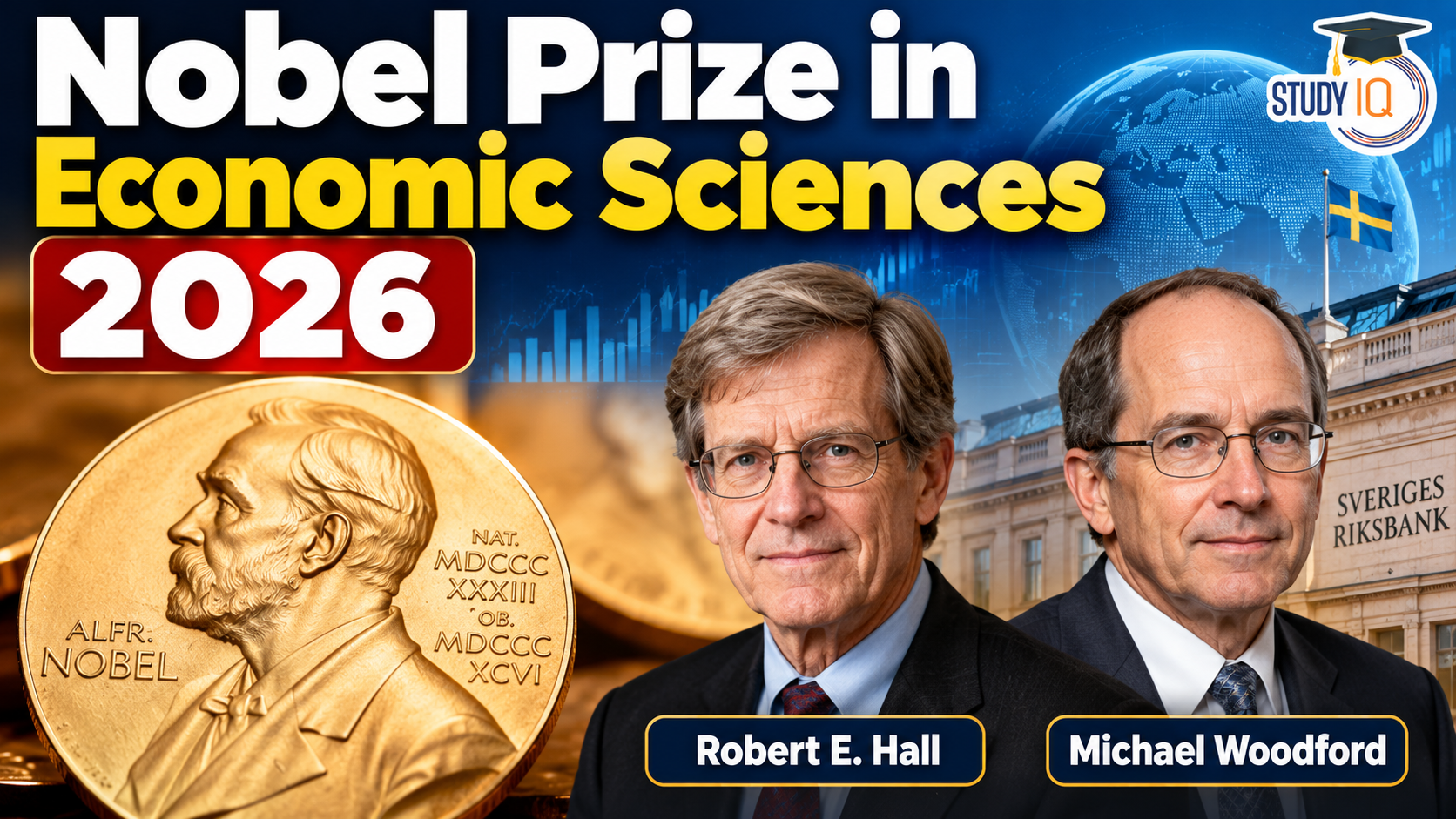
The 2026 Sveriges Riksbank Prize in Economic Sciences in Memory of Alfred Nobel was jointly awarded to American economists Robert E. Hall and Michael Woodford, according to the supplied source.
About the Nobel Prize in Economic Sciences 2026
- Established: In 1968 by Sveriges Riksbank, Sweden’s central bank, to mark its 300th anniversary.
- Award Ceremony: Held annually in Stockholm, Sweden, on 10 December.
- Nature: Awarded alongside the traditional Nobel Prizes and administered by the Nobel Foundation.
Key Contributions of the Winners
- Linking Individual Behaviour with Macroeconomic Outcomes
- Demonstrated how the expectations and decisions of consumers and firms influence overall economic performance.
- Strengthened the theoretical foundations of modern macroeconomic policy.
- Robert E. Hall: Random Walk Hypothesis of Consumption
- Proposed that forward-looking consumers adjust spending mainly in response to unexpected events or new information.
- Suggested that anticipated changes in income may have limited effects on consumption.
- Michael Woodford: Neo-Wicksellian Monetary Framework
- Integrated price stickiness, imperfect competition and forward-looking expectations into modern monetary analysis.
- Explained how central banks influence economic activity through interest rates and expectations management, rather than relying solely on control of the money supply.
- Central Bank Communication and Forward Guidance
- Highlighted how central bank announcements shape the expectations of consumers, businesses and financial markets.
- Reinforced the importance of forward guidance in improving monetary policy effectiveness and managing inflation expectations.
Significance
- Inflation Management: Supports inflation targeting and interest-rate decisions.
- Economic Stabilisation: Helps policymakers understand the effects of expectations on consumption, investment and economic growth.
- Monetary Policy: Informs policy frameworks used by central banks such as the Reserve Bank of India (RBI), the US Federal Reserve and the European Central Bank (ECB).

 Appointment of Deputy Election Commissio...
 Daily Current Affairs PDF 2026: Download...
 UAPA Act 1967: Key Provisions, Supreme C...














 WhatsApp