Table of Contents
Context
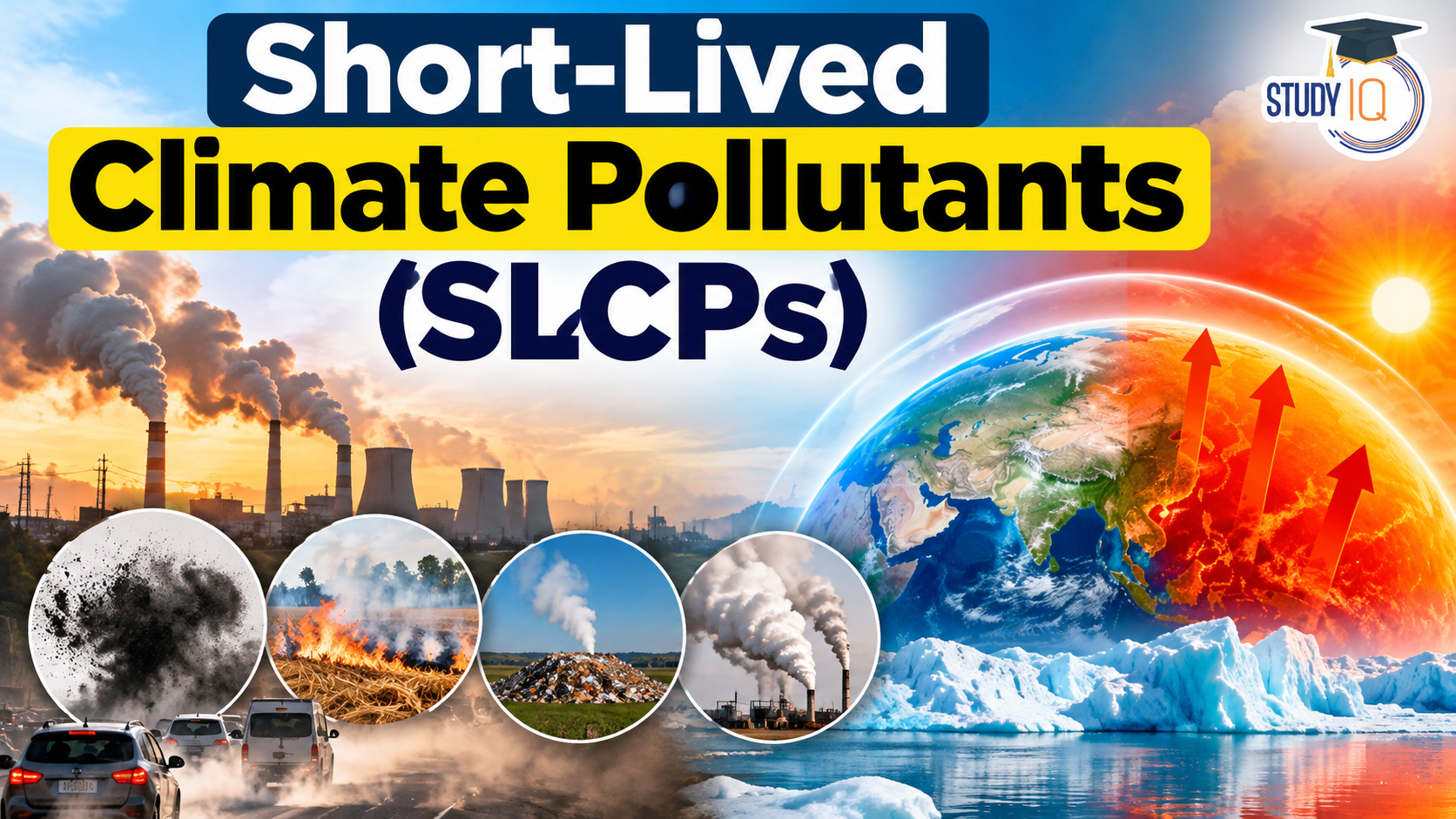
Short-lived climate pollutants (SLCPs), including methane, black carbon, tropospheric ozone and hydrofluorocarbons (HFCs), contribute significantly to near-term global warming and air pollution. Unlike carbon dioxide (CO₂), many SLCPs remain in the atmosphere for relatively short periods, making their reduction an effective tool for slowing near-term warming.
Read Also: UPSC Daily Current Affairs 2026
What are SLCPs, and why are they important for climate action?
- Definition: SLCPs are climate-warming gases and particles that remain in the atmosphere for periods ranging from days to approximately 15–20 years, depending on the pollutant.
- Major pollutants: These include methane, black carbon, tropospheric ozone and HFCs. Some aerosols, such as sulphates, have a cooling effect and influence the overall climate response.
- Rapid climate benefits: Reducing SLCP emissions can slow near-term warming, complementing long-term CO₂ reduction.
- Public health benefits: Cutting emissions from biomass burning, diesel engines and industrial sources can reduce exposure to harmful air pollutants.
- Developmental significance: SLCP mitigation can improve agricultural productivity, reduce health costs and strengthen climate resilience.
Why is SLCP reduction a near-term climate lever, while CO₂ reduction remains essential for long-term stabilisation?
| Parameter | SLCP Reduction | CO₂ Reduction |
| Atmospheric lifetime | Days (black carbon, ozone) to about a decade (methane) | Hundreds to thousands of years for a large share |
| What drives warming | The rate of current emissions; concentrations fall quickly once emissions stop | The cumulative stock of emissions; CO₂ keeps accumulating |
| Speed of response | Warming falls within years to decades of cuts | Warming stops rising only when net CO₂ emissions reach zero |
| Role in stabilisation | Slows the rate of warming but cannot hold temperature down alone | Essential: warming from the existing CO₂ stock persists after SLCP cuts |
| Relevance to tipping points | Lowers near-term risk, such as Arctic permafrost thaw | Needed to keep long-term warming within safe limits |
| Key limitation | Reductions must be sustained; they do not address the accumulated stock | Slow to show results; requires long-term commitments |
How does aerosol masking complicate India’s air-quality and climate policies?
- Aerosol masking effect: Sulphate aerosols reflect incoming sunlight and influence cloud formation, temporarily offsetting part of the warming caused by greenhouse gases.
- Air-quality and climate trade-off: Reducing sulphur dioxide emissions from coal-fired power plants and industries improves public health but can also reduce aerosol-induced cooling.
- Indian context: India’s dependence on coal-based electricity makes it important to assess the climate implications of pollution-control measures alongside their health benefits.
- Policy implication: Air-quality policies should account for both the health gains from cleaner air and the potential near-term warming associated with reduced aerosol cooling.
- Source-specific assessment: Black carbon warms the climate, while some co-emitted organic carbon aerosols have a cooling effect. Therefore, the net climate impact depends on the composition of emissions from each source.
Why does India’s SLCP policy framework face an implementation gap?
India has several laws and programmes addressing air pollution, clean energy and climate mitigation. However, implementation gaps, fragmented responsibilities and weak incentives can limit their effectiveness.
| Policy instrument | Objective | Key implementation challenge |
| National Clean Air Programme (NCAP), 2019 | Reduce particulate pollution in targeted cities through coordinated action. | Source-level emissions reductions, monitoring and sustained municipal capacity remain critical. |
| Pradhan Mantri Ujjwala Yojana (PMUY) | Expand access to LPG connections for eligible households. | Refill affordability and reliability can affect sustained LPG use, leading to continued reliance on traditional fuels. |
| Graded Response Action Plan (GRAP) | Implement emergency pollution-control measures in Delhi-NCR during severe pollution episodes. | Episodic restrictions cannot independently address structural sources such as transport emissions, industrial pollution and agricultural burning. |
| Crop-residue management initiatives | Reduce open burning through machinery, in-situ management and alternative uses of agricultural residue. | High equipment costs, limited time between harvests and inadequate markets for residue can discourage adoption. |
| Kigali Amendment to the Montreal Protocol | Phase down the production and consumption of HFCs. | Rising cooling demand requires affordable alternatives, energy-efficient equipment and effective refrigerant management. |
| Air (Prevention and Control of Pollution) Act, 1981 | Establish a framework for preventing and controlling air pollution. | Enforcement capacity, monitoring gaps and coordination among regulatory agencies affect implementation. |
Way Forward
- Integrate SLCP and CO₂ mitigation: Pursue rapid SLCP reductions for near-term climate benefits while maintaining sustained decarbonisation for long-term temperature stabilisation.
- Adopt integrated air-quality and climate planning: Assess the combined health and climate effects of pollution-control measures, including the consequences of reducing cooling aerosols.
- Prioritise high-impact sources: Target residential solid fuels, diesel emissions, brick kilns, waste and agricultural burning according to their measured health burden and climate impact.
- Promote climate-smart agriculture: Encourage water-efficient rice cultivation, improved livestock management and methane capture while safeguarding agricultural output and farmer incomes.
- Strengthen clean cooking access: Improve the affordability and reliability of clean fuels and support alternatives that reduce household air pollution.
- Improve crop-residue management: Combine machinery subsidies, in-situ residue management, biomass-based markets and suitable agricultural incentives to reduce open burning.

 Daily Mains Articles 2026 – Updated Da...
 Warming Himalayas: Causes, Impacts and W...
 Nobel Prize in Economic Sciences 2026: W...














 WhatsApp