Table of Contents
Context: The passage of the Transgender Persons (Protection of Rights) Amendment Bill, 2026, signifies a pivotal and contentious juncture in the advancement of gender rights in India. Enacted by Parliament on March 25, 2026, notwithstanding significant dissent, including a proposal by DMK MP Tiruchi Siva to submit it to a Select Committee, the Bill signifies a pivotal transformation in the legal framework regulating transgender identity. The Bill’s declared aim is to enhance the current legal framework; nonetheless, its contents provoke significant constitutional, social, and ethical dilemmas.
The crux of this issue centres on the conflict between personal autonomy and governmental regulation. A decade before, the National Legal Services Authority v Union of India (NALSA) decision acknowledged gender identity as an inherent component of personal liberty. The 2026 Amendment Bill, however, seems to revise this idea, establishing a framework that prioritises medical and administrative certification.
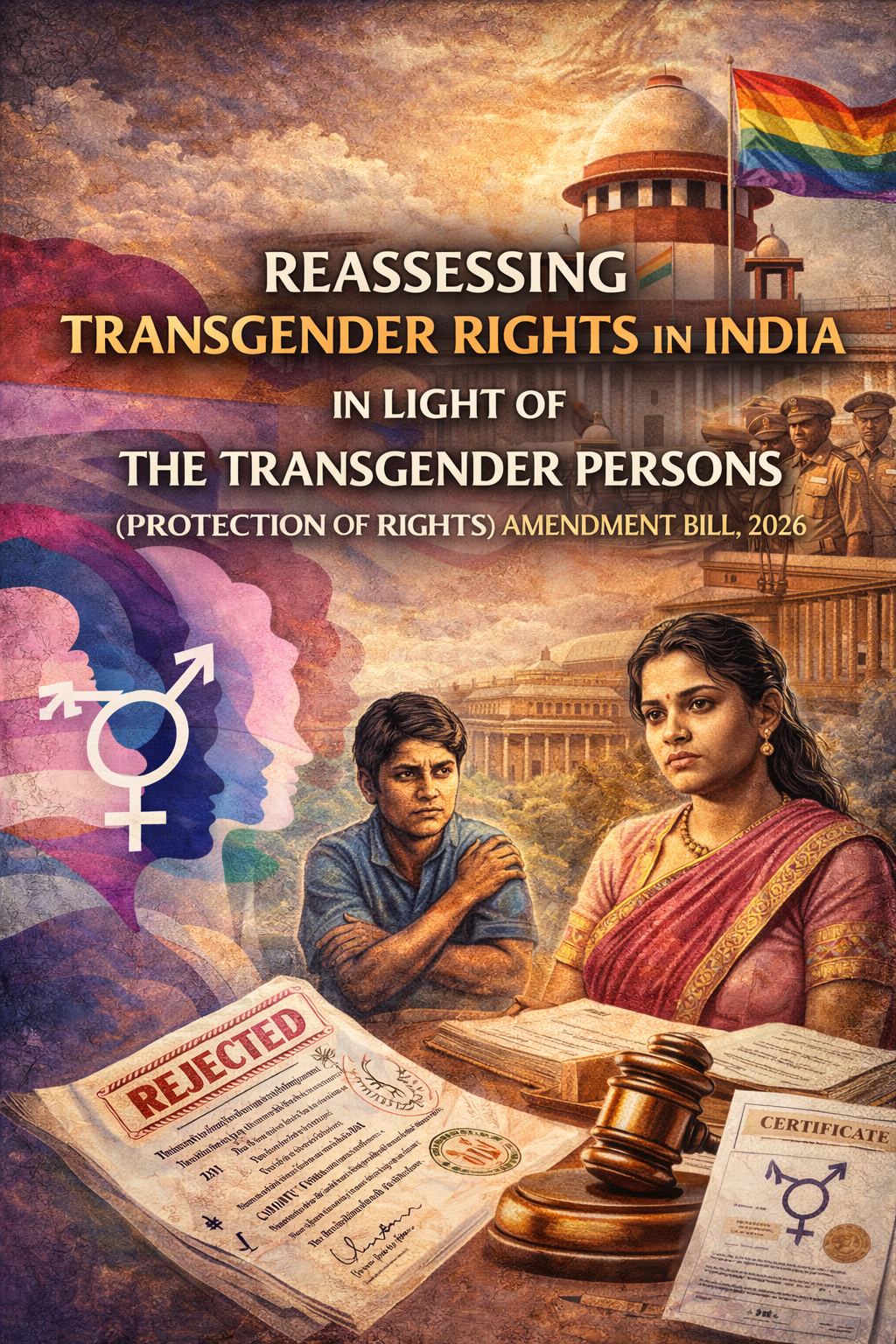
Historical Development of Transgender Rights in India
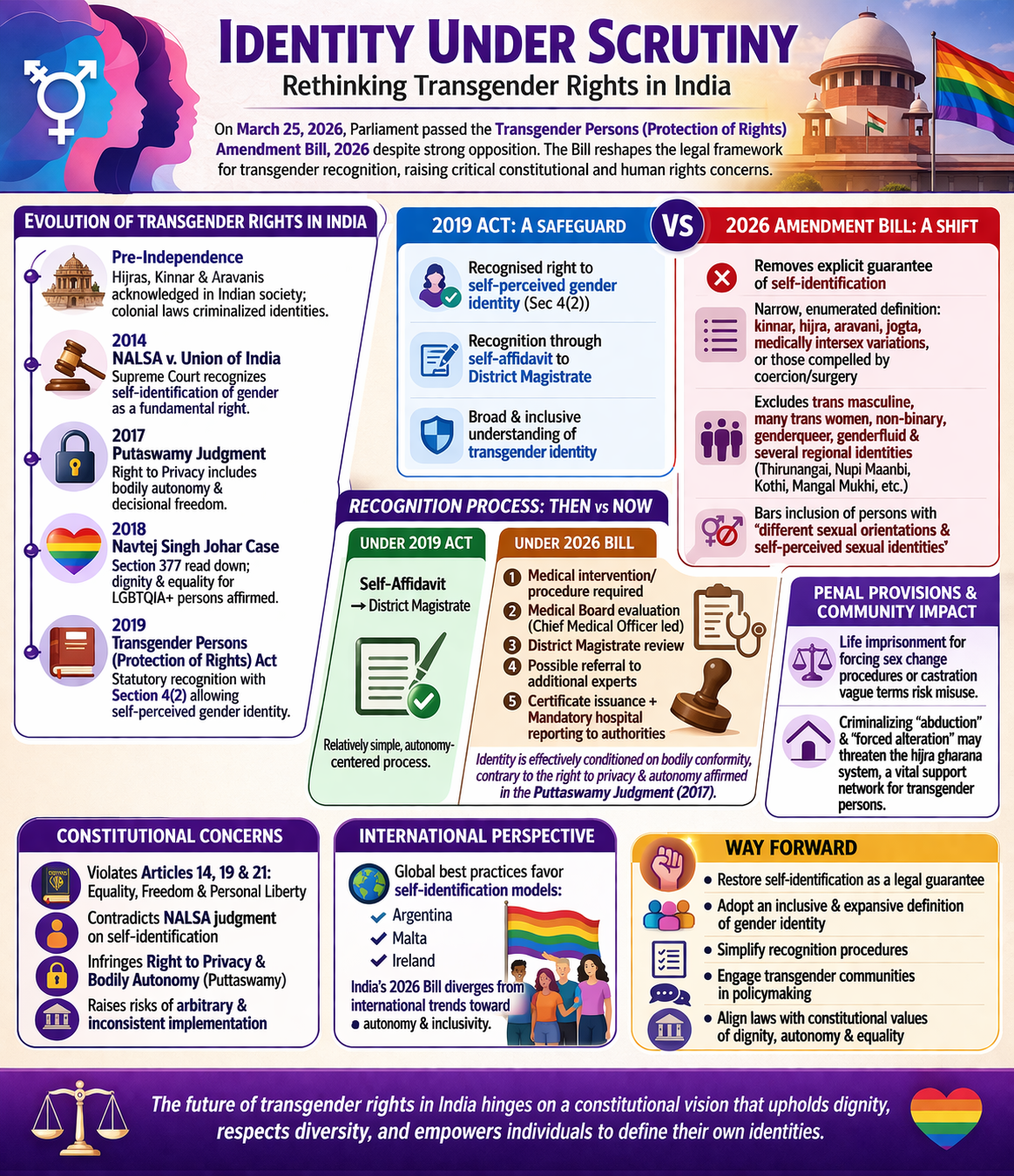
The acknowledgement of transgender identities in India has profound historical origins, with groups like hijras, kinnars, and aravanis holding a unique socio-cultural niche. Notwithstanding this historical presence, colonial legal structures, especially Section 377 of the Indian Penal Code, facilitated the marginalisation and criminalisation of gender and sexual minorities.
The post-independence era experienced incremental yet substantial legal advancements. The pivotal moment occurred with the NALSA judgement in 2014, in which the Supreme Court of India recognised that transgender people possess a fundamental right to self-identify their gender. The Court determined that gender identification is essential to individual autonomy, dignity, and freedom of expression as stipulated in Articles 14, 19, and 21 of the Constitution.
Subsequent judgments significantly broadened the extent of rights. In Navtej Singh Johar v Union of India, the Court decriminalised consensual same-sex relations, therefore affirming the ideals of dignity and equality. In Justice K S Puttaswamy v Union of India, the right to privacy was acknowledged as a fundamental right, including bodily autonomy and decisional freedom.
These decisions combined created a progressive paradigm prioritising human autonomy and constitutional ethics over societal biases.
The Transgender Persons (Protection of Rights) Act, 2019
The passage of the Transgender Persons (Protection of Rights) Act, 2019, constituted the legislative response to the judicial directive established in NALSA. Despite receiving criticism from the transgender community, the Act preserved specific fundamental protections.
Section 4(2) of the Act acknowledged the right to self-identified gender identity. The procedure of acquiring legal recognition necessitated engagement with administrative authorities, although the provision enabled persons to affirm their identity without compulsory medical intervention. This acknowledgement was a pivotal advancement in harmonising statute law with constitutional tenets.
The Act additionally forbade discrimination in sectors like education, employment, healthcare, and access to public services. It required the implementation of welfare initiatives and institutional support frameworks for transgender people. The execution of the Act exposed numerous issues, such as bureaucratic obstacles, insufficient awareness, and inadequate enforcement tools.
The Transgender Persons (Protection of Rights) Amendment Bill, 2026
The 2026 Amendment Bill implements a variety of modifications that substantially transform the current legal system. Although it does not expressly nullify the NALSA judgement, it redefines the parameters of legal recognition in a way that considerably restricts the extent of self-identification.
The most significant alteration is the elimination of the express assurance of self-identified gender under Section 4(2). The Bill establishes a specifically delineated and identified category of “transgender person.” This concept encompasses particular socio-cultural identities, like kinnar, hijra, aravani, and jogta, along with persons possessing medically acknowledged intersex variants or those who have undergone or been coerced into gender-affirming treatments.
This transition signifies a shift from a broad and inclusive conception of gender identity to a narrow and categorical framework.
Exclusionary Implications of the Revised Definition
The redefinition of transgender status within the Bill has significant implications. The statute limits recognition to particular categories, so excluding numerous groups that were before included under the more comprehensive framework.
Trans masculine persons are completely omitted from the legal definition. Trans women who do not align with the designated socio-cultural groupings lack a definitive route to recognition. Non-binary, genderqueer, and genderfluid individuals are similarly marginalised, indicating a lack of recognition for the range of gender identities.
The Bill additionally neglects region-specific identities, like Thirunangai, Thirunambi, and Thirunar from Tamil Nadu, Nupi Maanbi from Manipur, as well as groups such as Kothi and Mangal Mukhi. By favouring categories derived from Hindi and Sanskrit traditions, the law jeopardises the imposition of a culturally uniform framework that obliterates regional uniqueness.

Exclusion of Sexual Orientation and Identity
The Bill clearly specifies that those with “diverse sexual orientations and self-identified sexual identities” are excluded from the provisions of the Act. It moreover contends that these individuals were never encompassed under the original framework.
This retroactive claim presents significant constitutional issues. It jeopardises the comprehensive concept of identification established in judicial decisions and may result in the cancellation of certificates produced under the previous regime.
The exclusion also presents practical difficulties, as individuals who formerly benefited from the Act may now need to navigate a more stringent and cumbersome recognition process.
Alteration of the Recognition Mechanism
The Amendment Bill establishes a markedly more intricate and invasive procedure for securing legal recognition. According to the 2019 Act, persons were permitted to seek recognition by submitting a self-affidavit to the District Magistrate. While not entirely free from bureaucratic challenges, this process placed the individual at the centre of decision-making.
The new framework substitutes this with a multi-tiered structure. Applicants are required to first undergo a medical intervention or procedure. A Medical Board, led by a Chief Medical Officer, assesses the application. The District Magistrate thereafter examines the matter and may consult other experts before issuing a certificate.
The Bill requires hospitals to inform authorities before doing gender-affirming treatments, so subjecting private medical decisions to public oversight.
Bodily Autonomy and Constitutional Issues
The necessity of medical intervention as a prerequisite for legal recognition presents substantial constitutional concerns. It predicates identity on physical conformity, necessitating individuals to alter their bodies to meet state-defined standards.
This approach directly contradicts the concepts established in Justice K S Puttaswamy v Union of India, when the Court acknowledged bodily autonomy as a fundamental aspect of the right to privacy. It also contradicts the NALSA judgment’s assertion that self-identification is a fundamental right.
The Bill undermines personal autonomy by prioritising administrative and medical verification, therefore deviating from the constitutional principles of dignity and freedom.
Penal Provisions and Societal Implications
The Bill establishes severe legal measures, including life imprisonment for coercing individuals into sex reassignment treatments or castration. This provision seeks to tackle genuine cases of abuse; yet, its ambiguous and expansive wording raises apprehensions over possible exploitation.
Transgender communities in India have traditionally depended on social frameworks like the hijra gharana system, which serves as a type of elective kinship. These networks offer assistance and refuge to those frequently ostracised by their own families.
The Bill penalises actions such as “abduction” and “forced alteration“ without adequately differentiating between coercion and consensual association. This uncertainty may unintentionally criminalise traditional community behaviours and undermine existing support structures.
Government Rationale and the Issue of Proportionality
The Union Government has justified the Transgender Persons (Protection of Rights) Amendment Bill, 2026, asserting that it intends to avert fraudulent claims and the exploitation of support systems designated for transgender people. This rationale necessitates a more structured and verified system to guarantee that benefits are allocated to legitimate beneficiaries and not misappropriated through fraudulent identity claims.
Although the aim of preventing misuse is valid, the methods employed by the Bill provoke significant concerns about proportionality. Constitutional theory, especially as delineated in Justice K S Puttaswamy v Union of India, mandates that any limitation on fundamental rights must meet the proportionality test. This entails establishing the necessity of the policy, confirming the absence of less restrictive alternatives, and proving that the benefits surpass the associated harm.
The Bill’s strategy of restricting the scope of transgender identity and instituting medical requirements does not effectively tackle bogus assertions. Rather, it entirely omits substantial portions of the transgender population from legal recognition. A more balanced approach would have entailed enhancing verification measures while preserving the idea of self-identification.
Societal Influence and Experiences of Transgender People
The ramifications of the Amendment Bill reach well beyond legal principles, impacting the daily lives of transgender people. Legal recognition is not solely symbolic; it serves as the conduit to essential rights such as education, work, healthcare, and social security.
The Bill’s limitation of recognition to narrowly defined groups may intensify current marginalisation. Transgender individuals encounter systematic discrimination, including exclusion from official employment, restricted access to healthcare, and social ostracism. The refusal of legal recognition exacerbates these disparities, thereby rendering numerous individuals invisible to the law.
The necessity of medical intervention as a prerequisite for acknowledgement also entails considerable financial and psychological difficulties. Gender-affirming surgeries are frequently costly and not uniformly available. Furthermore, not all transgender individuals wish to or can undertake these treatments, rendering the demand both exclusionary and coercive.
The Bill’s influence on communal structures is notably substantial. The hijra gharana system, traditionally a support network, may encounter heightened scrutiny and possible criminalisation due to ambiguous laws concerning abduction and coerced transformation. This could undermine essential support networks for people already at risk.
Constitutional Morality and the Function of the Judiciary
The Indian judiciary has significantly advanced the rights of marginalised minorities by frequently utilising the principle of constitutional morality to contest established social norms. In National Legal Services Authority v Union of India, the Supreme Court of India underscored that the Constitution should be construed to safeguard human dignity and autonomy, notwithstanding societal bias.
The Amendment Bill introduces the potential for renewed judicial examination. Given its evident divergence from the principles outlined in NALSA and subsequent decisions, it is likely to be contested for infringing fundamental rights under Articles 14, 19, and 21.
The judiciary may be required to assess the compatibility of the Bill’s provisions with the fundamental assurances of equality, freedom of expression, and personal liberty. The Court must reconcile legislative purpose with constitutional requirements, possibly upholding the supremacy of self-identification.
Comparative and International Perspectives
Worldwide, there is an increasing acknowledgement of gender identification as an issue of personal autonomy. Numerous governments have implemented self-identification schemes for individuals to ascertain their gender without obligatory medical involvement.
Countries like Argentina, Malta, and Ireland have implemented progressive legislation that acknowledges gender identity by self-declaration. These frameworks are based on the concepts of dignity, privacy, and equality, and are widely recognised as best practices in the domain of gender rights.
The methodology employed by the 2026 Amendment Bill is retrogressive, deviating from global trends that favour increased autonomy and inclusivity. This discrepancy prompts enquiries over India’s dedication to international human rights standards, especially considering its constitutional framework and judicial decisions.
Conclusion
The Transgender Persons (Protection of Rights) Amendment Bill, 2026, is a pivotal moment in the evolution of gender rights in India. Although it aims to tackle valid issues like the abuse of social programs, its methodology prompts considerable constitutional and ethical dilemmas.
The Bill diverges from the progressive framework created by judicial precedents by restricting the definition of identity and implementing restrictive recognition mechanisms. The effect on marginalised communities, along with the difficulties of execution, highlights the necessity for thorough reevaluation.
The issue at hand transcends ordinary legal interpretation and pertains to constitutional philosophy. The future of transgender rights in India will hinge on the capacity of its institutions to maintain the concepts of dignity, autonomy, and equality amid changing social and legal difficulties.
 Supreme Court on Children's Right to Int...
 Daily Current Affairs PDF 2026: Download...
 Daily Mains Articles 2026 – Updated Da...














 WhatsApp