
Table of Contents
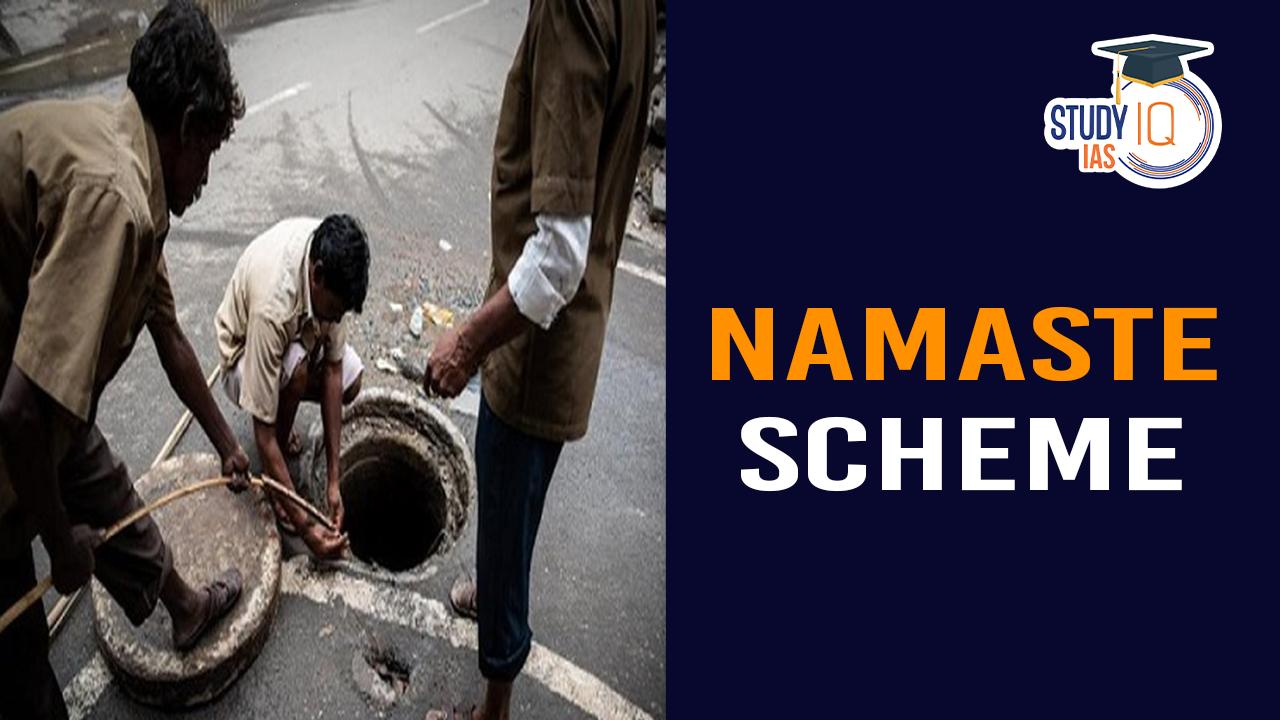
Context: The Union Ministry of Social Justice and Empowerment announced major progress under the NAMASTE Scheme, highlighting large-scale profiling, PPE distribution, health insurance coverage, and financial assistance for sanitation workers.
Recently a profiling initiative of people involved in hazardous cleaning of sewers and septic tanks across Indian cities was conducted by the Ministry of Social Justice and Empowerment under the NAMASTE programme.
NAMASTE Scheme
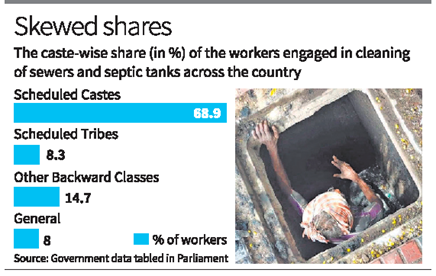
The National Action for Mechanised Sanitation Ecosystem (NAMASTE) Scheme is a central sector scheme aimed at eliminating hazardous manual cleaning of sewers and septic tanks by promoting mechanised sanitation. It focuses on ensuring dignity, occupational safety, and sustainable livelihoods for sanitation workers while replacing manual scavenging with technology-driven sanitation systems.
- Launch Year: 2022
- Joint Initiative: Ministry of Social Justice and Empowerment (MoSJE) and Ministry of Housing and Urban Affairs (MoHUA)
- Scheme Type: Central Sector
- Coverage: To be rolled out across all 4,800+ Urban Local Bodies (ULBs) in India.
- Duration: Implemented over three years, from FY 2023-24 to FY 2025-26.
- Replaced by: The scheme has replaced the Self-Employment Scheme for the Rehabilitation of Manual Scavengers (SRMS), which was started in 2007.
- Aim: To eliminate hazardous cleaning practices, prevent fatalities among sewer and septic tank workers and uphold their safety and dignity.
Key Features of the NAMASTE Scheme
- Identification: Systematic identification of Sewer/Septic Tank Workers (SSWs) across ULBs. (Urban local bodies)
- Training and Safety Gear: Provision of occupational training and distribution of Personal Protective Equipment (PPE) kits to SSWs.
- Safety Devices: Assistance in acquiring safety devices for Sanitation Response Units (SRUs).
- Health Insurance: Extension of health insurance benefits under the Ayushman Bharat – Pradhan Mantri Jan Arogya Yojana (AB-PMJAY) for identified SSWs and their families.
- Livelihood Support: Promotion of mechanisation and enterprise development through funding support, including capital and interest subsidies for procuring sanitation-related equipment.
- Awareness Campaigns: Extensive Information, Education, and Communication (IEC) campaigns conducted jointly by ULBs and the National Safai Karamcharis Finance & Development Corporation (NSKFDC) to raise awareness about NAMASTE interventions.
| National Safai Karamcharis Finance & Development Corporation (NSKFDC) |
|

 Sugar Prices Surge in India 2026: Why Su...
 Positive Indigenisation List (PIL) – 6...
 Death Penalty in India: Constitutional V...











 WhatsApp





