Table of Contents
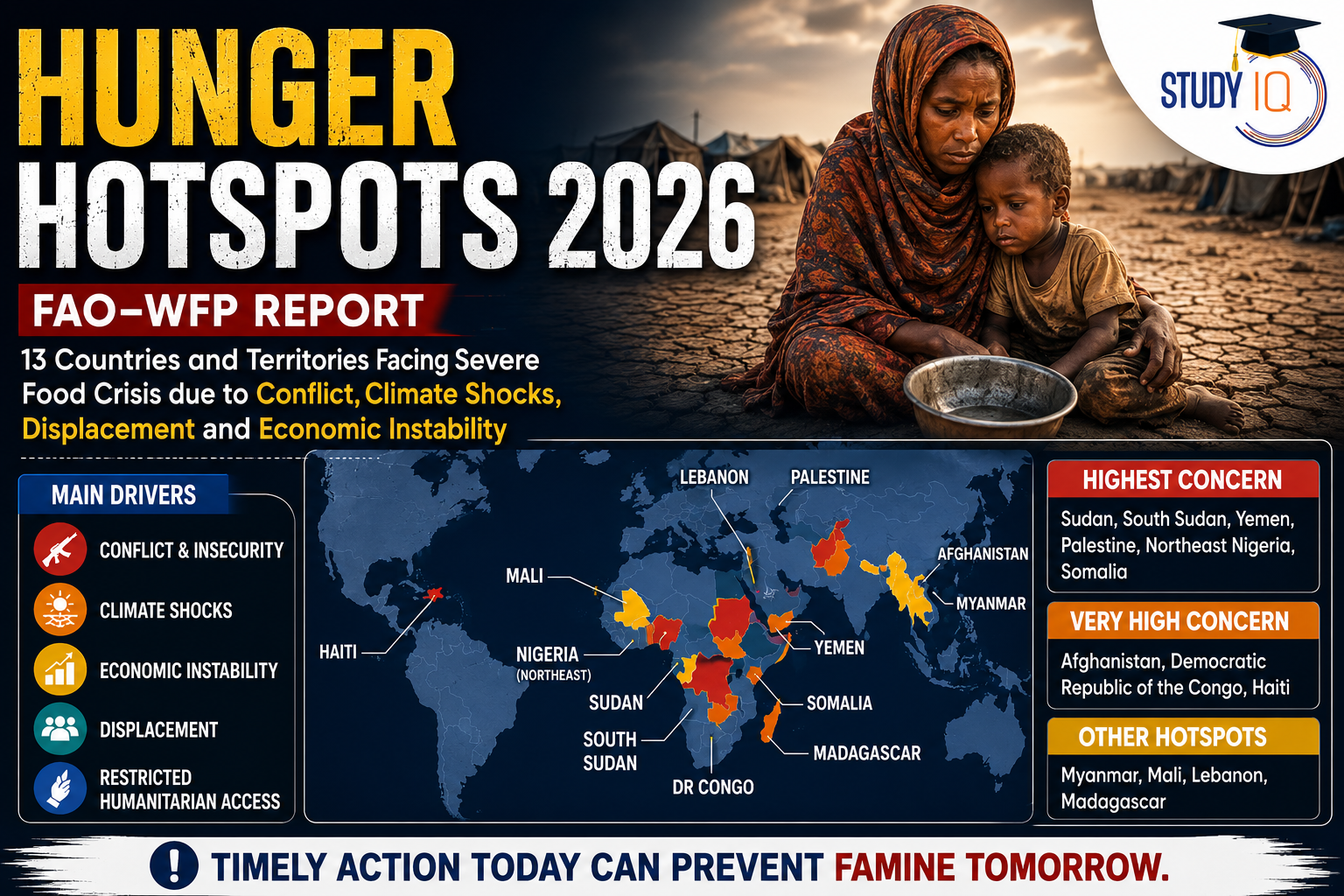
The FAO-WFP Hunger Hotspots 2026 report highlights 13 countries and territories where acute food insecurity is expected to remain a serious concern during the June-November 2026 period. The report by the Food and Agriculture Organization (FAO) and the World Food Programme (WFP) warns that conflict, climate shocks, economic instability, displacement and restricted humanitarian access are worsening hunger across several regions.
The report categorises the hotspots according to the severity and urgency of the food-security situation.
List of 13 Hunger Hotspots in 2026
The 13 countries and territories identified in the report are divided into three categories:
- Highest Concern: Sudan, South Sudan, Yemen, Palestine, Northeast Nigeria and Somalia.
- Very High Concern: Afghanistan, Democratic Republic of the Congo and Haiti.
- Other Hotspots: Myanmar, Mali, Lebanon and Madagascar.
Among these, countries affected by prolonged conflict and large-scale displacement face some of the most severe risks.
Sudan: One of the Worst Hunger Crises
Sudan remains one of the world’s most critical hunger hotspots following the conflict that began in April 2023. Violence has displaced millions of people and disrupted agriculture, markets, trade and humanitarian operations.
Parts of Darfur and Kordofan face particularly serious risks of famine. Economic instability, currency depreciation and rising prices have further reduced people’s ability to access food and essential commodities.
South Sudan: Conflict and Climate Risks
South Sudan’s food crisis is being driven by a combination of conflict, displacement, flooding, low agricultural production and economic instability.
Unpredictable rainfall and floods affect crops and livestock, while violence in areas such as Jonglei and Upper Nile disrupts agricultural activity, markets and humanitarian assistance.

UPSC IAS Live GS P2I Foundation 2027 Pratigya August Batch (Basic)
Yemen and Palestine
Yemen continues to face severe food insecurity after years of conflict and economic disruption. Limited livelihoods, weak purchasing power and humanitarian challenges have left millions vulnerable.
In Palestine, particularly Gaza, conflict has severely damaged agricultural infrastructure and disrupted food supply chains. Displacement, restricted humanitarian access and shortages of essential commodities have significantly increased food-security risks.
Northeast Nigeria and Somalia
In Northeast Nigeria, particularly Borno State, conflict and insecurity have disrupted farming and trade. Climate-related shocks have further affected agricultural production.
Somalia faces a combination of drought, conflict, displacement and rising food prices. Poor rainfall has reduced agricultural output, while insecurity continues to disrupt farming and markets. The crisis has also contributed to high levels of child malnutrition.
Other Hunger Hotspots
The report also identifies Afghanistan, the Democratic Republic of the Congo and Haiti as areas of very high concern. These countries face different combinations of conflict, displacement, economic difficulties and limited access to basic services.
Myanmar, Mali, Lebanon and Madagascar are also included among the 2026 hunger hotspots, reflecting the interaction of economic, political, climate and humanitarian pressures.
Major Causes of Food Insecurity
The 2026 Hunger Hotspots report demonstrates that food insecurity is rarely caused by a single factor. The major drivers include:
- Conflict and insecurity: Destroy farms, markets and infrastructure and force people from their homes.
- Climate shocks: Droughts, floods and irregular rainfall reduce agricultural production.
- Economic instability: Inflation, currency depreciation and high transport costs make food less affordable.
- Displacement: Refugees and internally displaced people often lose livelihoods and access to basic services.
- Humanitarian access restrictions: Insecurity and logistical barriers can prevent vulnerable populations from receiving food and medical assistance.
What Is a Hunger Hotspot?
A hunger hotspot is an area where food insecurity is expected to deteriorate significantly within a specified period and where urgent action can help prevent further deterioration.
Food insecurity can progress from Crisis to Emergency and, in the most extreme circumstances, Catastrophe, accompanied by severe food deprivation, acute malnutrition and increased mortality risks.
Hunger Hotspots 2026: UPSC Significance
The report is important for UPSC Current Affairs, particularly under GS Paper II and GS Paper III. It connects food security with international conflicts, climate change, humanitarian assistance, displacement, agriculture and sustainable development.
It is also closely linked to SDG 2 – Zero Hunger, which aims to end hunger and achieve food security and improved nutrition by 2030.
Conclusion
The FAO-WFP Hunger Hotspots 2026 report highlights how conflict, climate change, displacement and economic instability are creating complex food-security emergencies around the world. The findings underline the need for timely humanitarian assistance, resilient agricultural systems, climate adaptation and international cooperation to prevent acute food crises from developing into famine.\
Read Also: UPSC Daily Current Affairs 2026
 GST 2.0 and Decriminalisation of Tax Off...
 Tuvalu and Rising Sea Levels: Climate Ch...
 US Treasury Yields at 25-Year High: Impa...














 WhatsApp