
Table of Contents
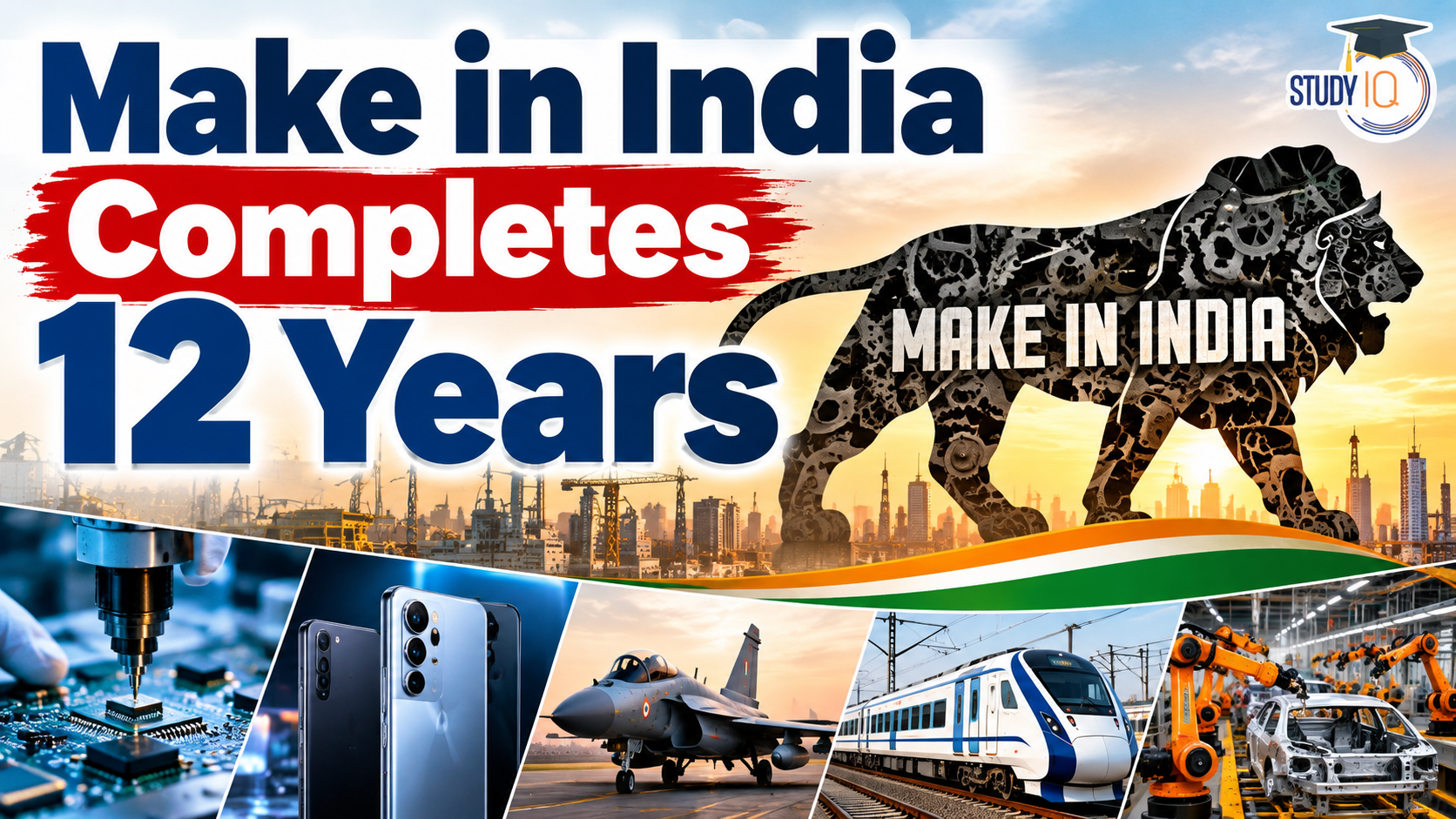
Make in India, launched on 25 September 2014, completes 12 years in 2026. The initiative was launched with the vision of making India a global hub for manufacturing, design and innovation. Over the years, it has expanded from investment promotion to strengthening domestic manufacturing capabilities, technology, skills and infrastructure.
Make in India: Key Facts
- Launched: 25 September 2014
- Objective: Promote manufacturing, investment, innovation and infrastructure
- Make in India 2.0: Covers 27 sectors
- Manufacturing sectors: 15
- Services sectors: 12
- Approach: “Minimum Government, Maximum Governance”
Major Achievements of Make in India
1. Growth of Electronics Manufacturing
Electronics has emerged as one of the major success areas of India’s manufacturing push.
- Electronics production increased from around ₹1.9 lakh crore in 2014-15 to over ₹13 lakh crore in 2025-26.
- This represents an increase of nearly seven times.
- The growth has been supported by policies aimed at strengthening domestic production and electronics supply chains.
2. Mobile Phone Manufacturing
India has witnessed a major expansion in mobile-phone manufacturing.
- Production increased from around ₹18,000 crore in 2014-15 to ₹6.27 lakh crore in 2025-26.
- This represents an approximately 33-fold increase.
- India has increasingly emerged as an important manufacturing base for mobile phones and electronics.
3. Defence Manufacturing
Defence manufacturing has become an important component of India’s push for greater domestic production.
- Indigenous defence production increased from ₹46,429 crore in 2014-15 to a record ₹1.78 lakh crore in FY 2025-26.
- The expansion reflects the increasing focus on domestic defence production and technological capabilities.
4. Railway Manufacturing
Indian Railways has also expanded its domestic manufacturing capacity.
- Nearly 55,000 coaches were manufactured during 2014–24.
- Average annual coach production increased from less than 3,300 during 2004–14 to more than 5,000 during 2014–24.
- More than 6,600 LHB (Linke Hofmann Busch) coaches were manufactured in 2025-26.
Make in India 2.0
The initiative has subsequently evolved into Make in India 2.0, with a wider sectoral focus.
It now covers 27 sectors, comprising:
- 15 manufacturing sectors
- 12 services sectors
The emphasis has expanded beyond attracting investment to developing domestic capabilities, technology, skills, infrastructure and value chains.
Major Policy Support
Several government initiatives have complemented Make in India, including:
- Production Linked Incentive (PLI) Scheme
- Semiconductor manufacturing initiatives
- National Single Window System
- PM GatiShakti
- Industrial corridors
- Startup India
- Defence indigenisation initiatives
- Electronics and mobile manufacturing programmes
These measures aim to improve India’s manufacturing competitiveness and encourage greater domestic value addition.
From “Make More” to “Make Better”
The evolution of Make in India can be understood through three broad stages:
Investment Promotion
↓
Manufacturing Expansion
↓
Technology + Skills + Components + Domestic Value Addition
The focus is increasingly shifting towards creating complete manufacturing ecosystems rather than simply assembling final products.
Why Make in India is Important for India
Make in India is significant because manufacturing can contribute to:
- Employment generation
- Export growth
- Technology development
- Domestic value addition
- Reduction of import dependence in strategic sectors
- Integration with global value chains
- Development of industrial infrastructure
- Greater private-sector participation
Make in India and Atmanirbhar Bharat
While Make in India focuses strongly on manufacturing and investment, Atmanirbhar Bharat provides a broader framework for building domestic capabilities and resilience.
Together, the policy approach seeks to strengthen India’s position in sectors such as:
Electronics → Semiconductors → Defence → Automobiles → Pharmaceuticals → Steel → Capital Goods → Renewable Energy

 World Lung Day 2026: Theme, Date, Histor...
 Deendayal Upadhyaya Jayanti 2026: Why 25...
 Partners for Multilateralism (P4M) 2026:...












 WhatsApp





