Table of Contents
Context
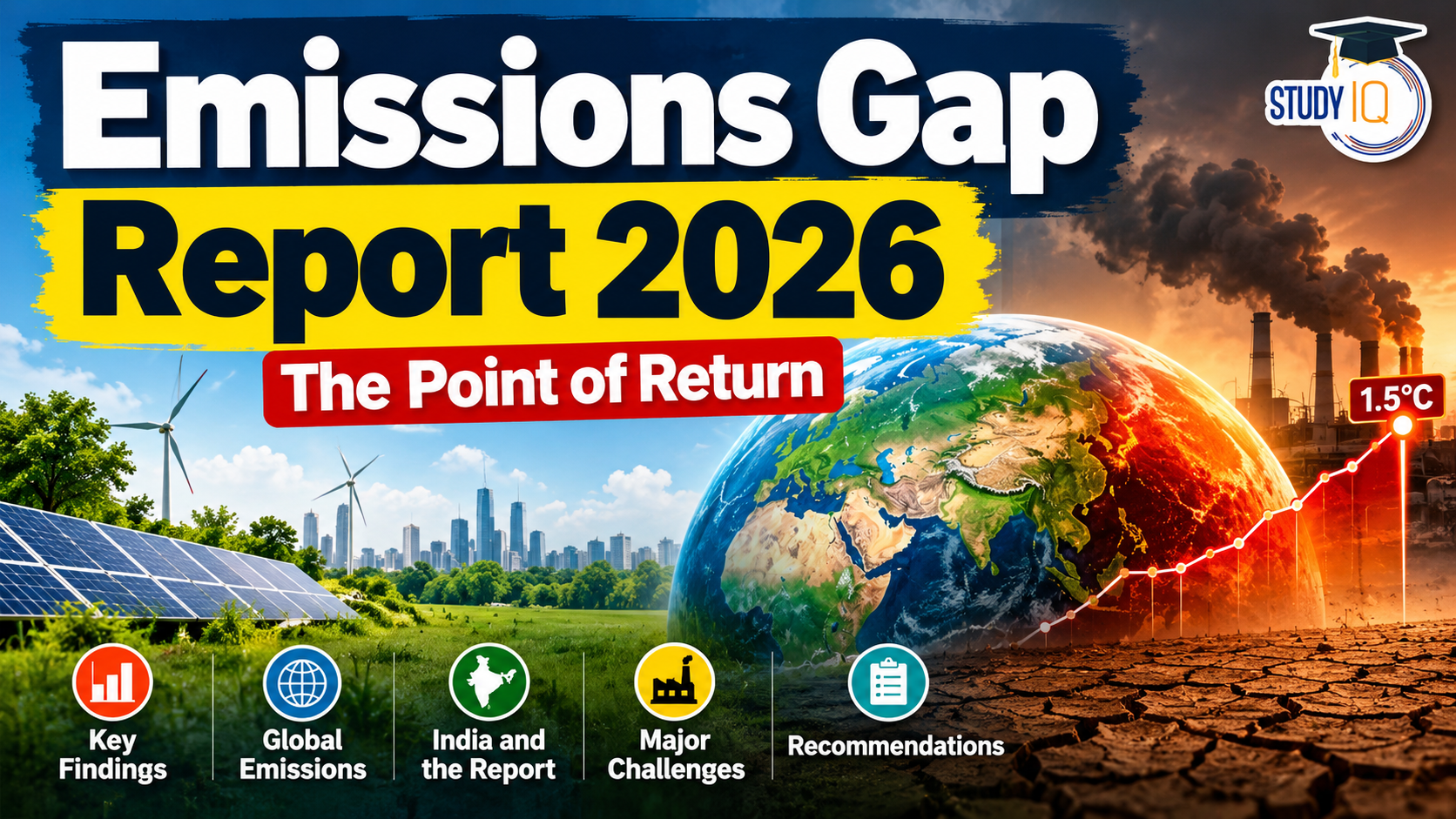
The United Nations Environment Programme (UNEP) released the Emissions Gap Report 2026: The Point of Return, warning that temporarily exceeding the 1.5°C warming threshold is now virtually unavoidable.
About the Emissions Gap Report
- Publisher: United Nations Environment Programme (UNEP).
- Purpose: Measures the gap between countries’ projected greenhouse gas (GHG) emissions under their climate pledges and the reductions required to meet the Paris Agreement’s temperature goals.
Key Findings
- Global Emissions: GHG emissions remained around 58.4 GtCO₂e in 2025, as rising fossil fuel emissions offset declines in land-use and wildfire emissions.
- 1.5°C Target: Exceeding the 1.5°C threshold is virtually unavoidable, making rapid emission reductions essential to limit the extent and duration of overshoot.
- Required Emission Reductions: Global emissions must fall from 2025 levels by 18% by 2030, 45% by 2035 and 69% by 2040.
- Emissions Gap: Current 2035 Nationally Determined Contributions (NDCs) leave a gap of 16 GtCO₂e, delivering only 11–15% reductions against the required 45%.
- Temperature Projections: Existing policies could lead to 2.8°C warming by 2100, while full implementation of climate pledges could limit warming to around 2.1°C.
- Carbon Dioxide Removal (CDR): Limiting overshoot may require removing approximately 320 GtCO₂ this century, raising concerns about feasibility, costs and ecological impacts.
- Clean Energy: Solar deployment has expanded much faster than earlier projections, but continued coal, oil and gas consumption undermines decarbonisation.
India and the Report
- NDC Targets: India is projected to meet its 2030 and 2035 climate targets under existing policies, according to the report.
- Emissions Intensity: India’s targets focus on reducing emissions per unit of GDP, even as absolute emissions may rise with economic growth.
- Per Capita Emissions: India’s projected 2035 emissions of 3.6 tCO₂e per capita are below China (9.3), Russia (11.5) and Saudi Arabia (15.2).
- Energy Transition: India is expanding non-fossil electricity capacity towards 500 GW by 2030, while continuing to rely on coal to meet rising electricity demand.
Major Challenges
- Weak Global Cooperation: Changing national policies and reduced climate commitments by major historical emitters weaken collective action.
- Carbon Removal Limitations: Technologies such as Bioenergy with Carbon Capture and Storage (BECCS) and Direct Air Capture (DAC) face land, water, energy and cost constraints.
- Fossil-Fuel Lock-in: Continued investment in oil and gas infrastructure risks extending fossil-fuel dependence.
- Deforestation: Forest loss remains off track, requiring a substantial acceleration in efforts to meet the 2030 goal of halting deforestation.
Recommendations
- Strengthen 2035 NDCs: Adopt ambitious, economy-wide emission reduction targets to close the global emissions gap.
- Accelerate Clean Energy: Expand renewable energy, electrification, energy storage and green hydrogen.
- Reduce Fossil-Fuel Dependence: Phase down unabated fossil fuels, reform inefficient subsidies and redirect investment towards clean energy.
- Adopt Integrated Policies: Combine carbon pricing, sector-specific standards and public investment suited to national circumstances.
- Regulate Carbon Removal: Establish environmental safeguards and transparent accounting standards for CDR technologies.
 GRAP Stage I Explained: AQI Limits, Meas...
 Daily Current Affairs PDF 2026: Download...
 eMudhra Certificates Blocked: Cybersecur...














 WhatsApp