
Table of Contents
Context
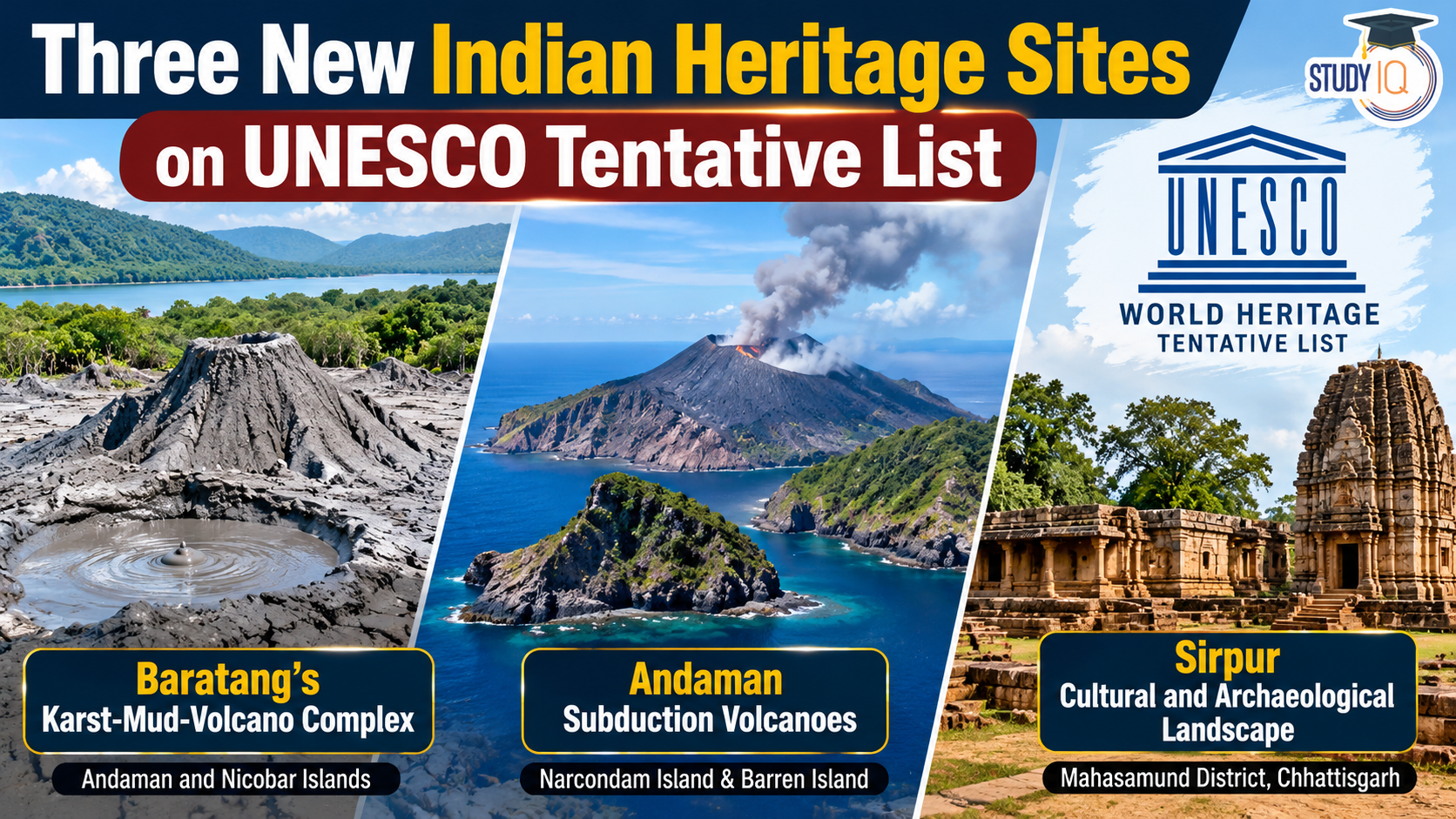
The Permanent Delegation of India to UNESCO announced the addition of three Indian sites to the UNESCO World Heritage Tentative List: Baratang’s karst-mud-volcano complex, Andaman subduction volcanoes, and Sirpur’s cultural and archaeological landscape.
Read Also: UPSC Daily Current Affairs 2026
About the UNESCO World Heritage Tentative List
- Nature: An inventory of sites that a country intends to nominate for the UNESCO World Heritage List in the future.
- Requirement: Inclusion in the Tentative List is a prerequisite for a site to be considered for formal nomination under the World Heritage Convention.
- Categories: Sites may qualify as cultural, natural, or mixed heritage.
1. Karst-Mud-Volcano Complex of Baratang
Location: Baratang Island, Andaman and Nicobar Islands
About:- A natural heritage site featuring limestone karst formations, caves and active mud volcanoes shaped by geological and tectonic processes.
Key Features:
- Limestone Karst: Contains caves, fissures, rugged limestone terrain, stalactites and stalagmites formed through long-term geological processes.
- Mud Volcanoes: Also known locally as Jalki, these release mud, water and gases such as methane and hydrogen sulphide. Unlike conventional volcanoes, they do not erupt molten magma.
- Tectonic Setting: The mud volcanoes are associated with fault zones in a sediment-rich accretionary wedge formed by the subduction of the Indian Plate beneath the Burma microplate.
2. Andaman Subduction Volcanoes
Location: Narcondam Island and Barren Island, Andaman Sea
About:- A natural heritage site representing volcanic activity associated with the subduction of the Indian Plate beneath the Burma microplate.
Key Features:
- Barren Island: South Asia’s only active volcano, with eruptions documented since 1787. It has a volcanic caldera and basaltic lava formations.
- Narcondam Island: A dormant volcanic island with a distinctive volcanic landscape and rocks such as dacite and andesite.
- Ecological Significance: Barren Island illustrates repeated ecological succession following volcanic eruptions, while Narcondam supports distinctive island ecosystems.
- Endemic Species: Narcondam is home to the Narcondam hornbill (Rhyticeros narcondami) and the Narcondam shrew (Crocidura narcondamica).
3. Sirpur Cultural and Archaeological Landscape
Location: Mahasamund district, Chhattisgarh, eastern bank of the Mahanadi River
About:- A cultural heritage site associated with the ancient city of Shripur, which served as a political and cultural centre under the Sharabhapuriya and Panduvamshi dynasties.
Key Features:
- Religious Diversity: Contains Hindu temples, including the Laxman Temple and Gandheshwar Temple, alongside Buddhist monastic remains such as Anandprabhu Kuti Vihara and Swastik Vihara.
- Historical Period: Archaeological remains reflect urban and religious activity spanning approximately the 5th to 12th centuries CE.
- Urban and Trade Centre: Remains include temples, monasteries, palace and market complexes, and bathing ghats along the Mahanadi River.
- Geological Heritage: Local stromatolitic rocks, formed through ancient microbial activity, are associated with the region’s geological history and building materials.

 Typhoon Champi Hits East Asia: Impact on...
 Agrivoltaics in India 2026: 10% of Suita...
 India–Poland Relations 2026: Strategic...














 WhatsApp






