
Table of Contents
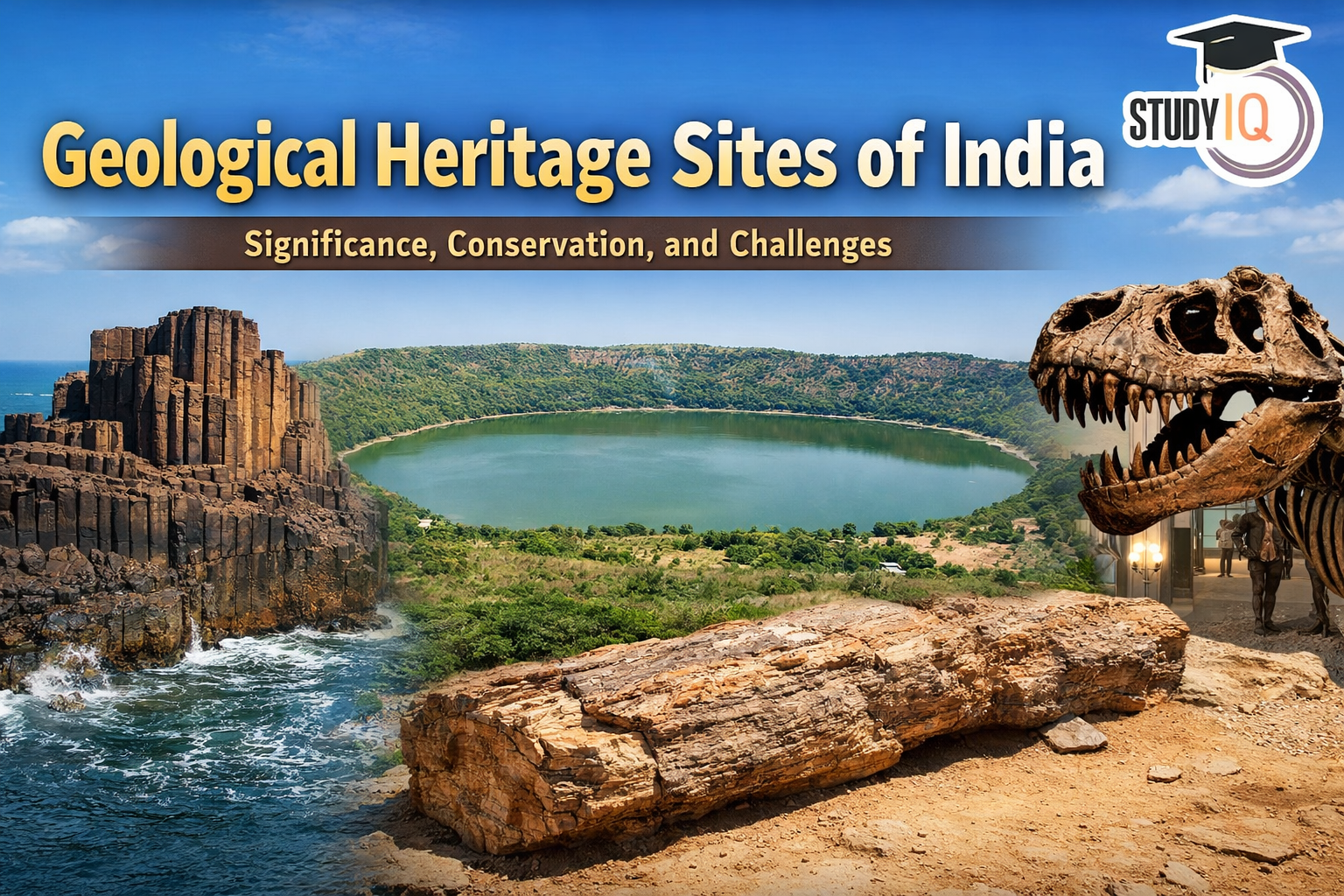
Geological Heritage Sites of India are natural laboratories that record the Earth’s evolutionary history through rocks, landforms, fossils, and mineral deposits. Recognizing their scientific, educational, and cultural importance, the Geological Survey of India (GSI) has identified several sites as National Geological Monuments and Geo-heritage Sites. These sites help in understanding tectonic movements, climate change, the evolution of life, volcanic activity, and mineral formation processes.
For UPSC, the Geological Heritage Sites of India is relevant under GS Paper I (Physical Geography), GS Paper III (Mineral Resources), and Environment & Conservation.
Read: Ramsar Sites in India 2026
What are Geological Heritage Sites of India?
Geological Heritage Sites of India are natural locations that display unique and scientifically important geological features such as rock formations, fossils, mineral deposits, landforms, and tectonic structures. They preserve evidence of Earth’s evolution over millions to billions of years, including volcanic activity, continental movements, climate change, and the origin of life. In India, many such sites are identified by the Geological Survey of India as National Geological Monuments. These sites serve as open-air laboratories for education and research, promoting geotourism and highlighting the need to conserve geo-diversity for future generations.
List of Geological Heritage Sites of India
| Category | Site Name | State | Significance |
| Volcanic & Igneous | Columnar Basalt (St. Mary’s Island) | Karnataka | Hexagonal columns formed by subaerial subvolcanic activity. |
| Lonar Lake | Maharashtra | A rare high-velocity meteorite impact crater in basaltic rock. | |
| Pali Felsite | Rajasthan | Rare volcanic rock (Felsite) from the Malani Igneous Suite. | |
| Angadipuram Laterite | Kerala | First identified laterite, crucial for understanding tropical weathering. | |
| Pyroxenite/Sill | Karnataka | High-pressure igneous intrusion in the Kudremukh area. | |
| Basaltic Pillow Lavas | Karnataka (Maradihalli) | Underwater volcanic eruptions; evidence of ancient oceanic crust. | |
| Sedimentary & Geomorphological | Natural Arch (Tirumala) | Andhra Pradesh | Rare geological arch formed by weathering of Quartzite. |
| Bharmour/Siwalik Section | HP/Punjab | Critical for understanding the evolution of the Himalayas. | |
| Stromatolite Park (Jharmarkotra) | Rajasthan | Fossilized algae; evidence of the earliest life on Earth. | |
| Peninsular Gneiss (Lalbagh) | Karnataka | One of the oldest rock types in the world (3 billion years). | |
| Jodhpur Group (Malani Beds) | Rajasthan | Represents the end of Proterozoic volcanic activity. | |
| Great Boundary Fault | Rajasthan (Bundi) | Massive tectonic fault between the Aravallis and Vindhyans. | |
| Erra Matti Dibbalu | Andhra Pradesh | Unique red sand dunes formed by sea-level changes. | |
| Sendra Granite | Rajasthan | Sculpted granite formations known for weathering patterns. | |
| Barr Conglomerate | Rajasthan | Clastic sedimentary rocks indicating ancient high-energy environments. | |
| Shali Formation | Himachal Pradesh | Limestone and dolomite formations showcasing ancient marine basins. | |
| Stromatolite Park (Sikkim) | Sikkim | High-altitude evidence of ancient microbial life. | |
| Fossil Sites | Akal Wood Fossil Park | Rajasthan | 180-million-year-old petrified tree trunks (Jurassic period). |
| Marine Gondwana Fossil Park | Chhattisgarh | Evidence of a marine transgression into Central India. | |
| Fossil Park (Ghughua) | Madhya Pradesh | Rare plant and fruit fossils from the Cretaceous-Paleogene period. | |
| National Fossil Wood Park | Tamil Nadu (Sathanur) | Massive fossilized conifer trunks (120 million years old). | |
| Tiruvakkarai Wood Fossil Park | Tamil Nadu | Exceptionally well-preserved petrified wood in cuddalore sandstones. | |
| Dinosaur Fossil Park | Gujarat (Raiyoli) | One of the world’s largest dinosaur egg nesting sites. | |
| Stromatalite Park (Chittorgarh) | Rajasthan | Extensive limestone beds containing algal structures. | |
| Mineral/Metallogenic | Zawar Lead-Zinc Mine | Rajasthan | World’s oldest documented zinc smelting site. |
| Kolar Gold Fields | Karnataka | Historically one of the deepest gold mines in the world. | |
| Hutti Gold Mines | Karnataka | One of the oldest underground gold mines, dating to the Ashokan era. | |
| Caves & Rock Shelters | Belum Caves | Andhra Pradesh | The second largest cave system in India formed in limestone. |
| Borra Caves | Andhra Pradesh | Deepest cave in India; features Stalactites and Stalagmites. | |
| Mawsmai/Krem Liat Prah | Meghalaya | Extensive limestone cave systems in a high-rainfall zone. | |
| Other Sites | Nepheline Syenite | Rajasthan | Rare alkaline igneous rock used in ceramic and glass industries. |
| Welded Tuff | Rajasthan | Compacted volcanic ash from ancient eruptions. | |
| Eparchaean Unconformity | Andhra Pradesh | A massive time gap (1 billion years) visible in the rock record. | |
| Bedded Barytes | Andhra Pradesh | One of the world’s largest deposits of Baryte in Mangampeta. |
State-wise Distribution of Geological Heritage Sites in India
Geological Heritage Sites are unevenly distributed across India, reflecting the country’s vast geological diversity shaped by tectonics, volcanism, sedimentation, and biological evolution. Rajasthan, Karnataka, and Andhra Pradesh dominate in numbers due to their complex rock formations, mineral wealth, fossil records, and unique geomorphological features.
| State / Region | Number of Sites | Major Sites | Key Features |
|---|---|---|---|
| Rajasthan | 11 | Akal Wood Fossil Park, Zawar Mines, Jodhpur Group, Pali Felsite, Great Boundary Fault | Highly diverse geology – volcanic, sedimentary, fossil, and metallogenic sites |
| Karnataka | 6 | Peninsular Gneiss (Lalbagh), Columnar Basalt (St. Mary’s Island), Kolar Gold Fields, Hutti Gold Mines | Archean rocks, igneous intrusions, ancient mining heritage |
| Andhra Pradesh | 6 | Borra Caves, Belum Caves, Eparchaean Unconformity, Bedded Barytes (Mangampeta), Erra Matti Dibbalu | Karst caves, major unconformity, mineral deposits, coastal geomorphology |
| Tamil Nadu | 2 | National Fossil Wood Park (Sathanur), Tiruvakkarai Fossil Park | Cretaceous fossilized wood and plant remains |
| Gujarat | 1 | Dinosaur Fossil Park (Raiyoli) | World’s largest dinosaur egg nesting sites |
| Chhattisgarh | 1 | Marine Gondwana Fossil Park | Evidence of marine transgression in Gondwana basin |
| Madhya Pradesh | 1 | Ghughua Fossil Park | Rare Cretaceous–Paleogene plant fossils |
| Himachal Pradesh / Punjab | 1 | Bharmour / Siwalik Section | Crucial for understanding Himalayan evolution |
| Meghalaya | 1 | Mawsmai / Krem Liat Prah Caves | Extensive limestone karst cave systems |
| Sikkim | 1 | Stromatolite Park | High-altitude evidence of ancient microbial life |
Important Note:
Lonar Lake is located in Maharashtra, not in Andhra Pradesh.
It is a unique meteorite impact crater formed in basaltic rock and is globally significant for planetary geology studies.
Significance
-
Scientific Importance
Geological heritage sites help in understanding:-
Plate tectonics and continental drift
-
Volcanic and seismic activity
-
Climate change and paleoenvironments
-
Evolution of life, especially through stromatolites and fossil parks
For example, the Eparchaean Unconformity in Andhra Pradesh shows a time gap of nearly one billion years, making it one of the most remarkable geological records in the world.
-
-
Educational Value
These sites function as open-air laboratories for students, researchers, and academicians. They make theoretical geological concepts tangible and strengthen field-based learning. -
Cultural and Historical Importance
Ancient mining sites like Zawar (Rajasthan) highlight India’s early technological excellence in metallurgy, particularly zinc smelting, centuries before similar techniques appeared elsewhere. -
Economic and Tourism Potential (Geo-tourism)
Properly developed geo-heritage sites can:-
Promote sustainable tourism
-
Generate local employment
-
Diversify tourism beyond wildlife and monuments
-
-
Environmental Awareness and Conservation
They promote the idea that conservation is not limited to flora and fauna but must also include geological diversity, known as geo-diversity.
Conservation Challenges
- Lack of Legal Protection-Unlike wildlife sanctuaries or archaeological monuments, most geo-heritage sites do not enjoy strong statutory protection.
- Urbanization and Industrial Activities-Encroachment, quarrying, mining, and infrastructure development pose serious threats.
- Low Public Awareness-Geo-heritage is less understood compared to biodiversity conservation.
- Inadequate Funding and Infrastructure-Many sites lack basic facilities like signboards, pathways, museums, and interpretation centers.
- Vandalism and Neglect-Fossil theft, graffiti, and unregulated tourism damage sensitive formations.
Way Forward
-
Enact a Geo-Heritage Protection Law
A dedicated legal framework is required to ensure identification, notification, and protection of geo-heritage sites. -
Integration with Geo-Tourism
-
Develop geo-parks on the lines of UNESCO Global Geoparks
-
Promote sustainable tourism models involving local communities
-
-
Institutional Strengthening
-
Enhance the role of GSI and State Geological Departments
-
Create a national geo-heritage authority
-
-
Awareness and Education
-
Include geo-heritage in school and university curricula
-
Organize exhibitions, documentaries, and heritage walks
-
-
Use of Technology
-
GIS mapping and digital documentation
-
3D models of fragile formations
-
Virtual tours for inaccessible sites
-
-
Public-Private Partnership (PPP)
Encourage corporate participation under CSR for conservation and infrastructure development. -
Community Participation
Involving local communities ensures protection, livelihood generation, and ownership of heritage.
Other Protected Categories
- Wildlife Sanctuaries: Protect specific species or habitats with less restrictive regulations than national parks.
- Biosphere Reserves: Protect representative ecosystems and promote sustainable development and scientific research.
- Tiger Reserves: Specifically designated for tiger conservation across critical habitat areas.
Sharing is caring!
 Species in News for UPSC Prelims 2026: C...
 World Wetlands Day 2026: Theme, History,...
 Wildlife Sanctuaries of India 2026: List...











 WhatsApp





