Table of Contents
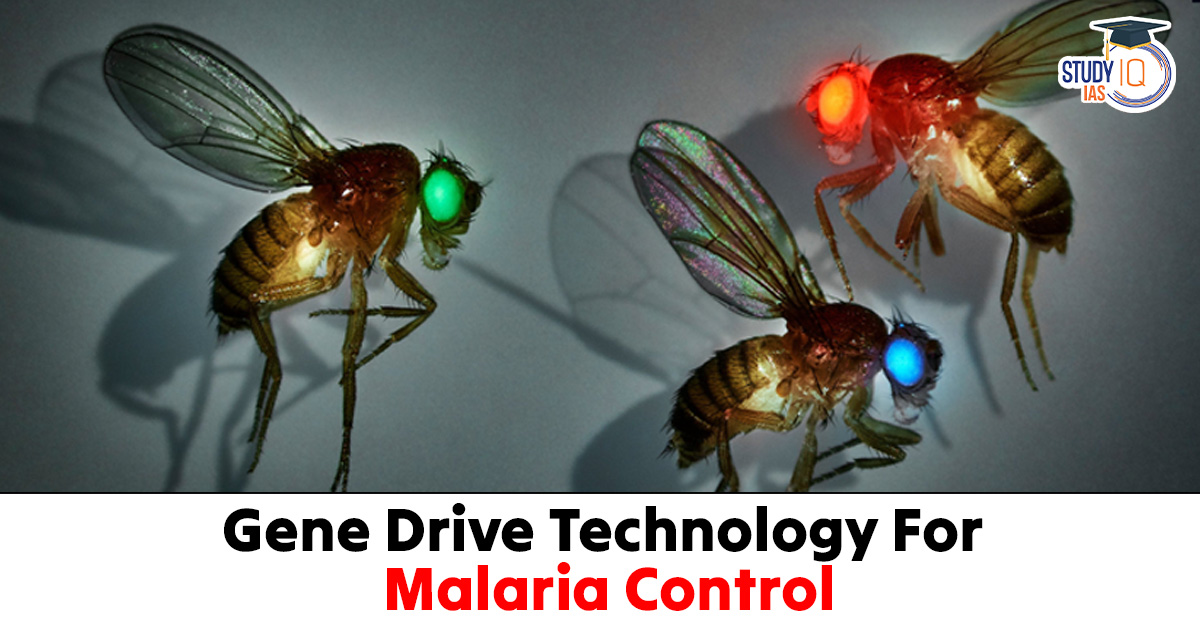
Context: Malaria remains a major global health challenge, which is now facing resistance issues, prompting exploration of genetic solutions like gene drives.
About Gene Drive
Normally, a gene passes to 50% of offspring, but a gene drive increases this to >90%, allowing it to spread very quickly through a population.
Mechanism
- A gene drive uses the CRISPR–Cas9 system, where a protein (Cas9) cuts the mosquito’s DNA at a specific site.
- The cell repairs this cut using the modified gene as a template, forcing it to copy the “drive sequence” into both DNA strands (instead of one).
- This ensures the modified gene is passed to most offspring (>90%), allowing it to spread rapidly in mosquito populations.
Types of Gene Drives
- Population Suppression: These drives disrupt the genes essential for female mosquitoes to develop or become fertile. As the drive spreads, more females become sterile, causing mosquito populations to shrink or collapse.
- Population Modification (Replacement): In these drives, mosquitoes remain alive but carry genes that prevent the malaria parasites from developing inside their bodies
How Gene Drive Helps Malaria Control
- Step 1: Genetic Engineering Scientists change mosquito genes so they either cannot reproduce properly or cannot carry malaria parasites.
- Step 2: Biased Inheritance. These changed genes are passed to most offspring (>90%) instead of half, so they spread very fast.
- Step 3: Population Spread Over generations, more and more mosquitoes carry the modified gene, making it common in the population.
- Step 4A: Suppression Pathway. If reproduction is affected, female mosquitoes become sterile, so the mosquito population is reduced.
- Step 4B: Modification Pathway. If parasites are targeted, mosquitoes produce substances that kill or stop malaria parasites inside them.
- Step 5: Transmission Block Parasites cannot grow to the infectious stage, so mosquitoes cannot spread malaria to humans.

 QDENGA Dengue Vaccine: India’s First A...
 Artificial Intelligence in Diplomacy: Ap...
 Google AI Data Centre in Visakhapatnam: ...













 WhatsApp