
Table of Contents
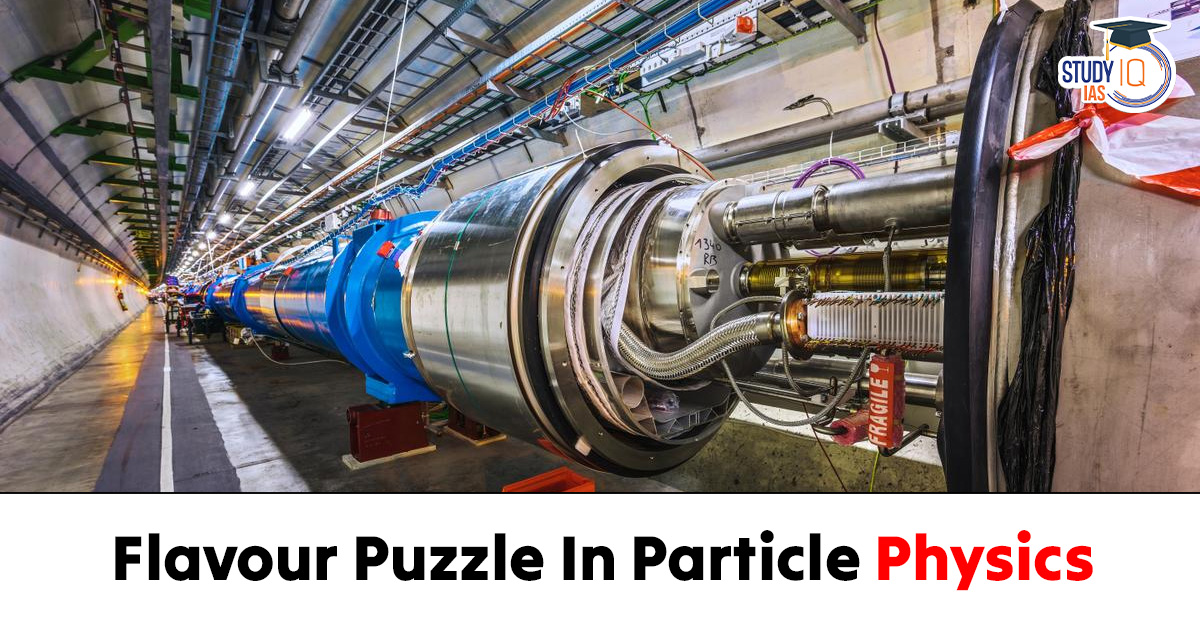
Context: In particle physics, scientists have discovered that fundamental particles occur in three repeating families called generations, but the reason for this pattern remains unexplained within current theory, creating the “flavour puzzle.”
| About Flavour and generations | ||||||||||||
In particle physics, “flavour” refers to different types of fundamental particles, while “generations” are groups that organise these flavours into repeating families with similar properties |
About the Flavour Puzzle
Despite its success, the Standard Model leaves several flavour-related questions unanswered. This is called The flavour puzzle:
- Generation Replication Problem: The model does not explain why particles exist in exactly three generations.
- Mass Hierarchy Problem: Particle masses vary enormously without a clear explanation. For Example:
- An electron is extremely light
- The top quark is about 350,000 times heavier than the electron.
- Mixing Angles Mystery: Particles can transform between flavours (e.g., quark mixing), but the theory cannot predict the values of these mixing parameters.
- Free Parameters: Many particle properties, such as masses and mixing angles, must be inserted into the theory from experiments, rather than derived from first principles.
- Neutrino Mass Problem: The Standard Model originally predicted massless neutrinos, but experiments show they have small but non-zero masses.
- CP Violation: Observed CP violation in the Standard Model cannot fully explain why the universe contains far more matter than antimatter
| Note |
| CP violation is a phenomenon in particle physics where the combined symmetry of charge conjugation (C) and parity (P) is broken, meaning physics laws differ for particles and their antiparticles. |
| What is the Standard Model | ||||||||||
Not Included: Gravity is not explained by the Standard Model. |
Significance of Solving the Flavour Puzzle
- Discovery of New Physics: Understanding flavour could reveal physics beyond the Standard Model (new particles, forces, or symmetries).
- Grand Unified Theories: Solutions may link electromagnetic, weak, and strong forces under a single framework.
- Understanding Matter–Antimatter Asymmetry: Explaining flavour mixing and CP violation could clarify why the universe contains more matter than antimatter.
- Insights into Fundamental Structure of Nature: Solving the puzzle may reveal deeper organisational principles of elementary particles.
- Advancement of Particle Physics Experiments: Future discoveries may require next-generation particle accelerators probing scales smaller than 10⁻²¹ m.

 US Losing Ground in the Middle East? Isr...
 Rising Labour Protests in India 2026: Ca...
 Anthropic's Claude Mythos AI Model: Mean...











 WhatsApp





