
Table of Contents
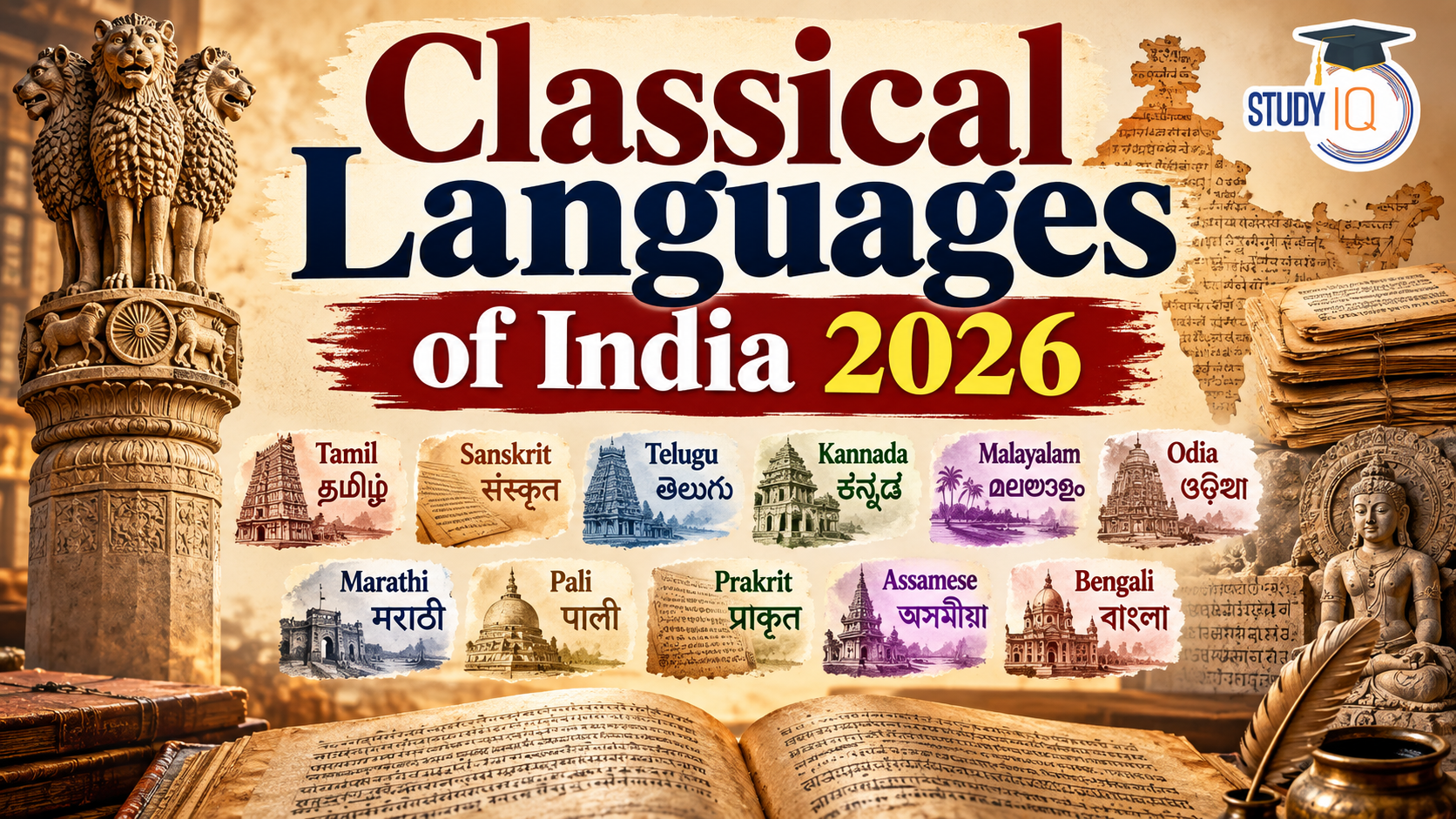
India has a rich and diverse linguistic heritage. Classical Language status is granted by the Government of India to languages that possess an exceptionally old literary tradition, ancient texts and significant historical and cultural importance. As of 2026, India has 11 Classical Languages.
What is a Classical Language?
A Classical Language is a language recognised for its:
- High antiquity of its early texts and recorded history.
- A substantial body of ancient literature and knowledge texts.
- A literary tradition that is considered original and not simply borrowed from another tradition.
- A classical body of literature that is distinct from its later forms.
- Significant contribution to India’s cultural and intellectual heritage.
The criteria for Classical Language status were revised by the Government in 2024, making the framework broader and more inclusive.
List of 11 Classical Languages of India
| Language | Year of Recognition | Language Family |
|---|---|---|
| Tamil | 2004 | Dravidian |
| Sanskrit | 2005 | Indo-Aryan |
| Telugu | 2008 | Dravidian |
| Kannada | 2008 | Dravidian |
| Malayalam | 2013 | Dravidian |
| Odia | 2014 | Indo-Aryan |
| Marathi | 2024 | Indo-Aryan |
| Pali | 2024 | Indo-Aryan |
| Prakrit | 2024 | Indo-Aryan |
| Assamese | 2024 | Indo-Aryan |
| Bengali | 2024 | Indo-Aryan |
Five Languages Added in 2024
In October 2024, the Government of India approved Classical Language status for:
- Marathi
- Pali
- Prakrit
- Assamese
- Bengali
This increased the total from 6 to 11 Classical Languages.
Recognition Timeline
2004 → Tamil
↓
2005 → Sanskrit
↓
2008 → Telugu & Kannada
↓
2013 → Malayalam
↓
2014 → Odia
↓
2024 → Marathi, Pali, Prakrit, Assamese & Bengali
↓
2026 → 11 Classical Languages
Tamil
Tamil was the first Indian language to receive Classical Language status in 2004.
It belongs to the Dravidian language family and possesses an ancient literary tradition associated particularly with Sangam literature. Tamil-Brahmi inscriptions also provide important evidence of its antiquity.
Sanskrit
Sanskrit was recognised as a Classical Language in 2005.
Its ancient form, Vedic Sanskrit, is associated with the Vedas and other early Indian literary and philosophical traditions. Sanskrit has had a profound influence on Indian philosophy, religion, science, literature and intellectual traditions.
Telugu
Telugu received Classical Language status in 2008.
It is a Dravidian language with a long literary and inscriptional tradition. Telugu literature developed significantly during the medieval period.
Kannada
Kannada was also recognised in 2008.
It is a Dravidian language with an extensive inscriptional and literary heritage. The Kavirajamarga, generally dated to the 9th century CE, is an important early work in Kannada literature.
Malayalam
Malayalam received Classical Language status in 2013.
It belongs to the Dravidian family and developed as a distinct literary language in southern India, particularly in Kerala.
Odia
Odia became a Classical Language in 2014.
It belongs to the Indo-Aryan language family and has a long literary tradition. Its classical status recognises its historical development and substantial body of literature.
Marathi
Marathi received Classical Language status in 2024.
It belongs to the Indo-Aryan family and has a rich literary tradition extending over several centuries. Its classical recognition highlights the historical depth of Marathi’s literary and cultural heritage.
Pali
Pali was granted Classical Language status in 2024.
Pali is particularly significant for Buddhist literature, including the Tipitaka (Tripitaka) tradition. It played an important role in preserving and transmitting Buddhist teachings.
Prakrit
Prakrit was recognised as a Classical Language in 2024.
The term Prakrit refers to a group of Middle Indo-Aryan linguistic traditions. Prakrits played an important role in ancient Indian literature, inscriptions and religious traditions, particularly Jainism and Buddhism.
Assamese
Assamese received Classical Language status in 2024.
It is an Indo-Aryan language with a long literary history associated with the cultural development of Assam. Its recognition highlights the linguistic heritage of northeastern India.
Bengali
Bengali was granted Classical Language status in 2024.
It belongs to the Indo-Aryan family and possesses a rich literary tradition that has played an important role in the cultural history of eastern India.
Recent Initiative: Centres of Excellence
The recognition of the five new Classical Languages has also been followed by institutional efforts to strengthen research and preservation.
The Ministry of Education has approved five Centres of Excellence dedicated to the study of Classical Assamese, Bengali, Marathi, Pali and Prakrit.
| Language | Centre of Excellence |
|---|---|
| Classical Assamese | Tezpur University |
| Classical Bengali | Visva-Bharati University |
| Classical Marathi | Deccan College Post-Graduate and Research Institute, Pune |
| Classical Pali | Central University of Odisha |
| Classical Prakrit | Central University of Gujarat |
These centres are intended to support:
- Advanced academic research
- Preservation of manuscripts and texts
- Digitisation of linguistic heritage
- Translation and documentation
- Wider dissemination of knowledge
- Strengthening of institutional research infrastructure
Why is Classical Language Status Important?
Classical Language status contributes to the preservation and promotion of India’s linguistic heritage.
1. Preservation of Heritage
It encourages systematic preservation of ancient texts, manuscripts, inscriptions and literary traditions.
2. Academic Research
Universities and research institutions can undertake specialised studies in linguistics, literature, history and culture.
3. Digitisation
Ancient manuscripts and other linguistic resources can be digitised, making them accessible to researchers and the wider public.
4. Cultural Continuity
Recognition helps connect contemporary linguistic communities with their historical literary and cultural traditions.
5. Translation and Dissemination
Classical texts can be translated into Indian and foreign languages, enabling wider access to India’s intellectual heritage.
Classical Language vs Official Language
These two concepts should not be confused.
- Classical Language: Recognition based primarily on antiquity, literary heritage and historical significance.
- Official Language: A language designated for official governmental purposes under the constitutional and legal framework.
A language can therefore have Classical Language status without being an official language of the Union.

 India Demonstrates First Free-Space Quan...
 India–EFTA Trade and Economic Partners...
 Daily Mains Articles 2026 – Updated Da...














 WhatsApp





